

Generative AI has moved from experiment to infrastructure. In 2026, the question for most organisations is no longer whether to use it, but how to use it safely, at scale and in a way that produces measurable business value. This guide explains what enterprise generative AI is, where it delivers results, and how leaders can roll it out without creating new risks.
Key takeaways
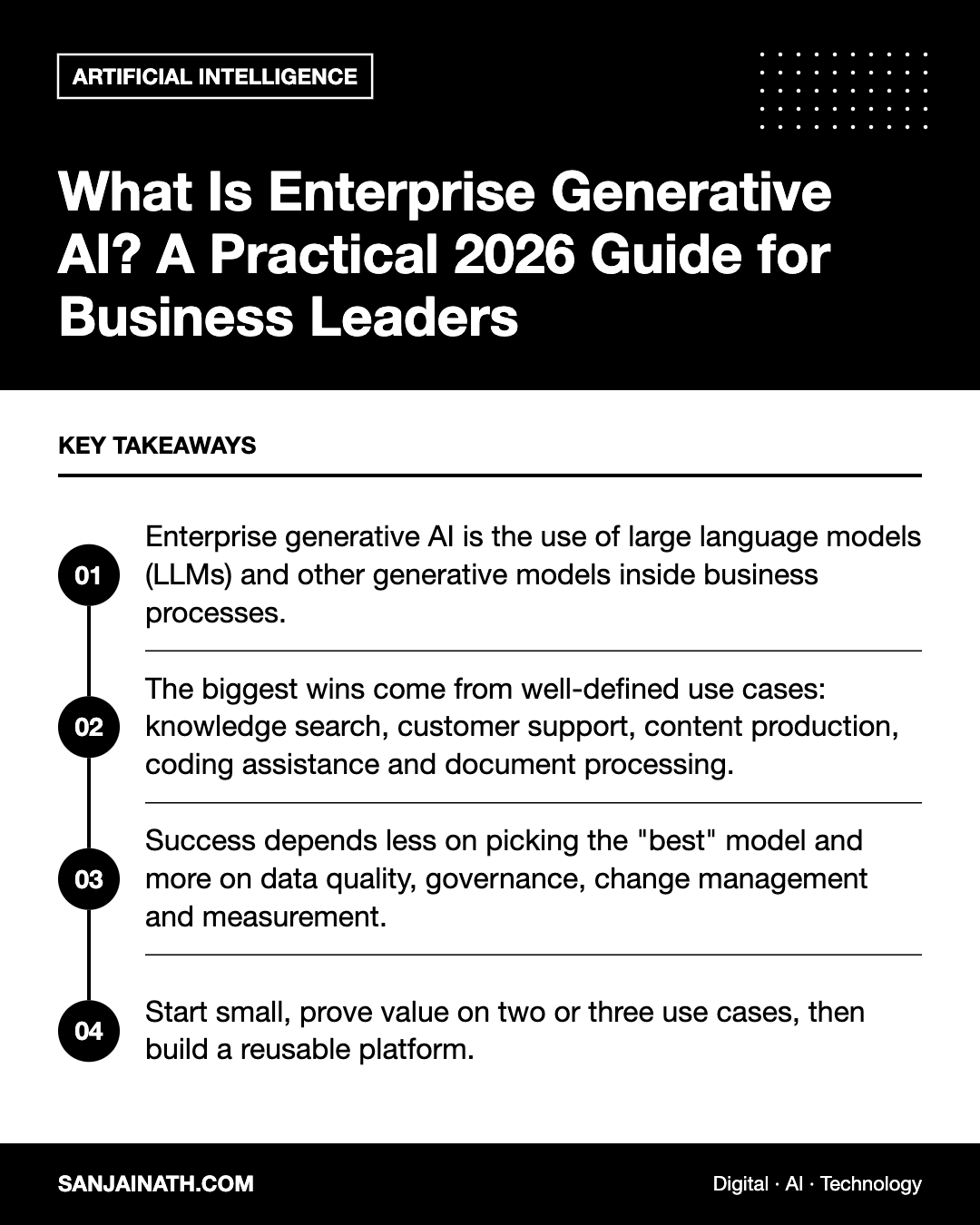
- Enterprise generative AI is the use of large language models (LLMs) and other generative models inside business processes, connected to company data and governed by company policy.
- The biggest wins come from well-defined use cases: knowledge search, customer support, content production, coding assistance and document processing.
- Success depends less on picking the “best” model and more on data quality, governance, change management and measurement.
- Start small, prove value on two or three use cases, then build a reusable platform.
What is enterprise generative AI?
Generative AI refers to models that create new content — text, images, code, audio or video — based on patterns learned from large datasets. Consumer tools like ChatGPT, Gemini and Claude made the technology famous. Enterprise generative AI is different in three important ways:
- It is connected to your data. Instead of answering from general internet knowledge, enterprise systems retrieve information from internal documents, CRMs, knowledge bases and databases — usually through a technique called retrieval-augmented generation (RAG).
- It is governed. Access controls, data residency, logging, content filters and human review are built in, so sensitive information stays protected and outputs can be audited.
- It is embedded in workflows. Rather than a separate chat window, AI shows up inside the tools people already use: email, document editors, CRM, service desks and developer environments.
Where enterprise generative AI delivers value
1. Knowledge search and internal assistants
Employees spend a large part of their week looking for information. An internal AI assistant that can answer questions from policies, product documentation and past projects — with citations back to the source — is often the fastest route to visible productivity gains.
2. Customer service
Generative AI can draft replies for agents, summarise long ticket histories, and power self-service chat that resolves routine questions. The best implementations keep a human in the loop for complex or sensitive cases and hand over smoothly when the AI is unsure.
3. Marketing and content production
Teams use AI to produce first drafts of articles, ad variations, product descriptions, social posts and localised versions of campaigns. The value is speed and scale; the risk is generic, off-brand content. Clear brand guidelines, style prompts and editorial review are essential.
4. Software development
Coding assistants help developers write, explain, test and refactor code. Many engineering teams also use AI agents to handle repetitive tasks such as writing unit tests, updating dependencies or generating documentation.
5. Document processing
Contracts, invoices, reports and forms can be summarised, classified and turned into structured data. This is especially useful in legal, finance, procurement and real estate, where teams handle high volumes of long documents.
The building blocks of an enterprise AI stack
- Foundation models: commercial models (such as those from OpenAI, Google, Anthropic or Microsoft) or open-weight models you host yourself.
- Data layer: clean, permission-aware access to documents and systems, often via a vector database and search index.
- Orchestration: the logic that combines prompts, retrieval, tools and agents into reliable workflows.
- Guardrails and governance: policies, filters, monitoring, evaluation and audit logs.
- User experience: the interfaces and integrations where people actually use the AI.
Risks leaders must manage
- Hallucinations: models can produce confident but wrong answers. Grounding responses in trusted sources and showing citations reduces this risk.
- Data leakage: sensitive data must not be sent to tools without proper contracts and controls. Define which data classes may be used with which tools.
- Security: prompt injection and misuse of connected tools are real threats, especially with AI agents that can take actions.
- Compliance: regulations such as the EU AI Act, GDPR and regional data-protection laws (including in the UAE and wider GCC) affect how AI can be deployed.
- Adoption: the most common failure is not technical — it is people not changing how they work.
A practical roadmap: from pilot to platform
- Pick two or three high-value use cases. Look for frequent, text-heavy tasks with clear owners and measurable outcomes (time saved, tickets resolved, content produced).
- Set up governance early. Publish an acceptable-use policy, approve a small set of tools, and define data rules.
- Prepare the data. Clean up and organise the documents your use cases depend on; outdated content produces outdated answers.
- Pilot with real users. Run a four-to-eight-week pilot with a defined group, collect feedback and measure against a baseline.
- Evaluate quality systematically. Build a test set of real questions and expected answers, and re-run it whenever you change models or prompts.
- Train and support people. Offer short, role-specific training on prompting and on when not to trust AI output.
- Scale through a shared platform. Reuse connectors, guardrails and evaluation tooling so each new use case is faster and cheaper.
How to measure success
Tie every use case to business metrics, not just usage. Useful measures include hours saved per employee per week, reduction in average handling time, content throughput, first-contact resolution, error rates and employee satisfaction. Track cost per task as well — model usage costs can grow quickly at scale.
Frequently asked questions
Is enterprise generative AI the same as ChatGPT?
No. ChatGPT is one product. Enterprise generative AI is the broader practice of using generative models — which may include ChatGPT Enterprise, Microsoft Copilot, Gemini for Workspace, Claude or custom-built solutions — inside governed business processes.
Do we need to build our own model?
Almost never at the start. Most organisations get the best return by using existing models and investing in data, integration and governance. Fine-tuning or custom models make sense later for specialised, high-volume tasks.
How long does it take to see results?
Well-scoped pilots can show measurable results within a couple of months. Organisation-wide transformation takes longer because it depends on process change and skills.
What skills does my team need?
Product owners who understand the business process, data and integration engineers, security and compliance specialists, and — just as important — employees trained to use AI critically and effectively.
Final thoughts
Enterprise generative AI rewards organisations that treat it as a business capability rather than a novelty. Start with focused use cases, protect your data, measure honestly and invest in your people. Do that, and generative AI becomes a durable competitive advantage rather than another short-lived pilot.