

When people want a restaurant recommendation, a skincare routine, an honest product review or advice on a software tool, many no longer start with a traditional search engine. They type the question into TikTok, scroll Instagram, or add “reddit” to the end of a query to find real opinions. This shift, known as social search, is changing how brands are discovered and forcing marketers to think about visibility far beyond a single search results page.
Key takeaways
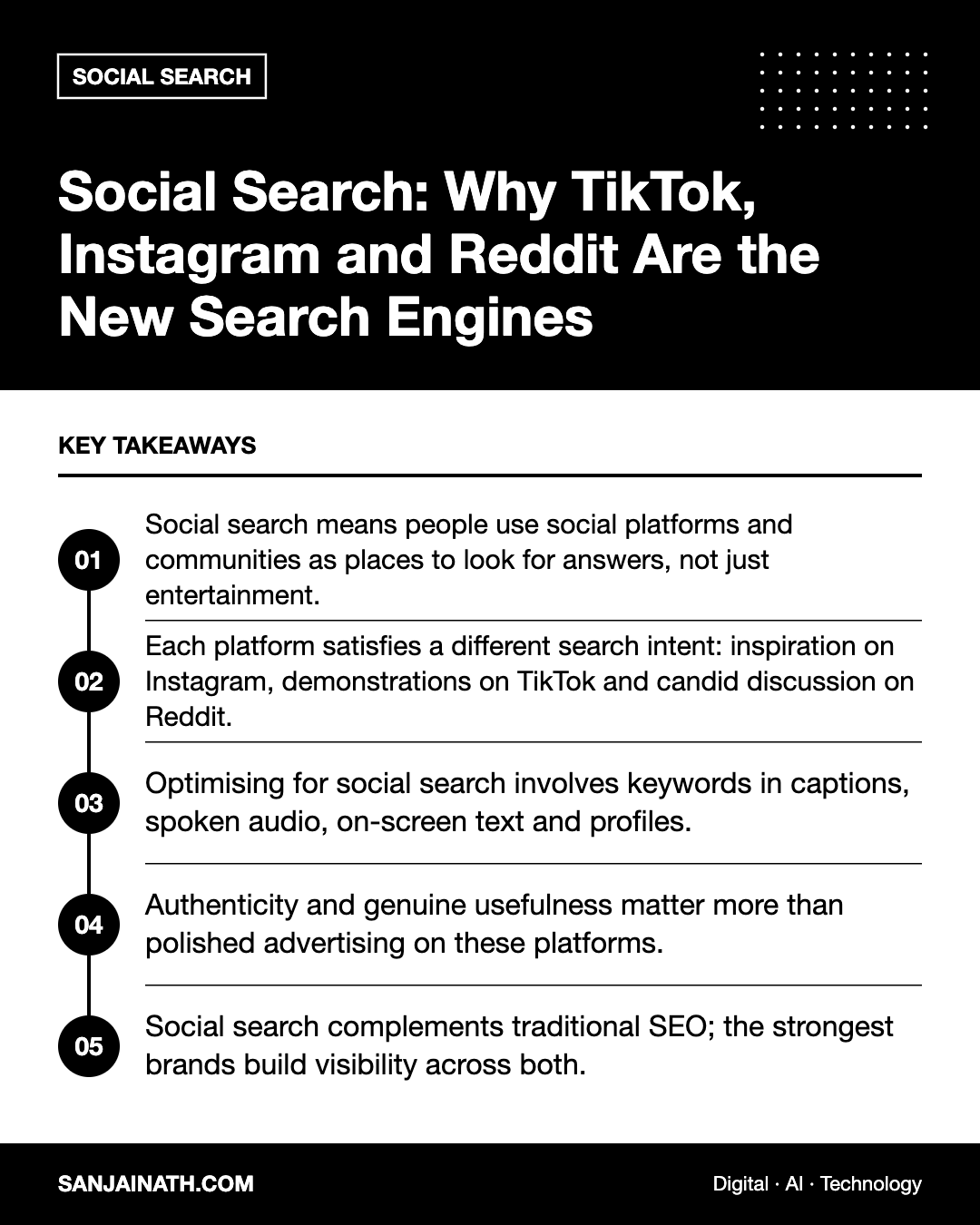
- Social search means people use social platforms and communities as places to look for answers, not just entertainment.
- Each platform satisfies a different search intent: inspiration on Instagram, demonstrations on TikTok and candid discussion on Reddit.
- Optimising for social search involves keywords in captions, spoken audio, on-screen text and profiles.
- Authenticity and genuine usefulness matter more than polished advertising on these platforms.
- Social search complements traditional SEO; the strongest brands build visibility across both.
What is social search?
Social search is the behaviour of using social media platforms and online communities to find information, products, services and recommendations. Instead of reading a list of web pages, users watch short videos, browse carousels or read threaded discussions from real people.
These platforms have invested heavily in search features, including search bars that suggest queries, keyword-based results and dedicated search results pages. Their content also increasingly appears in traditional search engines, with videos and forum threads showing up in results for many queries. That means content created for social search can earn visibility in more than one place.
Why people search on social platforms
Visual, fast answers
A thirty-second video showing how to style an outfit, set up a feature or cook a dish can be easier to follow than a long article. For many practical and visual topics, video simply communicates faster.
Trust in real people
Users often trust recommendations from creators and fellow customers more than brand claims. Seeing a real person use a product, or reading a candid thread about a service, feels more credible than a polished landing page.
Discovery and inspiration
Many searches on social platforms are exploratory. People are not always looking for a single answer; they want ideas, options and inspiration, which is exactly what scrolling feeds provide.
How TikTok, Instagram and Reddit differ
| Platform | Typical search intent | What brands should create |
|---|---|---|
| TikTok | How-to, reviews, recommendations, trends, “is it worth it” questions | Short, helpful videos with clear hooks, demonstrations and honest opinions |
| Inspiration, local places, aesthetics, products and creators | Reels, carousels and well-described posts, plus a complete, keyword-rich profile | |
| Candid opinions, comparisons, troubleshooting, niche expertise | Genuine participation, helpful answers and transparent brand accounts | |
| YouTube | Tutorials, in-depth reviews and explanations | Searchable long-form videos and Shorts with descriptive titles |
How to optimise for social search
1. Research what your audience actually searches
Type relevant topics into each platform’s search bar and note the auto-suggested queries. Look at which videos and threads rank, what formats they use and which questions appear repeatedly in comments. Combine this with insights from your sales and customer service teams, who hear real questions every day.
2. Use keywords naturally everywhere the platform reads
- Captions and descriptions: describe what the content covers using the words people search for.
- On-screen text: platforms can read text overlays, and they also help viewers watching without sound.
- Spoken audio: say the key phrase early in the video, as spoken words may be transcribed and used to understand content.
- Profile names and bios: include what you do and where you operate, for example a Dubai-based interior design studio.
- Hashtags: use a few relevant, specific hashtags rather than long lists of generic ones.
3. Answer one question per piece of content
Content that clearly answers a single question tends to perform well in social search. “How to choose a CRM for a small business” or “three things to check before renting an apartment in Abu Dhabi” gives both users and algorithms a clear signal of relevance.
4. Prioritise watch time and engagement
Social platforms rank content partly on how people interact with it. Strong hooks, concise delivery, and prompts that invite comments or saves help content surface in search results and recommendations.
5. Participate authentically on Reddit and forums
Reddit communities are often hostile to overt promotion. Brands succeed by contributing expertise, answering questions honestly, disclosing affiliations and following each community’s rules. Monitor relevant subreddits for mentions and questions, and respond helpfully rather than defensively.
6. Work with creators
Creators who already rank for relevant searches can introduce your brand to engaged audiences. Choose partners whose content is genuinely useful, allow them creative freedom and ensure paid partnerships are properly disclosed. In the UAE, check that creators hold any licence or permit required for advertising on social media.
Measuring social search performance
Social search is harder to measure than traditional SEO, but several signals help:
- Track which videos and posts gain views from search, where platform analytics provide traffic source data.
- Monitor follower growth, saves, shares and profile visits alongside views.
- Search your target queries periodically to see where your content appears.
- Add “how did you hear about us” fields to forms and ask customers during sales conversations.
- Watch for increases in branded search on traditional search engines after social campaigns.
Social search and traditional SEO together
Social search does not replace SEO; it extends it. People often move between platforms, discovering a brand on TikTok, checking opinions on Reddit and then searching the brand name on a search engine before buying. A strong website, well-optimised content and consistent messaging across platforms make that journey smoother. Many brands find that ideas which perform well on social platforms also make excellent blog topics, and vice versa.
Common social search mistakes to avoid
- Repurposing adverts as organic content, which rarely matches what people are searching for or how they expect content to look.
- Stuffing captions with keywords, making posts awkward to read and less likely to earn engagement.
- Ignoring comments and questions, which are both ranking signals and a rich source of new content ideas.
- Posting only in one language when your audience, as in much of the GCC, searches in both Arabic and English.
- Treating Reddit as an advertising channel rather than a community where credibility has to be earned.
Frequently asked questions
What is social search?
Social search is using social media platforms and online communities, such as TikTok, Instagram, YouTube and Reddit, to find information, recommendations and products instead of, or alongside, traditional search engines.
Is social search replacing Google?
Not replacing, but sharing attention. Traditional search engines remain central for many queries, while social platforms have become important for visual, experiential and opinion-based searches.
Do hashtags still matter for social search?
They can help platforms categorise content, but captions, spoken words and on-screen text are also important. A few precise hashtags are generally more useful than many broad ones.
How can B2B brands use social search?
B2B brands can create short educational videos, answer industry questions, share expert perspectives on LinkedIn and YouTube, and participate in professional communities where buyers research solutions.
Final thoughts
Social search reflects a simple truth: people look for answers wherever they trust the information and enjoy the experience. Brands that understand the search intent on each platform, create genuinely helpful content, use natural keywords and participate authentically in communities will be discovered more often. Treat social search as a core part of your visibility strategy, working hand in hand with SEO, and you will meet customers wherever they choose to ask their questions.