

Every time a web page or app loads an ad, an automated auction may decide in milliseconds which advertiser’s message appears. That process is programmatic advertising: the automated buying and selling of digital ad space using software, data and real-time bidding. This guide explains the moving parts, from demand-side platforms to ad exchanges and targeting, so you can judge when programmatic makes sense and how to run it responsibly.
Key takeaways
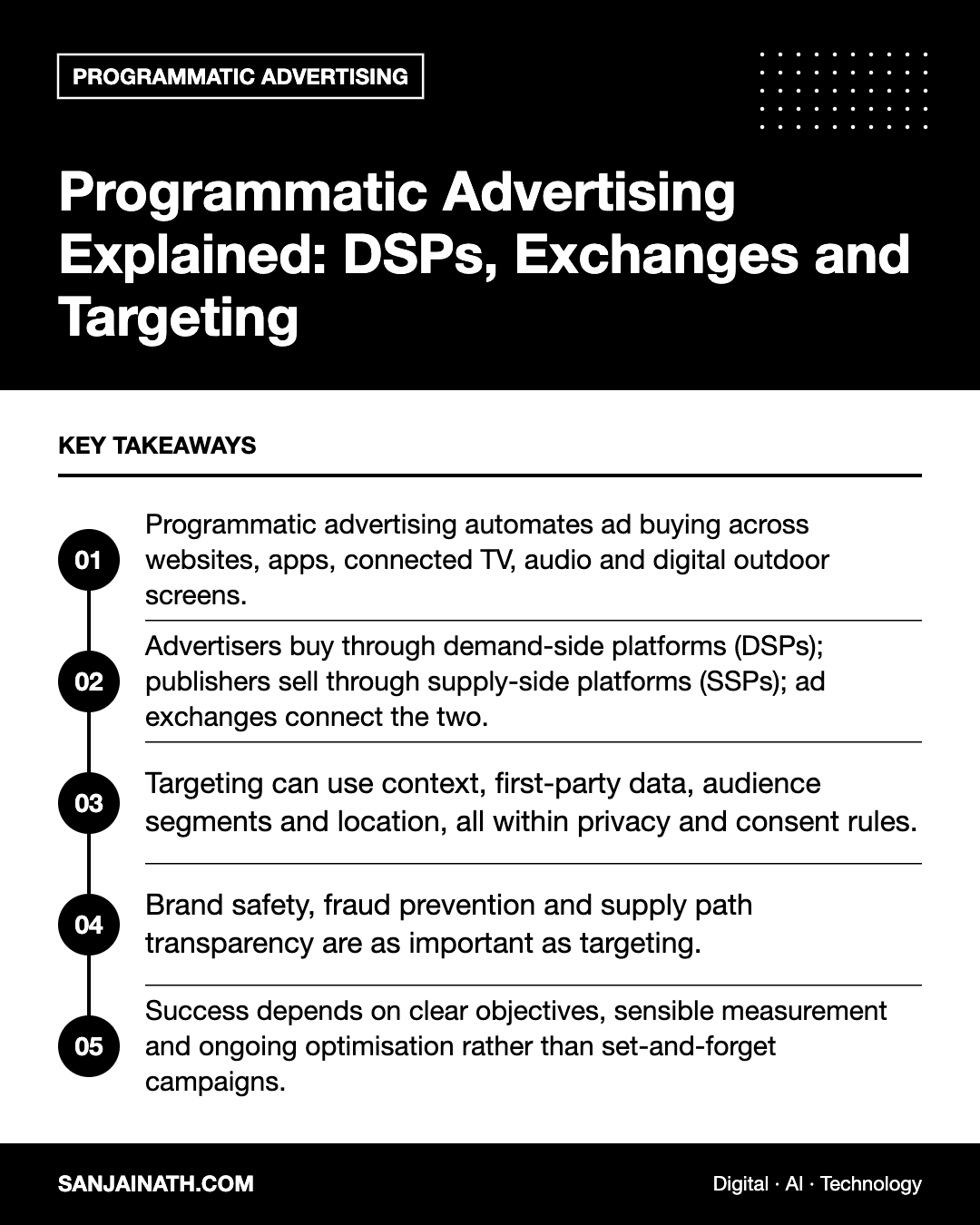
- Programmatic advertising automates ad buying across websites, apps, connected TV, audio and digital outdoor screens.
- Advertisers buy through demand-side platforms (DSPs); publishers sell through supply-side platforms (SSPs); ad exchanges connect the two.
- Targeting can use context, first-party data, audience segments and location, all within privacy and consent rules.
- Brand safety, fraud prevention and supply path transparency are as important as targeting.
- Success depends on clear objectives, sensible measurement and ongoing optimisation rather than set-and-forget campaigns.
What is programmatic advertising?
Before programmatic, most display advertising was bought through direct negotiations, insertion orders and fixed placements. Programmatic replaces much of that manual work with technology that evaluates each ad opportunity, known as an impression, and decides whether to bid and how much.
It covers many formats and channels:
- Display banners and native ads on websites.
- In-app ads on mobile games and utilities.
- Online video, including pre-roll ads.
- Connected TV (CTV) on streaming platforms and smart TVs.
- Digital audio and podcasts.
- Digital out-of-home screens in malls, airports and roadside billboards, a growing channel in cities such as Dubai and Riyadh.
The programmatic ecosystem: who does what
| Player | Role |
|---|---|
| Advertiser or agency | Sets objectives, budgets and creative, and runs campaigns |
| Demand-side platform (DSP) | Software advertisers use to set targeting, bid on impressions and manage campaigns across many sources |
| Ad exchange | Marketplace where impressions are auctioned between buyers and sellers |
| Supply-side platform (SSP) | Software publishers use to make inventory available and maximise revenue |
| Publisher | Owner of the website, app or screen where ads appear |
| Data providers | Supply audience or contextual data used for targeting |
| Verification vendors | Measure viewability, brand safety and invalid traffic |
In practice, the lines blur, as some companies offer both DSP and SSP services, and large platforms run their own closed ecosystems.
How a programmatic ad auction works
- A user opens a page or app with ad space.
- The publisher’s SSP sends a bid request containing information about the placement, device, general location and any permitted audience signals.
- DSPs evaluate the request against each advertiser’s targeting and budget rules.
- Qualifying DSPs submit bids, and the exchange selects a winner.
- The winning ad is delivered and the impression is recorded, all in a fraction of a second.
Most open-market auctions now use first-price rules, meaning the winner pays what it bid, which makes smart bid strategies important.
Ways to buy programmatic media
Open auction
Any eligible buyer can bid on inventory. It offers the widest reach and often lower prices, but less control over where ads appear.
Private marketplace (PMP)
An invitation-only auction in which a publisher, or a group of publishers, offers inventory to selected buyers, typically at a floor price. It balances automation with quality.
Preferred deals
A buyer gets first look at specific inventory at a fixed price before it goes to auction, without a guaranteed volume.
Programmatic guaranteed
A direct agreement on price and volume, executed through programmatic pipes. It suits premium placements and planned campaigns.
Programmatic advertising targeting options
Targeting is where programmatic advertising earns its reputation, but it must be used thoughtfully.
- Contextual targeting: placing ads next to relevant content, such as a travel ad on a destination guide. It relies on page content rather than personal data and has become more valuable as privacy rules tighten.
- First-party audiences: reaching people who have interacted with your brand, such as website visitors or customers, with appropriate consent.
- Third-party and platform segments: audiences grouped by interests, demographics or intent, supplied by data partners or the DSP.
- Lookalike modelling: finding new users who resemble your best customers.
- Geographic and device targeting: narrowing by country, city, radius, language, device type or operating system.
- Time and frequency controls: limiting how often a person sees an ad and when ads run.
Privacy considerations
Browser restrictions on third-party cookies, mobile app tracking permissions and data protection laws have changed how audience targeting works. Build campaigns that rely on consented first-party data and context, and check that your partners follow the laws relevant to your markets, including the UAE’s data protection framework and GDPR where European users are involved.
Brand safety, fraud and transparency
Automation brings scale, but also risk. Protect your budget and reputation with these controls:
- Brand safety and suitability settings that exclude content categories you do not want to appear beside.
- Inclusion lists of approved sites and apps for sensitive campaigns, and exclusion lists for poor performers.
- Invalid traffic filtering using DSP tools and independent verification to reduce bot and fraudulent impressions.
- Viewability measurement to check that ads actually had a chance to be seen.
- Supply path optimisation: favouring direct, authorised routes to inventory, supported by industry standards such as ads.txt and sellers.json.
Ask partners for transparent reporting on fees, placements and data sources. If you cannot see where your ads ran, you cannot judge whether they worked.
Setting up and optimising a campaign
- Define the objective: awareness, consideration or conversions. Each needs different targeting, creative and metrics.
- Choose your access route: a self-serve DSP, a managed service from a DSP or an agency trading desk.
- Prepare creative in multiple sizes and formats, with clear messaging and a strong call to action.
- Set targeting, budgets, bids and frequency caps, starting reasonably broad so the platform can learn.
- Install measurement such as conversion tags or server-side events, and agree how you will attribute results.
- Review performance regularly by placement, audience, creative and device, and reallocate budget to what works.
Measure beyond clicks. For awareness campaigns, look at reach, viewable impressions and brand lift studies; for performance campaigns, focus on cost per acquisition and incremental conversions.
Frequently asked questions
Is programmatic advertising suitable for small businesses?
It can be, especially through self-serve platforms with low minimum spends, but it needs time and expertise to manage. Smaller budgets are often better concentrated on search and social ads first.
What is the difference between a DSP and an ad network?
An ad network typically packages inventory from its own publisher group, while a DSP lets you bid across many exchanges and sources from one platform with more control.
Does programmatic advertising still work without third-party cookies?
Yes. Contextual targeting, first-party data, publisher audiences and newer privacy-preserving methods keep campaigns effective, although tactics are shifting.
How do I know my ads are not appearing on unsafe sites?
Use brand safety settings, inclusion and exclusion lists and independent verification, and request placement reports from your partners.
Final thoughts
Programmatic advertising gives marketers efficient access to vast audiences across screens, but automation is not a strategy in itself. Understand the ecosystem, choose the right buying methods, respect privacy, insist on transparency and optimise against meaningful outcomes. Handled that way, programmatic becomes a disciplined, measurable part of your media mix.