

Pay-per-click advertising can deliver customers within days, but it can also drain a budget just as quickly if the basics are wrong. Mastering PPC fundamentals means understanding how ad auctions work, how to set and allocate budgets, which bidding strategy suits each stage and how to measure return on ad spend (ROAS) honestly. This guide covers those essentials for business owners and marketers running search, shopping and social campaigns.
Key takeaways
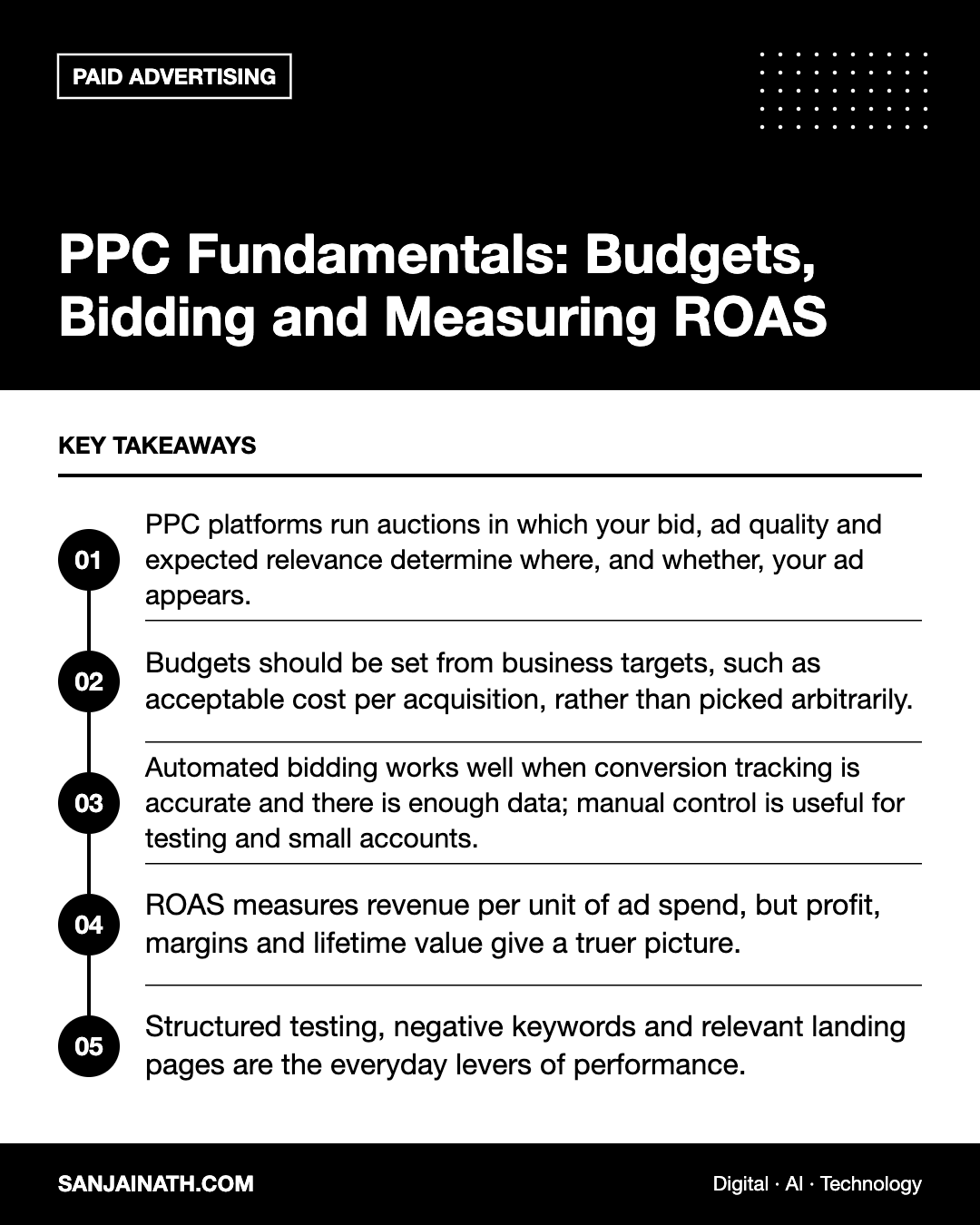
- PPC platforms run auctions in which your bid, ad quality and expected relevance determine where, and whether, your ad appears.
- Budgets should be set from business targets, such as acceptable cost per acquisition, rather than picked arbitrarily.
- Automated bidding works well when conversion tracking is accurate and there is enough data; manual control is useful for testing and small accounts.
- ROAS measures revenue per unit of ad spend, but profit, margins and lifetime value give a truer picture.
- Structured testing, negative keywords and relevant landing pages are the everyday levers of performance.
How PPC advertising works
In PPC advertising, you pay when someone clicks your ad, although some formats charge per thousand impressions or per view. The largest platforms include Google Ads and Microsoft Advertising for search, and Meta, LinkedIn, TikTok and others for social.
The ad auction
On search platforms, an auction runs each time someone searches. The platform considers:
- Your bid: the maximum you are willing to pay, set manually or by automated bidding.
- Ad quality: expected click-through rate, ad relevance and landing page experience, often summarised as a Quality Score.
- Context: the user’s device, location, time and search terms.
- Ad assets: extra information such as sitelinks, callouts and call buttons.
The result is that a highly relevant advertiser can outrank a competitor who bids more. Improving relevance is often the cheapest way to lower costs.
Search vs social PPC
| Aspect | Search PPC | Social PPC |
|---|---|---|
| Targeting basis | Keywords and intent expressed in searches | Audience interests, demographics, behaviours and lookalikes |
| User mindset | Actively looking for a solution | Browsing; needs to be interrupted and engaged |
| Strengths | Capturing existing demand | Creating demand and reaching new audiences |
| Key creative | Ad copy matching the query | Visuals and video that stop the scroll |
Setting a PPC budget
A common mistake is to choose a monthly budget first and work out goals afterwards. Reverse the process by starting from business economics.
- Work out what a customer is worth. Consider average order value, gross margin and, where relevant, repeat purchases.
- Decide your target cost per acquisition (CPA). This is the maximum you can pay for a customer or lead while remaining profitable.
- Estimate conversion rates. Use your website data or conservative assumptions for new campaigns.
- Estimate cost per click using the platform’s keyword planning tools.
- Calculate the budget needed to generate the volume of conversions you want at your target CPA.
A simple worked example
Suppose a service business earns a gross profit of 2,000 dirhams per new client and decides it can spend up to 500 dirhams to acquire one. If its website converts one in twenty clicks into an enquiry and one in four enquiries becomes a client, it needs around eighty clicks per client. At that point, the average cost per click must stay at or below roughly 6.25 dirhams for the campaign to hit its target. These are illustrative figures; use your own data to run the same calculation.
Allocating budget across campaigns
- Prioritise high-intent campaigns, such as brand terms and specific product or service keywords.
- Reserve a portion for testing new keywords, audiences and creative.
- Shift budget towards campaigns meeting your CPA or ROAS targets and away from those that are not.
- Avoid spreading a small budget across too many campaigns; each needs enough data to learn.
Bidding strategies explained
Manual bidding
You set maximum bids for keywords or ad groups. This gives control and transparency, and suits new accounts, small budgets or tightly managed tests, but it requires regular attention.
Automated or smart bidding
The platform uses machine learning and auction-time signals to set bids. Common strategies include:
- Maximise clicks: drive traffic within a budget; useful for early data gathering.
- Maximise conversions: get as many conversions as possible within budget.
- Target CPA: aim for a set average cost per conversion.
- Maximise conversion value: prioritise higher-value conversions.
- Target ROAS: aim for a set ratio of conversion value to ad spend.
Automated bidding is only as good as the data it learns from. Accurate conversion tracking, meaningful conversion values and sufficient conversion volume are prerequisites. Allow a learning period after changes and avoid frequent large adjustments.
Measuring ROAS and what it misses
Return on ad spend is calculated as revenue attributed to ads divided by ad spend. If campaigns generate 40,000 dirhams of revenue from 10,000 dirhams of spend, ROAS is 4, sometimes written as 400 per cent.
ROAS is valuable, but interpret it carefully:
- It ignores margin. A strong ROAS on low-margin products can still lose money. Calculate your break-even ROAS as one divided by your gross margin.
- It depends on attribution. Different attribution models credit clicks differently, so ROAS can change without any real change in results.
- It can reward the easy wins. Brand campaigns often show high ROAS because many of those customers would have bought anyway.
- It usually ignores lifetime value. A campaign that attracts loyal repeat customers may justify a lower first-purchase ROAS.
For lead generation, where revenue is not immediate, track cost per lead, cost per qualified lead and, ideally, revenue from closed deals imported from your CRM.
Everyday optimisation checklist
- Review search terms reports and add irrelevant queries as negative keywords.
- Test new ad copy variations focusing on benefits, offers and clear calls to action.
- Match landing pages closely to ad messages and keep them fast on mobile.
- Use ad assets to improve visibility and relevance.
- Adjust targeting by location, schedule and device based on performance.
- Check conversion tracking regularly to make sure it is firing correctly.
- For GCC campaigns, consider separate campaigns or ads for Arabic and English searches, and plan for seasonal shifts such as Ramadan and major shopping events.
Frequently asked questions
How much should I spend on PPC?
Work backwards from your target cost per acquisition and the number of customers you want. Start with enough budget to gather meaningful data, then scale what works.
What is a good ROAS?
It depends on your margins and business model. Calculate your break-even ROAS from gross margin, then set targets above it that reflect your growth and profit goals.
Should I bid on my own brand name?
Often, yes, especially if competitors bid on it. Brand campaigns are usually inexpensive, but judge their value on incremental results rather than headline ROAS.
How long does it take for PPC campaigns to perform?
Ads can generate traffic immediately, but campaigns typically need several weeks of data and optimisation before performance stabilises, particularly with automated bidding.
Final thoughts
Strong PPC fundamentals come down to disciplined economics and continuous improvement. Set budgets from business targets, choose bidding strategies that match your data, measure ROAS alongside profit and lifetime value, and optimise relentlessly. Paid search and social can then become a predictable, scalable engine for growth rather than an unpredictable expense.