

Big-name creators attract attention, but they are not always the best route to trust or sales. Micro-influencer marketing focuses on creators with smaller, highly engaged audiences who are often seen as peers rather than celebrities. This guide explains how to find the right creators, brief them effectively and measure whether the partnership actually worked.
Key takeaways
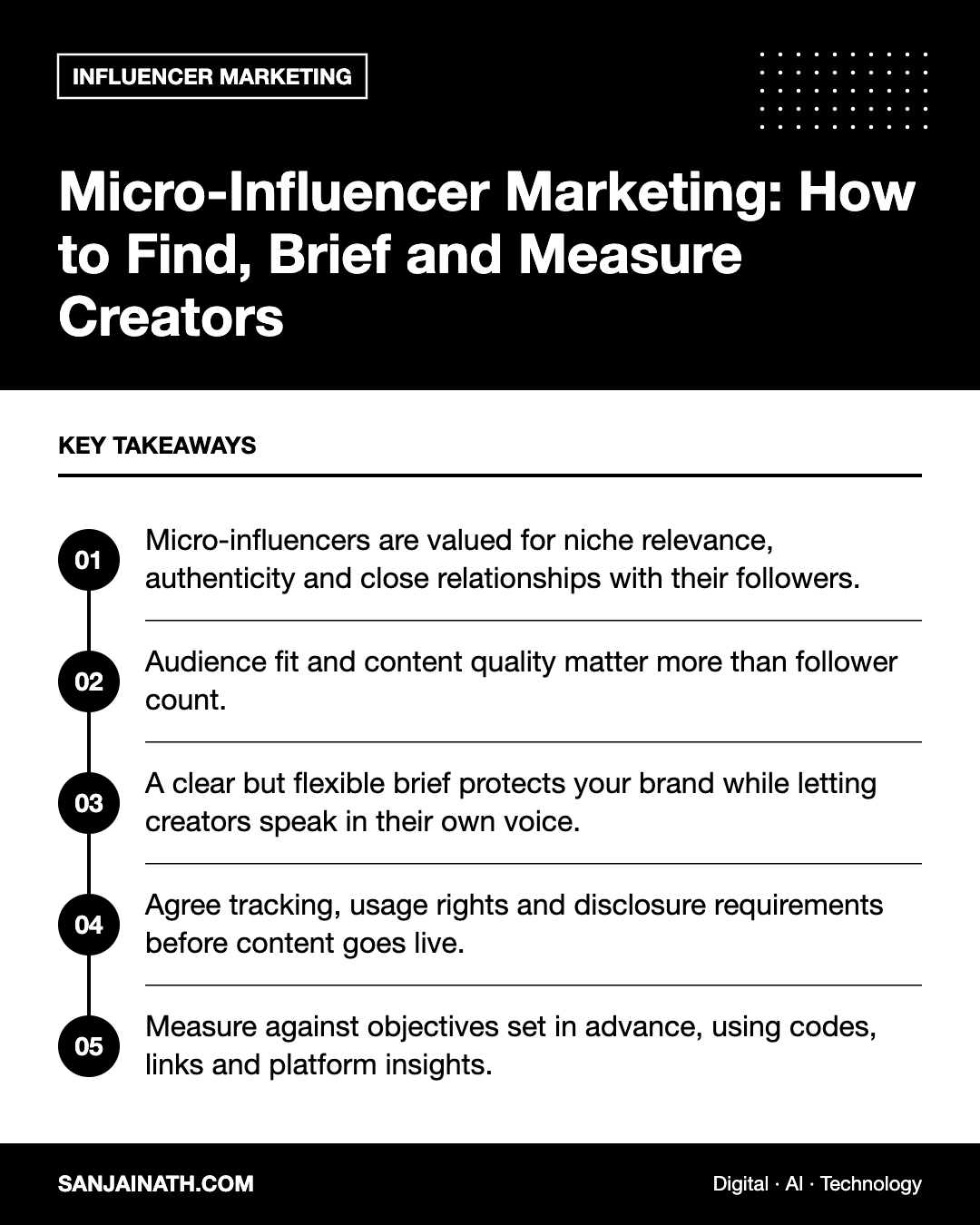
- Micro-influencers are valued for niche relevance, authenticity and close relationships with their followers.
- Audience fit and content quality matter more than follower count.
- A clear but flexible brief protects your brand while letting creators speak in their own voice.
- Agree tracking, usage rights and disclosure requirements before content goes live.
- Measure against objectives set in advance, using codes, links and platform insights.
What counts as a micro-influencer?
Definitions vary between agencies and platforms, but micro-influencers are commonly described as creators with somewhere in the region of ten thousand to one hundred thousand followers, with “nano-influencers” below that range. The exact threshold matters less than the characteristics:
- A clearly defined niche, such as home cooking, fitness for new mothers, sustainable fashion, property investment or gaming.
- Regular two-way conversation with followers in comments and direct messages.
- Content that feels personal and practical rather than heavily produced.
- Often, a strong local or community identity — valuable for brands targeting a specific city or market.
Why micro-influencer marketing works
Relevance over reach
A creator with a modest following of engaged home cooks may influence more relevant purchase decisions for a kitchenware brand than a general lifestyle celebrity with millions of followers. You pay for attention from the people you actually want to reach.
Trust and relatability
Followers often perceive micro-influencers as knowledgeable friends. Their recommendations can feel more credible, particularly for considered purchases where people seek reassurance.
Flexibility and scale
Working with several smaller creators spreads risk, lets you test different messages and audiences, and produces a variety of content you can learn from and, with permission, reuse.
How to find the right creators
Start with a clear definition of your target audience, then look for creators they already follow.
- Search natively: explore relevant hashtags, locations and keywords on Instagram, TikTok, YouTube and LinkedIn.
- Check who your customers follow: look at the followers who engage with your brand and see which creators they interact with.
- Use discovery tools: influencer platforms and marketplaces can filter by niche, location, audience demographics and engagement, though you should still verify manually.
- Ask your community: customers who already love your brand may be creators themselves.
- Tap regional networks: in markets such as the UAE, local agencies and creator communities can help you find bilingual Arabic and English creators.
A vetting checklist
- Audience fit: does the audience’s location, age and interest match your market? Ask for audience insight screenshots.
- Engagement quality: are comments genuine conversations, or generic emojis and repeated phrases?
- Growth pattern: sudden follower spikes without a clear reason can indicate purchased followers.
- Content standards: are visuals, tone and values compatible with your brand?
- Brand safety: review past posts for controversial content and check recent partnerships with competitors.
- Professionalism: are they responsive, clear about rates and familiar with disclosure rules?
In the UAE, creators who promote products commercially are expected to hold the appropriate media or advertiser permit under the country’s media regulations. Confirm your creators’ status and check current requirements before contracting.
Writing a creator brief that gets results
A good brief balances clarity and creative freedom. Creators know what their audience responds to; a brief that dictates every word usually produces stiff, underperforming content.
What to include
- Background: a short introduction to your brand and why you chose this creator.
- Objective: awareness, website traffic, app installs, sign-ups or sales.
- Key message: one or two points you want the audience to remember.
- Deliverables: formats, platforms, number of posts or stories, and timeline.
- Mandatories: links, discount codes, hashtags, tags and required disclosures such as “#ad” or platform paid-partnership labels.
- Do’s and don’ts: claims they must not make, competitor mentions to avoid and any cultural sensitivities.
- Approval process: whether you review drafts, and how quickly you will respond.
- Usage rights: whether you can reuse content in ads or on your website, for how long and where.
Compensation models
- Flat fee: simple and predictable for defined deliverables.
- Product gifting: suitable for some nano-creators, but never assume free product equals an obligation to post.
- Affiliate or commission: aligns rewards with sales, often combined with a lower base fee.
- Long-term ambassador retainers: build deeper association and consistent content over months.
Measuring micro-influencer marketing campaigns
Decide how you will measure success before the campaign starts, and match metrics to objectives.
| Objective | Primary metrics | How to track |
|---|---|---|
| Awareness | Reach, impressions, video views | Creator insight screenshots or platform partnership tools |
| Engagement | Comments, saves, shares, engagement rate | Platform insights and manual review of comment quality |
| Traffic | Clicks, sessions, engaged sessions | Unique UTM-tagged links per creator |
| Sales or leads | Conversions, revenue, cost per acquisition | Unique discount codes, affiliate links and CRM attribution |
Look beyond immediate conversions. Micro-influencer content often influences customers who purchase later through another channel, so watch branded search, direct traffic and social mentions during and after campaigns. Where appropriate, run the best-performing creator content as paid ads through partnership ad formats to extend its reach.
Building long-term creator relationships
The strongest programmes treat creators as partners. Share results with them, give feedback, invite them to launches and offer early access to products. Repeat partnerships tend to feel more authentic to audiences than one-off sponsored posts, and creators who genuinely use your product become more persuasive advocates over time.
Common pitfalls to avoid
Even well-funded programmes stumble on the same avoidable mistakes. Watch out for these:
- Choosing creators by follower count alone. A large but poorly matched audience delivers impressions without influence.
- Over-scripting content. Asking creators to read your ad copy word for word usually produces posts their followers scroll past.
- Vague contracts. Unclear deliverables, deadlines, exclusivity or usage terms lead to disputes. Put everything in writing, however small the fee.
- Skipping tracking. Without unique links or codes per creator, you cannot tell who drove results, and you lose the evidence needed to scale.
- Judging too quickly. A single post rarely tells the full story. Assess performance across several pieces of content and the weeks that follow.
- Ignoring comments. Questions left on a creator’s post are sales conversations. Agree who will answer product queries and make sure your team monitors them during the campaign.
Frequently asked questions
How much should I pay a micro-influencer?
Rates vary by platform, niche, market, deliverables and usage rights. Ask creators for their rate cards, compare several quotes, and budget separately for extended usage rights.
How many micro-influencers should I work with?
Start with a small test group — enough to compare creators and messages — then scale up with those who perform best.
Do sponsored posts need to be disclosed?
Yes. Advertising regulators and platform policies in many markets require clear disclosure of paid or gifted content. Use platform partnership labels and clear wording such as “ad”.
Is micro-influencer marketing suitable for B2B brands?
It can be. Industry experts on LinkedIn, YouTube and podcasts can act as micro-influencers for software, professional services and specialist equipment.
Final thoughts
Micro-influencer marketing rewards brands that do their homework. Choose creators for audience fit rather than vanity metrics, brief them clearly without stifling them, and measure against goals you set up front. Treat the best creators as long-term partners, and your programme will compound in value over time.