

How you structure campaigns in Meta Ads Manager has a direct effect on how well Facebook and Instagram’s delivery system can find your customers. Structures that worked years ago, with dozens of narrowly targeted ad sets and tiny budgets, now tend to fragment data and slow down learning. This guide sets out Meta ads best practices for campaign structure, so your budget works harder and your results are easier to understand and scale.
Key takeaways
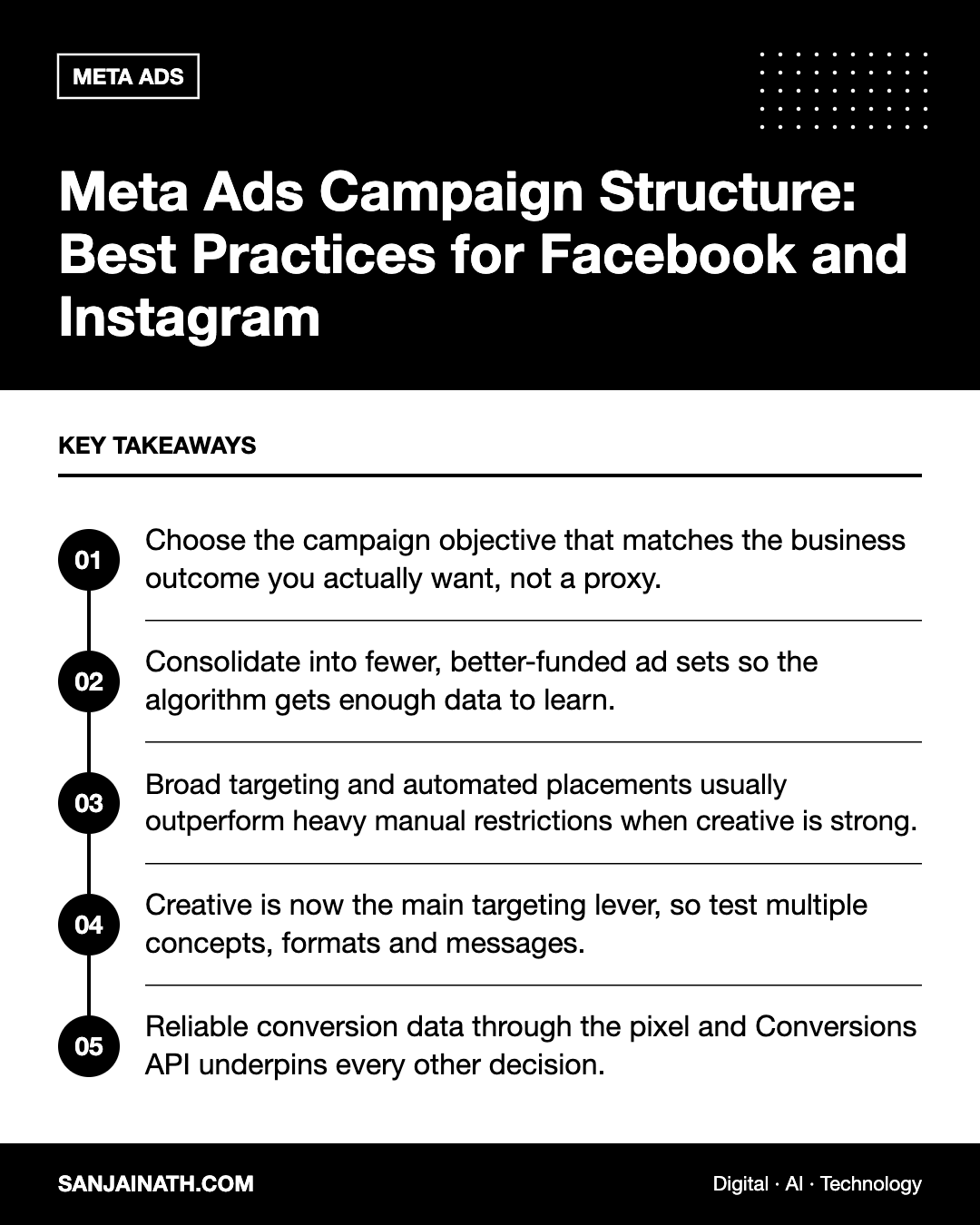
- Choose the campaign objective that matches the business outcome you actually want, not a proxy.
- Consolidate into fewer, better-funded ad sets so the algorithm gets enough data to learn.
- Broad targeting and automated placements usually outperform heavy manual restrictions when creative is strong.
- Creative is now the main targeting lever, so test multiple concepts, formats and messages.
- Reliable conversion data through the pixel and Conversions API underpins every other decision.
Understanding the three levels of a Meta campaign
Every Meta campaign has three levels, each controlling different settings.
| Level | What you control | Key decisions |
|---|---|---|
| Campaign | Objective, and budget if using campaign-level budgets | What outcome Meta should optimise for |
| Ad set | Audience, placements, schedule, optimisation event, budget if set here | Who sees ads, where and how delivery is optimised |
| Ad | Creative, copy, format, call to action, destination | What people actually see and do |
Good structure keeps each level focused on its job: one clear objective per campaign, meaningful audience or optimisation differences between ad sets, and a healthy variety of creative within each ad set.
Meta ads best practices for choosing objectives
Meta optimises towards whatever objective and conversion event you select. If you choose traffic when you really want purchases, the system will find people who click, not necessarily people who buy.
- Awareness: for reach and brand recall among a broad audience.
- Traffic: for sending people to a destination when conversions cannot be tracked.
- Engagement: for interactions, video views or messaging conversations.
- Leads: for instant forms, messaging leads or website lead events.
- App promotion: for installs and in-app actions.
- Sales: for purchases and other valuable website or catalogue conversions.
For lead generation, optimising towards a deeper event, such as a qualified lead passed back from your CRM, often produces better quality than optimising for raw form submissions.
Consolidate your account structure
Meta’s delivery system needs enough conversion events in each ad set to exit the learning phase and stabilise. When budgets are spread across many small ad sets, each one learns slowly and audiences often overlap, causing your own ads to compete with each other.
A simple, scalable structure
- Prospecting campaign: reaching new customers with broad targeting or a few distinct audience approaches.
- Retargeting campaign: reaching website visitors, video viewers, engagers and cart abandoners, if your audience is large enough to justify a separate budget.
- Retention campaign: optional, for upselling or re-engaging existing customers using customer lists.
Many advertisers now also use Meta’s automated sales or app campaign options, which combine prospecting and retargeting in one campaign with less manual control. These can work well, particularly with strong creative and good conversion data, but test them against your existing structure rather than switching everything at once.
Targeting: let the algorithm work
Privacy changes and platform developments have reduced the precision of detailed interest targeting, while Meta’s modelling has improved. As a result, broad targeting with minimal restrictions frequently performs as well as, or better than, narrow interest stacks.
Practical targeting guidance
- Start with location, language and basic age limits where legally or commercially necessary, then let delivery optimise.
- Use custom audiences, such as customer lists and site visitors, as signals or for retargeting.
- Test lookalike or similar audiences against broad targeting, rather than assuming either wins.
- Exclude recent purchasers from acquisition campaigns where it makes sense.
- For the UAE and GCC, consider separate ad sets or campaigns by language, as Arabic and English creative often perform differently.
Placements
Automatic placements, sometimes labelled Advantage+ placements, allow Meta to deliver across Feeds, Stories, Reels and other surfaces wherever results are cheapest. Restrict placements only when you have a clear brand safety or creative reason, and supply assets in vertical, square and landscape ratios so every placement looks native.
Budgets and bidding
- Campaign budget versus ad set budget: campaign-level budgets distribute spend automatically to the best-performing ad sets, which suits consolidated structures. Ad set budgets give tighter control, which can help when testing.
- Bid strategies: highest volume or lowest cost is a sensible default. Cost per result goals or ROAS goals help protect efficiency once you have stable data.
- Scaling: increase budgets gradually to avoid destabilising delivery, and duplicate proven ad sets only when you have a clear reason.
Creative is your strongest lever
With targeting broader, creative does much of the work of finding the right people. Different messages and formats naturally attract different audiences.
Creative best practices
- Run several genuinely different concepts in each ad set, not just colour variations of one idea.
- Mix formats: short vertical video, static images, carousels and user-generated-style content.
- Hook attention in the first seconds of video and design for sound-off viewing with captions.
- Match the message to the audience’s stage, with education for prospects and specific offers for retargeting.
- Refresh creative regularly when frequency rises and performance declines.
Tracking and measurement foundations
Every structural decision depends on accurate data. Install the Meta pixel correctly, implement the Conversions API, often via your platform’s integration or a server-side setup, and configure your most important events with correct values. Verify your domain and review event priority settings where they apply. Compare Meta-reported results with your analytics and back-end sales data, and consider lift or holdout tests to understand true incremental impact.
Naming conventions and testing discipline
A consistent naming convention makes a consolidated account far easier to manage and report on. Include the objective, audience approach, market, language and launch date in campaign and ad set names, and label ads by concept and format. When you test, change one major variable at a time, such as the offer, the hook or the format, and give each test enough budget and time to produce a meaningful result. Keep a simple log of what you tested, what you learned and what you changed, so insights build up over time rather than being forgotten.
Frequently asked questions
How many ad sets should a campaign have?
Usually fewer than you think. Two to five well-funded ad sets with meaningful differences are often more effective than many small ones that each struggle to gather conversion data.
Is interest targeting still worth using?
It can still help in some niches and for new accounts with limited data, but test it against broad targeting. Many advertisers find broad audiences combined with strong creative perform just as well.
How often should I change my Meta ads?
Avoid constant edits, which can reset learning. Review performance weekly, and introduce new creative when results decline or frequency climbs noticeably.
What are the most important Meta ads best practices for beginners?
Choose the right objective, set up conversion tracking properly, keep the structure simple, use broad targeting with automatic placements and invest time in producing varied, high-quality creative.
Final thoughts
The most effective Meta ads best practices today favour simplicity: a clear objective, consolidated campaigns, broad targeting, automated placements and a steady flow of strong creative, all built on reliable conversion data. Structure your account so the algorithm can learn, measure against real business outcomes and test changes deliberately. That combination gives your Facebook and Instagram campaigns the best chance of delivering consistent, scalable results.