

Most leads are not ready to buy the moment they first make contact. They download a guide, attend a webinar or sign up for a newsletter, then drift away unless something keeps the conversation going. Marketing automation solves this by using pre-built journeys that send the right message at the right time based on each person’s behaviour, so leads are nurtured consistently without your team having to remember every follow-up manually.
Key takeaways
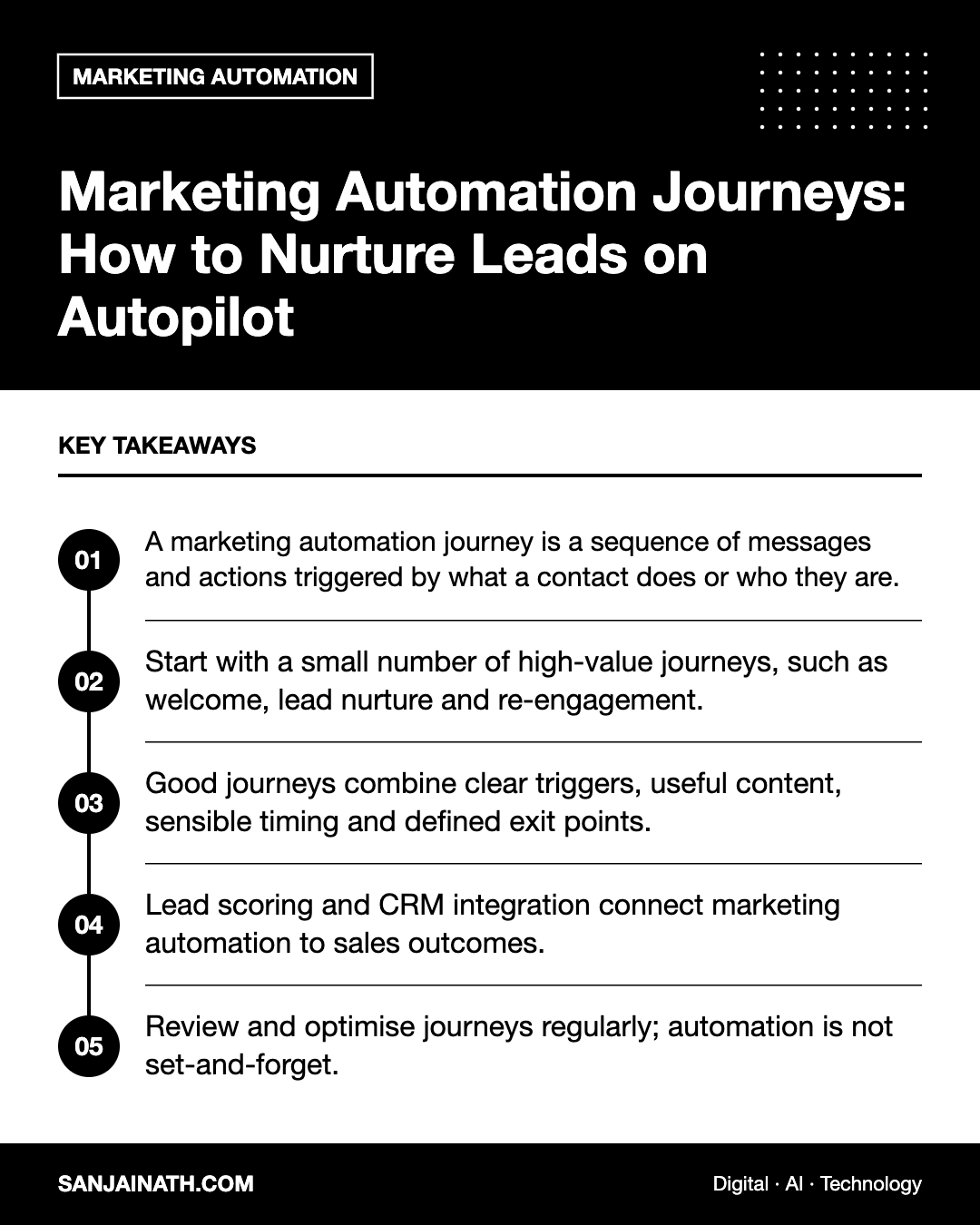
- A marketing automation journey is a sequence of messages and actions triggered by what a contact does or who they are.
- Start with a small number of high-value journeys, such as welcome, lead nurture and re-engagement.
- Good journeys combine clear triggers, useful content, sensible timing and defined exit points.
- Lead scoring and CRM integration connect marketing automation to sales outcomes.
- Review and optimise journeys regularly; automation is not set-and-forget.
What is a marketing automation journey?
A journey, sometimes called a workflow, flow or programme, is a set of rules that tells your marketing platform what to do when a contact meets certain conditions. It typically includes:
- A trigger: the event that starts the journey, such as a form submission, a purchase or a page visit.
- Actions: emails, SMS or WhatsApp messages where permitted, internal notifications, CRM updates or task assignments.
- Delays: waiting periods between steps.
- Conditions and branches: rules that send contacts down different paths depending on their behaviour or data.
- Goals and exits: criteria that remove contacts from the journey once it has done its job, such as booking a call.
Five marketing automation journeys every business should consider
1. Welcome journey
Triggered when someone subscribes or creates an account. Introduce your brand, set expectations about what they will receive, deliver any promised resource and point them towards a useful next step. Welcome journeys typically see strong engagement because interest is at its peak.
2. Lead magnet follow-up
When someone downloads a guide or checklist, follow up with related content that deepens understanding of the problem and positions your solution. For example, a company offering cybersecurity services might follow a “WordPress security checklist” download with a short series on common vulnerabilities, a case-style explanation of how an audit works and an invitation to book a review.
3. Sales-ready nurture
For leads showing strong buying signals, such as visiting pricing pages repeatedly, the journey can shift from education to evaluation: comparisons, answers to common objections, implementation details and a clear invitation to speak with sales. It can also alert a salesperson to follow up personally.
4. Post-purchase and onboarding
After a purchase or contract signature, automation can guide new customers through setup, share tips for getting value quickly, request feedback and, at the right moment, introduce complementary products or services.
5. Re-engagement journey
Contacts who have not engaged for a long period can be targeted with a short series that reminds them of your value, asks about their preferences and offers an easy way to stay or leave. Those who remain inactive can be suppressed, protecting your sender reputation.
How to design a marketing automation journey step by step
- Define the goal. Decide what success looks like, such as a booked demo, a first purchase or a completed onboarding task.
- Identify the audience and trigger. Be specific about who enters the journey and what starts it.
- Map the customer’s questions. List what this person needs to know, believe or feel at each stage to move closer to the goal.
- Plan the content. Match each question with a message: an article, video, case explanation, FAQ or offer.
- Set timing. Space messages so they feel helpful rather than relentless. Early steps can be closer together; later ones can be spaced out.
- Add branches. Adjust the path based on behaviour, such as sending a different follow-up to people who clicked than to those who did not.
- Define exits. Remove contacts when they convert, unsubscribe or move into a more relevant journey.
- Test before launch. Run test contacts through every branch, check links, personalisation and timing, and confirm that CRM updates work as intended.
Lead scoring and sales alignment
Lead scoring assigns points to contacts based on who they are and what they do, helping teams focus on the most promising prospects. It is one of the most useful ways to connect marketing automation to revenue.
| Signal type | Examples | Why it matters |
|---|---|---|
| Fit | Job title, company size, industry, location | Shows whether the contact matches your ideal customer |
| Engagement | Email clicks, webinar attendance, content downloads | Indicates interest and awareness |
| Intent | Pricing page visits, demo page views, comparison content | Suggests active evaluation |
| Negative signals | Student emails, competitors, long inactivity | Prevents wasted sales effort |
Agree with your sales team what score or combination of signals makes a lead sales-ready, how quickly sales will follow up and how they will feed outcomes back into the CRM. Review the model periodically against actual closed deals and adjust.
Personalisation without overdoing it
Personalisation goes beyond inserting a first name. Tailor content based on industry, role, interests, previous purchases or pages viewed. However, keep it respectful: overly specific references to someone’s browsing can feel intrusive. Use data that contacts would reasonably expect you to have, and always honour their communication preferences.
For audiences in the UAE and GCC, consider language preferences, local weekends and regional calendars, such as adjusting timing during Ramadan when routines and online behaviour change.
Compliance and data quality
- Collect clear consent for marketing communications and record when and how it was given.
- Include easy unsubscribe options and preference centres in every marketing message.
- Follow the rules for each channel; SMS and WhatsApp messaging usually have stricter consent and template requirements than email.
- Keep data accurate by validating form inputs, deduplicating records and syncing regularly with your CRM.
- Review applicable data protection laws in each market you serve, with advice from qualified professionals where needed.
Measuring and optimising journeys
Track performance at both the step level and the journey level. Step metrics, such as open, click and reply rates, show which messages resonate. Journey metrics, such as goal completion, time to conversion and influenced revenue, show whether the journey is achieving its purpose. Test one element at a time, such as subject lines, calls to action, message order or delays, and schedule a regular review so content stays current and accurate.
Frequently asked questions
What is marketing automation?
Marketing automation is the use of software to send targeted messages and perform marketing tasks automatically, based on rules, triggers and customer behaviour, so each contact receives relevant communication at the right time.
How many emails should a nurture journey include?
There is no fixed number. Many effective journeys have between four and eight messages, but the right length depends on the complexity of your offer and how long customers typically take to decide.
Is marketing automation only for large companies?
No. Many platforms are affordable for small businesses, and even a simple welcome series and a lead follow-up journey can save time and improve results.
Will automation make our communication feel robotic?
Not if it is designed well. Write in a human voice, send genuinely useful content, personalise thoughtfully and make it easy for contacts to reply and reach a real person.
Final thoughts
Marketing automation works best when it reflects a genuine understanding of your customers’ questions and decisions. Start with a few essential journeys, give each a clear goal, provide useful content at sensible intervals and connect the whole system to your sales process through lead scoring and CRM integration. Measure, refine and keep it human, and your journeys will nurture leads reliably while your team focuses on the conversations that matter most.