

For decades, industrial automation has meant fixed robotic arms bolted to factory floors, performing the same precise movement thousands of times a day. Humanoid robots promise something different: general-purpose machines shaped like people, able to work in spaces, and with tools, designed for human workers. Interest and investment in the field have grown quickly, but for business leaders the real question is not whether humanoid robots are impressive; it is when, where and how they might create practical value.
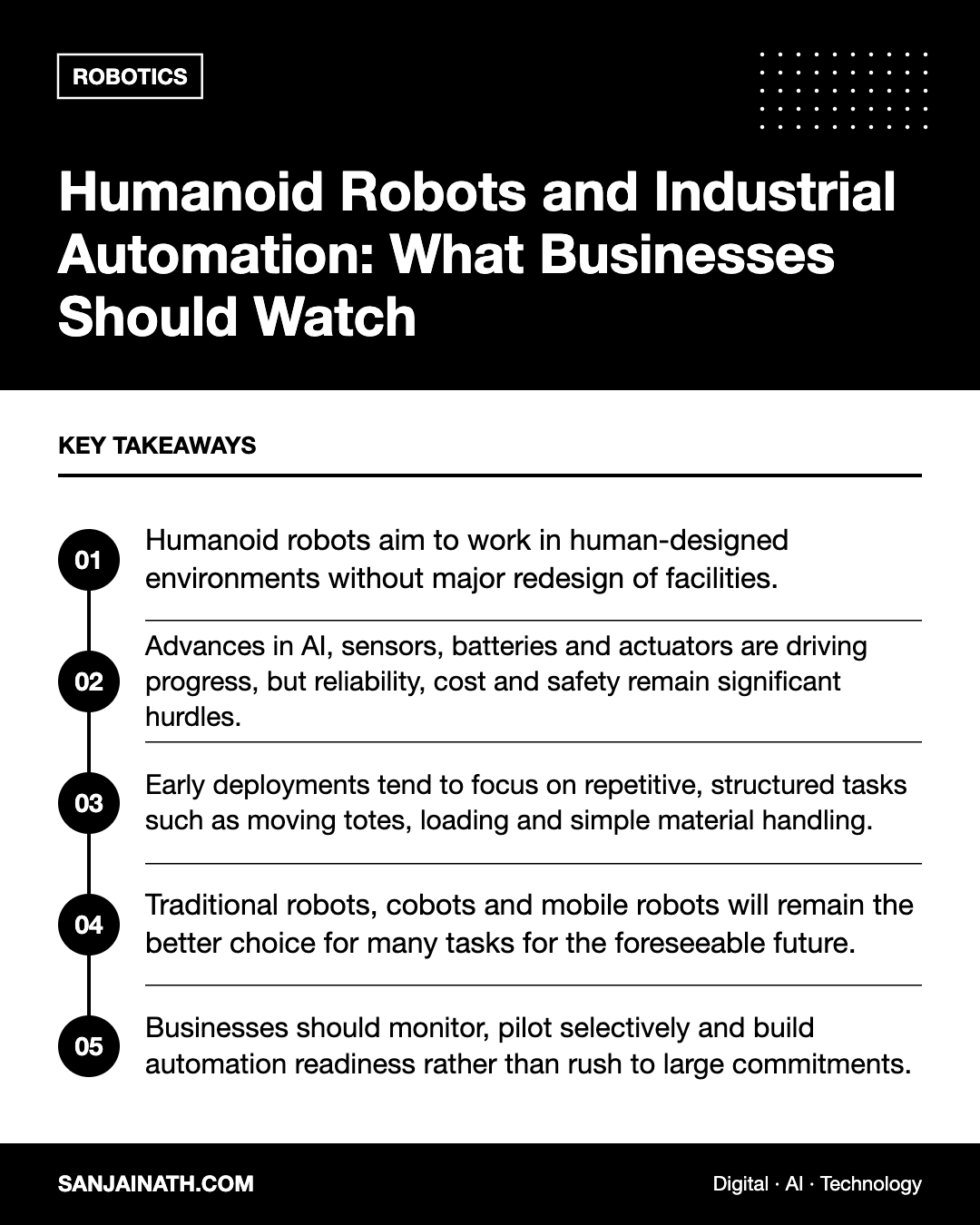
Key takeaways
- Humanoid robots aim to work in human-designed environments without major redesign of facilities.
- Advances in AI, sensors, batteries and actuators are driving progress, but reliability, cost and safety remain significant hurdles.
- Early deployments tend to focus on repetitive, structured tasks such as moving totes, loading and simple material handling.
- Traditional robots, cobots and mobile robots will remain the better choice for many tasks for the foreseeable future.
- Businesses should monitor, pilot selectively and build automation readiness rather than rush to large commitments.
What makes humanoid robots different
Most industrial robots are specialised. A welding robot welds; an autonomous mobile robot moves goods along mapped routes. They are extremely efficient in the roles they were designed for, but they usually require the environment to be adapted around them, with guarding, fixtures, conveyors or dedicated lanes.
Humanoid robots take the opposite approach. With two arms, hands, a torso and often legs, they are designed to move through doorways, climb steps, reach shelves and use tools built for people. The promise is flexibility: a single platform that could, in principle, be redeployed to many tasks through software rather than new hardware.
The technologies behind the progress
- AI and robot learning: techniques that allow robots to learn tasks from demonstrations, simulation and large datasets rather than being programmed step by step.
- Perception: cameras, depth sensors and tactile sensing that let robots recognise objects and handle them with appropriate force.
- Actuators and hands: more compact, powerful and precise motors, alongside increasingly dexterous grippers.
- Batteries and power management: enabling longer operating periods between charges.
- Simulation: virtual environments where robots can practise tasks safely and at scale before real-world deployment.
Where humanoid robots may fit first
Early commercial pilots have generally centred on tasks that are repetitive, physically demanding and relatively structured, where occasional slowness is acceptable and the environment is controlled. Likely early applications include:
- Warehouse and logistics: moving totes, picking from shelves, loading and unloading.
- Manufacturing support: transferring parts between stations, kitting and machine tending.
- Retail back-of-house: restocking and moving inventory outside customer hours.
- Inspection and hazardous environments: tasks in hot, dusty or dangerous settings where reducing human exposure is valuable.
Customer-facing roles in hospitality, healthcare and homes attract attention, but they involve less predictable environments and higher safety expectations, so they are likely to take longer to mature.
Humanoid robots versus other automation options
| Option | Strengths | Limitations |
|---|---|---|
| Industrial robot arms | Very fast, precise and reliable for fixed tasks | Need guarding and fixed layouts; costly to reconfigure |
| Collaborative robots (cobots) | Safe to work near people, easier to redeploy | Lower payloads and speeds; usually stationary |
| Autonomous mobile robots | Proven for moving goods around facilities | Limited manipulation; rely on accessible floor space |
| Humanoid robots | Potentially flexible across many tasks in human spaces | Early-stage maturity, higher uncertainty on cost, speed and reliability |
For many businesses, the smartest automation today is still a combination of proven technologies. Humanoids become compelling where tasks vary, environments cannot easily be changed and labour is scarce or the work is unsafe.
Challenges businesses should watch
Reliability and productivity
Demonstration videos show what is possible, not necessarily what is dependable over thousands of hours. Key questions include how often the robot needs human intervention, how fast it completes tasks compared with people and how well it copes with unexpected situations.
Total cost of ownership
Beyond the purchase or lease price, consider integration, maintenance, software subscriptions, charging infrastructure, spare parts, training and downtime. Some vendors are exploring robots-as-a-service models, which shift costs to operating budgets but still need careful evaluation.
Safety and standards
Humanoid robots are mobile, powerful and may work near people, which raises complex safety questions, including what happens if a robot falls. Safety standards and regulations for this category are still developing, so involve health and safety specialists early.
Cybersecurity and data
Connected robots are computers with cameras, microphones and physical capabilities. They need secure update processes, network segmentation and clear policies on the data they collect.
Workforce impact
Automation changes jobs. Involving employees early, explaining goals, and offering reskilling for roles such as robot supervision and maintenance improves adoption and trust.
What this means for the GCC
Gulf economies, including the UAE and Saudi Arabia, have placed strong emphasis on advanced technology, smart logistics and industrial diversification. Large logistics hubs, new industrial zones and extreme summer heat, which makes some outdoor and warehouse work physically demanding, create conditions where automation, including humanoid robots in the longer term, could be attractive. Businesses in the region should keep an eye on government innovation programmes, free-zone pilot opportunities and local system integrators building robotics capability.
How to prepare: a practical checklist
- Map candidate tasks. Identify repetitive, physically demanding or hazardous work, and note how variable each task is.
- Start with proven automation. Address clear opportunities with existing robots, conveyors or software before betting on emerging platforms.
- Improve process data. Document workflows, cycle times and exceptions; any robot deployment depends on this understanding.
- Engage vendors critically. Ask for unedited demonstrations, reference sites, uptime data and clear support commitments.
- Run tightly scoped pilots. Define success metrics, safety requirements and an exit plan before starting.
- Build skills. Develop internal capability in robotics, maintenance and data so you are ready as the technology matures.
Frequently asked questions
Are humanoid robots ready for widespread use?
Not yet for most businesses. They are moving from research into early commercial pilots, but reliability, speed, cost and safety still need to improve before broad adoption.
Why build robots in human form?
Most workplaces, tools and equipment are designed for people. A human-shaped robot can, in theory, operate in those spaces without costly redesign, and could switch between different tasks through software updates.
Will humanoid robots replace human workers?
They are more likely to take on specific tasks, particularly dull, dirty or dangerous ones, than to replace entire roles in the near term. New jobs in supervision, maintenance and integration are also likely to emerge.
Should my business invest in humanoid robots now?
For most organisations, the right move is to monitor developments, prepare processes and data, and consider small pilots where there is a clear use case, rather than making large early commitments.
Final thoughts
Humanoid robots represent one of the most ambitious frontiers in automation, combining AI, advanced hardware and the promise of general-purpose flexibility. The technology is advancing, but it is still early. Business leaders who understand the trade-offs, strengthen their automation foundations and run disciplined pilots will be best positioned to benefit as humanoid robots move from striking demonstrations to dependable tools on the factory and warehouse floor.