

Many organisations have experimented with artificial intelligence, yet far fewer have turned those experiments into lasting business value. The difference is rarely the technology itself; it is usually the absence of a clear plan that links AI to strategy, people, data and governance. An AI adoption roadmap provides that plan, setting out where AI will help, in what order, with what safeguards and how success will be measured.
Key takeaways
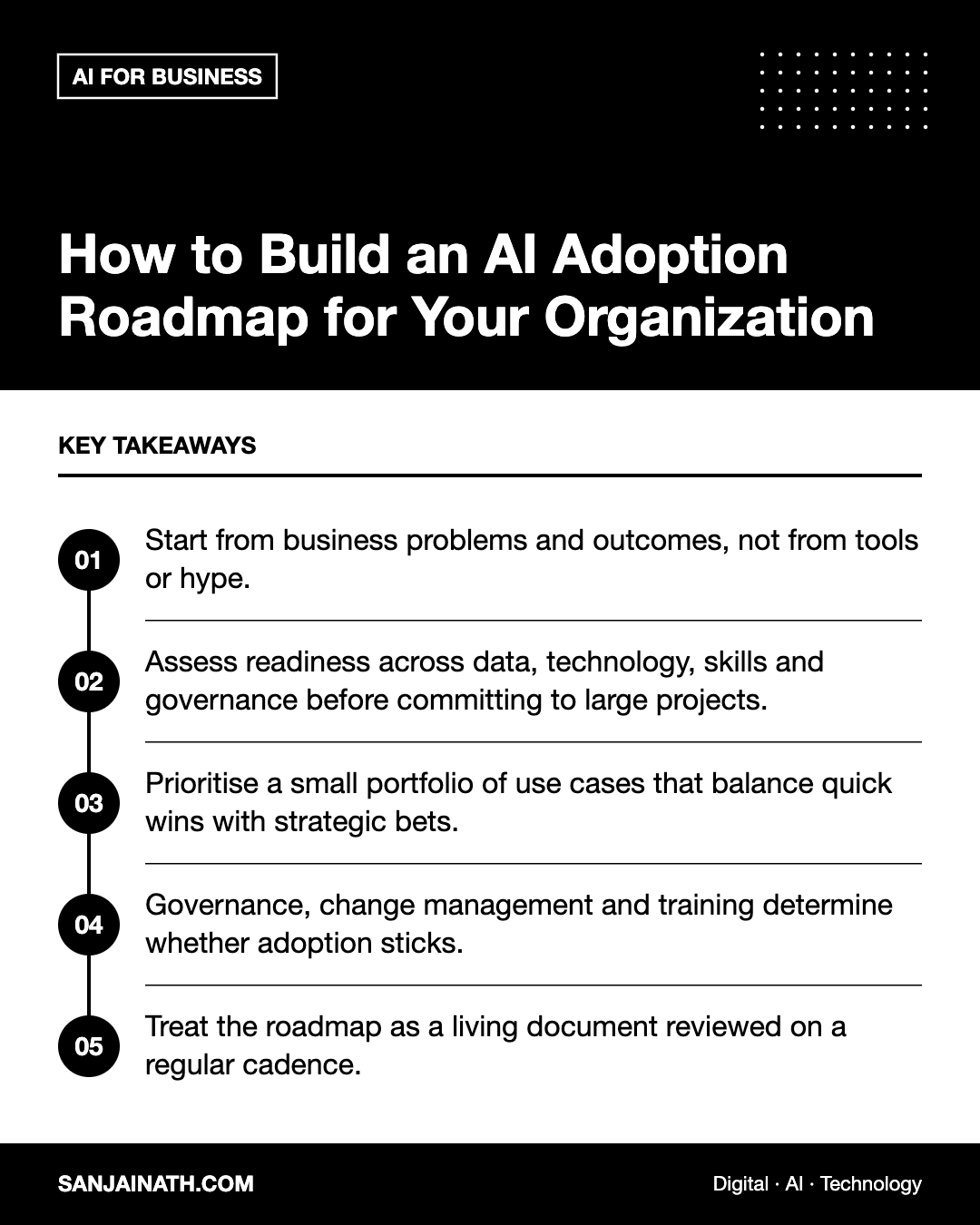
- Start from business problems and outcomes, not from tools or hype.
- Assess readiness across data, technology, skills and governance before committing to large projects.
- Prioritise a small portfolio of use cases that balance quick wins with strategic bets.
- Governance, change management and training determine whether adoption sticks.
- Treat the roadmap as a living document reviewed on a regular cadence.
Why you need an AI adoption roadmap
Without a roadmap, AI adoption tends to happen in one of two unhelpful ways. Either it stalls in endless pilots that never scale, or it spreads chaotically as individual teams sign up for tools without oversight, creating security, compliance and cost risks. A structured roadmap helps leaders make deliberate choices, align investment with priorities and communicate a clear direction to employees who may be excited, sceptical or anxious about what AI means for their roles.
Phase 1: Define your ambition and objectives
Begin with a conversation among senior leaders about what the organisation wants AI to achieve. Typical ambitions include improving productivity, enhancing customer experience, reducing operational costs, accelerating decision-making or creating new products and services.
Questions to answer
- Which strategic goals over the next few years could AI genuinely accelerate?
- Where are the biggest bottlenecks, delays or sources of error today?
- What is our appetite for risk, and where are the red lines?
- How will we know, in measurable terms, that AI adoption is working?
For organisations in the UAE and wider GCC, national AI strategies and digital transformation agendas may also shape expectations, particularly for government-linked entities and regulated sectors.
Phase 2: Assess readiness
A readiness assessment shows where you are starting from and what must be in place before AI can deliver. Assess four dimensions honestly.
| Dimension | What to assess | Warning signs |
|---|---|---|
| Data | Quality, accessibility, ownership and documentation of key data | Critical data locked in spreadsheets or inconsistent across systems |
| Technology | Cloud infrastructure, integration capability, security tooling | Legacy systems with no APIs, weak identity controls |
| People and skills | AI literacy, technical talent, leadership understanding | No internal champions, fear or confusion about AI |
| Governance | Policies, risk management, legal and compliance processes | No policy on AI use, unclear data protection responsibilities |
Gaps are normal. The point is to identify them early so the roadmap includes the foundational work, such as data clean-up or policy development, alongside the more visible use cases.
Phase 3: Identify and prioritise use cases
Run workshops with each business function to gather potential use cases. Encourage people to describe problems rather than solutions: “our team spends hours summarising supplier contracts” is more useful than “we want a chatbot”.
Score each use case
Evaluate ideas against consistent criteria, for example:
- Business value: impact on revenue, cost, risk or customer experience.
- Feasibility: availability of data, technical complexity and integration effort.
- Risk: potential for harm, regulatory exposure and reputational sensitivity.
- Time to value: how quickly benefits could be realised.
Plot the results on a simple value-versus-feasibility grid. High-value, high-feasibility ideas become early priorities. High-value but harder ideas become strategic projects for later phases. Low-value ideas are parked.
Build a balanced portfolio
Aim for a mix: a few quick wins, such as using approved generative AI assistants for drafting and summarising, alongside one or two deeper initiatives, such as intelligent document processing or demand forecasting. Quick wins build confidence and momentum; strategic projects deliver lasting differentiation.
Phase 4: Establish governance and guardrails
Governance should enable safe adoption rather than block it. The essentials include:
- An AI acceptable use policy covering approved tools, prohibited data and requirements for human review.
- A risk assessment process for new use cases, scaled to their potential impact.
- Clear accountability, such as an AI steering group with representatives from business, technology, legal, risk and HR.
- Data protection and security controls aligned with applicable laws in every market you operate in.
- Vendor due diligence covering data handling, model transparency and contractual protections.
Phase 5: Pilot, measure and scale
Pilots should be designed to answer a specific question: does this use case deliver the expected value under real conditions? Define success metrics and a baseline before the pilot starts, choose a representative group of users and set a fixed time frame.
From pilot to production
- Review results against the baseline and gather qualitative feedback from users.
- Decide explicitly whether to scale, adjust or stop. Stopping a pilot that does not work is a valid and valuable outcome.
- For scaled solutions, plan integration, support, monitoring, cost management and ongoing model or prompt maintenance.
Phase 6: Invest in people and change management
Technology adoption is ultimately people adoption. Communicate openly about why the organisation is investing in AI, how roles may evolve and what support is available. Offer tiered training: general AI literacy for everyone, practical tool training for specific teams, and deeper technical upskilling for those building or managing solutions.
Identify AI champions in each department who can share tips, collect feedback and help colleagues. Celebrate practical successes and be honest about lessons learned.
A sample AI adoption roadmap timeline
- First quarter: leadership alignment, readiness assessment, AI usage policy and approved tool list.
- Second quarter: use case prioritisation, two or three pilots, foundational data work and AI literacy training.
- Second half of the year: scale successful pilots, launch one strategic initiative and formalise governance processes.
- Ongoing: quarterly roadmap reviews, new use case intake, and continuous training.
Frequently asked questions
What is an AI adoption roadmap?
An AI adoption roadmap is a structured plan that sets out how an organisation will introduce and scale artificial intelligence, including objectives, priority use cases, readiness work, governance, training and success metrics.
Who should own the AI roadmap?
Ownership usually sits with a senior executive sponsor supported by a cross-functional steering group. Technology teams are essential, but business leaders must own the outcomes.
How long should the roadmap cover?
A detailed plan for the next twelve months with a broader view of two to three years works well. The technology changes quickly, so review and update the roadmap at least quarterly.
Do small businesses need an AI adoption roadmap?
Yes, although it can be much lighter. Even a one-page plan listing goals, approved tools, a few use cases and basic rules on data use will help a small business adopt AI safely and effectively.
Final thoughts
A well-crafted AI adoption roadmap turns scattered experimentation into focused progress. Anchor it in business outcomes, be honest about readiness, prioritise use cases rigorously, put sensible guardrails in place and invest in your people. Revisit it regularly as you learn. Organisations that approach AI this way are far more likely to move beyond pilots and capture real, sustainable value.