

For years, digital marketing leaned heavily on third-party cookies and data bought from outside sources to target and measure audiences. Browser restrictions, platform privacy changes and stricter regulation have steadily eroded that approach. A first-party data strategy — collecting, organising and activating data your customers share directly with you — is now the most resilient foundation for targeting, personalisation and measurement.
Key takeaways
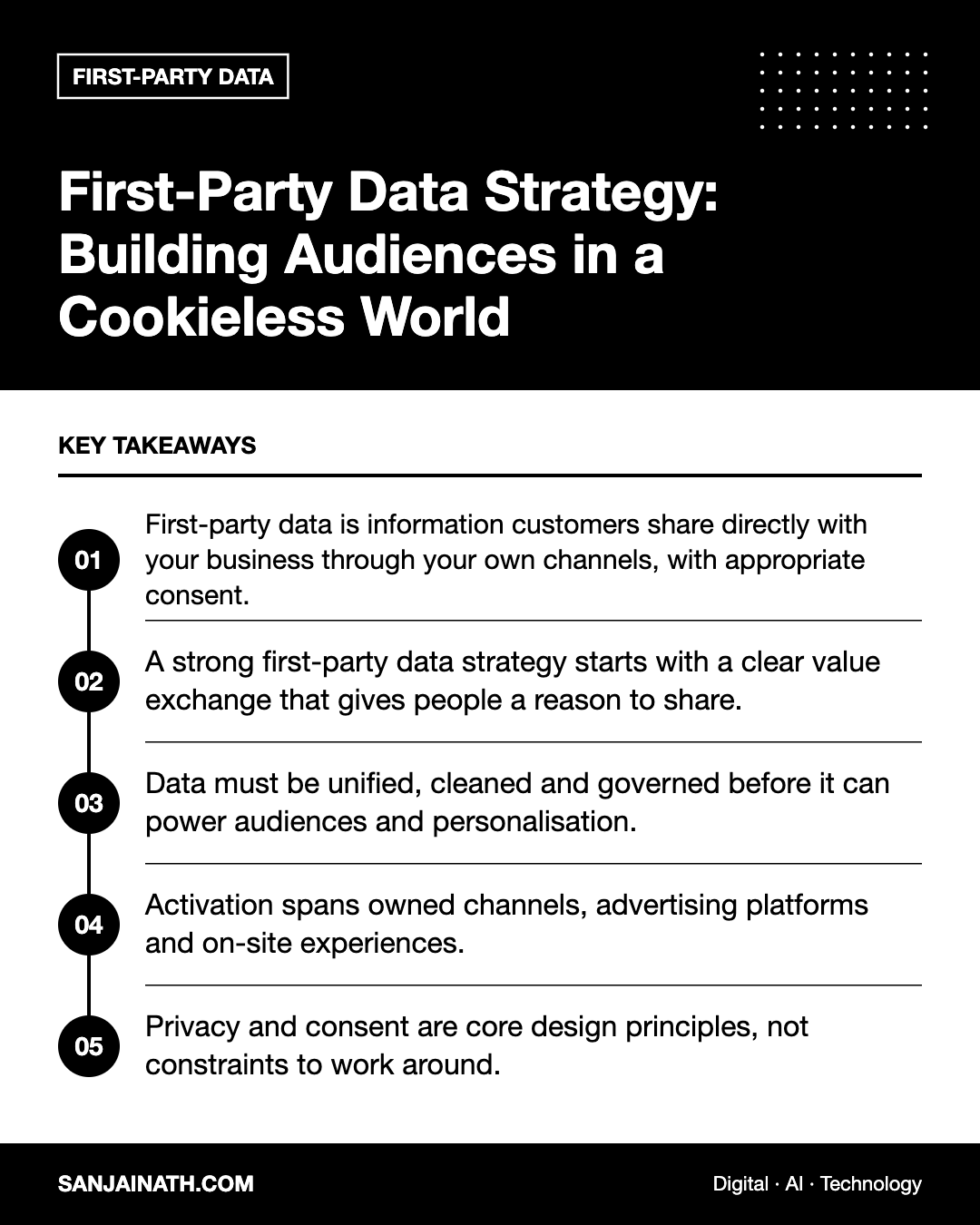
- First-party data is information customers share directly with your business through your own channels, with appropriate consent.
- A strong first-party data strategy starts with a clear value exchange that gives people a reason to share.
- Data must be unified, cleaned and governed before it can power audiences and personalisation.
- Activation spans owned channels, advertising platforms and on-site experiences.
- Privacy and consent are core design principles, not constraints to work around.
Understanding the types of data
| Type | Definition | Examples |
|---|---|---|
| Zero-party data | Information customers intentionally and proactively share | Preferences in a quiz, stated interests, communication choices |
| First-party data | Data collected directly from interactions with your channels | Purchases, website behaviour, email engagement, CRM records |
| Second-party data | Another organisation’s first-party data shared through a partnership | Co-marketing audiences with a trusted partner |
| Third-party data | Data aggregated by providers without a direct customer relationship | Purchased audience segments, cross-site cookie profiles |
First- and zero-party data are the most valuable because they are relevant, accurate and collected in a way customers understand.
Why the cookieless shift matters
Several major browsers already block third-party cookies by default, and mobile operating systems require apps to ask permission before tracking users across other companies’ apps and websites. Google’s plans for third-party cookies in Chrome have changed more than once, so rather than betting on any single timeline, treat reduced cross-site tracking as the long-term direction.
The practical effects for marketers include:
- Less precise retargeting and audience targeting built on cross-site tracking.
- Gaps in attribution and conversion measurement.
- Greater reliance on platforms’ own modelled data.
- Increased regulatory expectations around consent and transparency, including in the UAE, Saudi Arabia, the UK and the EU.
Building your first-party data strategy
Step 1: Define business goals and use cases
Start by deciding what the data is for. Typical use cases include:
- Building lookalike or similar audiences for acquisition.
- Personalising website and email content.
- Improving advertising measurement through conversion uploads.
- Reducing churn by identifying at-risk customers.
- Increasing repeat purchases through lifecycle marketing.
Prioritise two or three use cases with clear business value. They will determine what data you need to collect.
Step 2: Design a compelling value exchange
People share information when they get something worthwhile in return. Effective value exchanges include:
- Useful content: guides, reports, calculators and templates.
- Personalised experiences: product finders, style quizzes or property matching based on budget and preferences.
- Loyalty and membership: points, exclusive offers, early access and member pricing.
- Service convenience: accounts that save preferences, order history and appointments.
- Community and events: webinars, workshops and exclusive launches.
Step 3: Collect data with consent and progressive profiling
Ask for a small amount of information at each interaction rather than long forms up front. An email address and one preference question might be enough initially; further details can be requested as the relationship develops. Record consent clearly for each purpose — analytics, email marketing, advertising — and make preferences easy to change.
Step 4: Unify and clean your data
First-party data often sits in silos: website analytics, CRM, e-commerce platform, email tool, point-of-sale system, customer service software and mobile app. To use it effectively:
- Audit your sources and map what each one holds.
- Choose a central system — a CRM, customer data platform (CDP) or data warehouse — depending on scale and technical resources.
- Standardise identifiers such as email, phone number and customer ID.
- Deduplicate and validate records regularly.
- Define a shared data dictionary so teams agree on terms like “active customer” or “qualified lead”.
Step 5: Segment and build audiences
With unified data, create segments based on behaviour and value rather than demographics alone. Useful segments include recent purchasers, high-lifetime-value customers, lapsed customers, engaged non-buyers, and people interested in specific product categories or locations.
Activating first-party data
Owned channels
Email, SMS, WhatsApp and in-app messaging are the most direct activation channels. Use segments and triggers to send relevant messages, such as welcome series, abandoned basket reminders, replenishment prompts and win-back campaigns.
Paid media
Major advertising platforms let you upload hashed customer lists for targeting, exclusion and lookalike audiences, and send offline or server-side conversions to improve measurement and optimisation. Always ensure your consent covers these uses and follow each platform’s policies.
On-site personalisation
Tailor homepage content, product recommendations and calls to action based on known preferences or behaviour — for instance, showing a returning visitor the category they browsed last time.
Data clean rooms and partnerships
Larger organisations increasingly use data clean rooms to match and analyse data with partners or media platforms without exchanging raw personal data. These can support measurement and audience insights while preserving privacy, though they require technical expertise and clear agreements.
Governance and privacy by design
A first-party data strategy is only as strong as the trust behind it. Build governance into every stage:
- Collect only what you need for defined purposes.
- Be transparent in privacy notices and at the point of collection.
- Secure data with access controls, encryption and vendor due diligence.
- Set retention periods and delete data you no longer need.
- Respect data subject rights, such as access, correction and deletion requests.
- Check cross-border transfer rules, which may apply when using global cloud platforms from the GCC.
Measuring success
Track metrics that show both the health of your data and its business impact:
- Data growth: number of known, consented contacts and profile completeness.
- Data quality: duplicate rates and match rates on advertising platforms.
- Engagement: open, click and response rates by segment.
- Commercial impact: conversion rates, customer lifetime value, repeat purchase rate and acquisition cost for audiences built from first-party data.
Common pitfalls to avoid
- Collecting data without a use case. Large databases that nobody activates add cost and privacy risk without adding value.
- Buying technology first. A customer data platform cannot fix unclear goals, poor data quality or missing consent records.
- Over-personalising. Messages that reveal too much about what you know can feel intrusive. Personalise to be helpful, not to show off.
- Letting data decay. Contact details and preferences change. Build regular re-permission and preference-update moments into your lifecycle programme.
- Working in silos. Marketing, sales, customer service and IT all touch customer data, so agree shared ownership, definitions and processes from the start.
Frequently asked questions
What is a first-party data strategy?
It is a plan for collecting, unifying, governing and activating data customers share directly with your business, to improve marketing and customer experience in a privacy-conscious way.
Do I need a customer data platform?
Not always. Smaller businesses can start with a well-organised CRM and email platform. A CDP becomes useful when you have many data sources and complex activation needs.
Is first-party data enough without third-party cookies?
For most businesses it is the core foundation, supported by contextual advertising, platform modelling and marketing mix modelling for broader measurement.
How can B2B companies build first-party data?
Through gated content, webinars, events, product trials, account portals and newsletters, combined with CRM data from sales interactions.
Final thoughts
A first-party data strategy is ultimately a relationship strategy. Give customers real value, ask for information transparently, organise it well and use it to make their experience better. Brands that earn and respect customer data will be best placed to grow, whatever changes come next in the cookieless world.