

Customers meet your brand in dozens of places online: search results, social feeds, marketplaces, email inboxes, review sites and your own website. Digital branding is the discipline of making sure every one of those encounters feels unmistakably like you, so that recognition and trust build with each interaction instead of resetting. This guide explains the building blocks of a consistent online identity and how to keep it intact as your team and channels grow.
Key takeaways
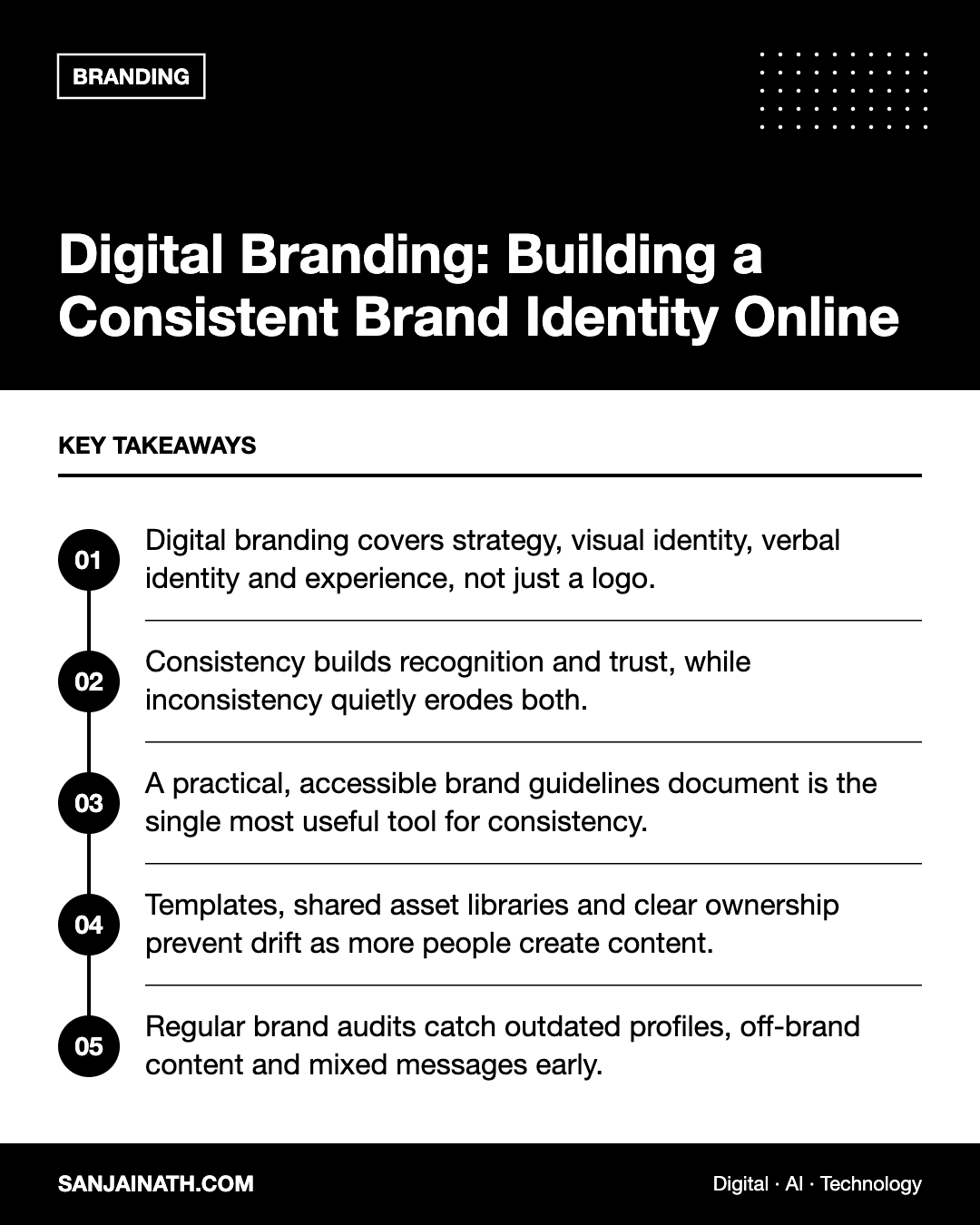
- Digital branding covers strategy, visual identity, verbal identity and experience, not just a logo.
- Consistency builds recognition and trust, while inconsistency quietly erodes both.
- A practical, accessible brand guidelines document is the single most useful tool for consistency.
- Templates, shared asset libraries and clear ownership prevent drift as more people create content.
- Regular brand audits catch outdated profiles, off-brand content and mixed messages early.
What is digital branding?
Digital branding is how a business expresses and manages its identity across digital channels. It includes what people see, such as colours, typography and imagery; what they read, such as tone of voice and messaging; and what they experience, such as how easy your website is to use or how quickly you reply to a message.
A brand is ultimately the perception people hold about a business. You cannot fully control that perception, but you can shape it by being clear, consistent and credible everywhere customers find you.
Why consistency matters
- Recognition: repeated exposure to the same visual and verbal cues helps people remember you.
- Trust: a coherent presence signals professionalism and reliability.
- Efficiency: clear rules make content faster to produce and approve.
- Differentiation: a distinctive, consistent identity stands out in crowded feeds.
Start with brand strategy
Visual design without strategy produces a nice-looking brand that says nothing in particular. Before refining logos or colours, agree on the foundations.
- Purpose: why the business exists beyond making money.
- Audience: who you serve, what they care about and where they spend time online.
- Positioning: what makes you different and why that matters to your audience.
- Personality: three to five traits that describe how the brand behaves, such as confident, warm or precise.
- Key messages: the core ideas you want people to associate with you.
These foundations become the filter for every creative decision. If a campaign idea does not fit the positioning or personality, it probably does not belong.
Build a flexible visual identity
Your visual identity must work on a large desktop screen, a tiny app icon, a dark-mode inbox and a vertical video. Designing for flexibility from the start prevents awkward compromises later.
Core visual elements
| Element | What to define | Digital consideration |
|---|---|---|
| Logo | Primary, secondary and icon versions, clear space, minimum sizes | Legible as a small social avatar and favicon |
| Colour palette | Primary, secondary and neutral colours with digital colour codes | Sufficient contrast for accessibility, light and dark backgrounds |
| Typography | Headline and body typefaces, sizes and hierarchy | Web-friendly fonts and fallbacks, support for other scripts such as Arabic |
| Imagery | Photography style, illustration, iconography | Crop rules for square, vertical and wide formats |
| Motion | Animation style, transitions, logo animation | Short, subtle movement suited to video and interfaces |
For brands operating in the UAE and GCC, bilingual design deserves early attention. Choose an Arabic typeface that pairs well with your Latin font, and plan layouts that work in both left-to-right and right-to-left directions.
Define a clear verbal identity
Words carry a brand as much as visuals. A consistent tone of voice makes a website, a social caption and a customer service reply feel as if they come from the same organisation.
What to include in voice guidelines
- Voice traits with a short explanation of what each means and does not mean, for example “friendly, not over-familiar”.
- Tone shifts for different situations, such as celebratory announcements versus apologies.
- Vocabulary: preferred terms, words to avoid and how to describe your products.
- Grammar and style: spelling conventions, capitalisation, date formats and punctuation.
- Examples of good and weak copy side by side.
Apply your brand across every digital touchpoint
Consistent digital branding means auditing and aligning each channel so they reinforce one another rather than competing.
A touchpoint checklist
- Website: design system, page templates, forms, error messages and cookie banners.
- Social media: handles, profile images, bios, highlight covers, post templates and captions.
- Email: sender name, templates, signatures and automated messages.
- Search and maps: business profiles, descriptions, photos and opening hours.
- Marketplaces and directories: listings, product images and descriptions.
- Advertising: ad creatives, landing pages and video intros.
- Customer service: chat widgets, help centre articles and reply templates.
Small details matter. Mismatched profile pictures, old taglines or inconsistent business names across platforms can confuse customers and even weaken local search visibility.
Create systems that keep the brand consistent
As more people create content, brands drift unless there are systems to keep them aligned.
- Write practical brand guidelines: short, visual and easy to search, with do and do not examples.
- Build templates: social posts, presentations, email layouts and ad formats with locked brand elements.
- Centralise assets: one shared library for logos, fonts, images and approved copy, with outdated files removed.
- Assign ownership: a named person or team who approves new applications and answers brand questions.
- Brief partners: give agencies, freelancers and creators a concise brand pack before they start.
- Train the team: short onboarding sessions help everyone understand not just the rules but the reasons behind them.
Measure and audit your digital branding
Brand strength is harder to measure than clicks, but useful indicators exist. Track branded search interest, direct traffic, social mentions and sentiment, review themes and survey-based awareness or recall where budgets allow.
Run a brand audit at least once a year, or whenever you launch a new product or market. Review every channel against your guidelines, list inconsistencies, prioritise fixes and update the guidelines where real-world use has revealed gaps.
Frequently asked questions
What is the difference between branding and digital branding?
Branding covers every expression of a business’s identity, online and offline. Digital branding focuses on how that identity is expressed and experienced across websites, social platforms, search, email and other digital channels.
How long does it take to build a strong digital brand?
It depends on your market, budget and consistency. Recognition grows through repeated, consistent exposure over time, so think in terms of years rather than weeks, while quick wins such as aligning profiles can be done immediately.
Do small businesses need brand guidelines?
Yes. Even a two-page guide covering logo use, colours, fonts and tone of voice helps small teams and freelancers produce consistent work and saves time on revisions.
How often should a brand be refreshed?
There is no fixed schedule. Refresh when the business strategy changes, the identity no longer works on modern channels, or research shows it is not resonating. Evolution is usually safer than a complete rebrand.
Final thoughts
Strong digital branding is less about a single brilliant design and more about disciplined consistency. Ground your identity in a clear strategy, design it to flex across channels, document it in practical guidelines and support it with templates and ownership. Do that, and every post, page and message will steadily build the recognition and trust your business deserves.