

Customers rarely judge a business on a single interaction. They judge the whole journey, from the first search and website visit to onboarding, support and renewal. A clear customer experience strategy gives you a structured way to understand those journeys, find the moments that matter most and improve them in a measurable way. This guide sets out a practical framework for mapping and improving digital journeys, whatever the size of your organisation.
Key takeaways
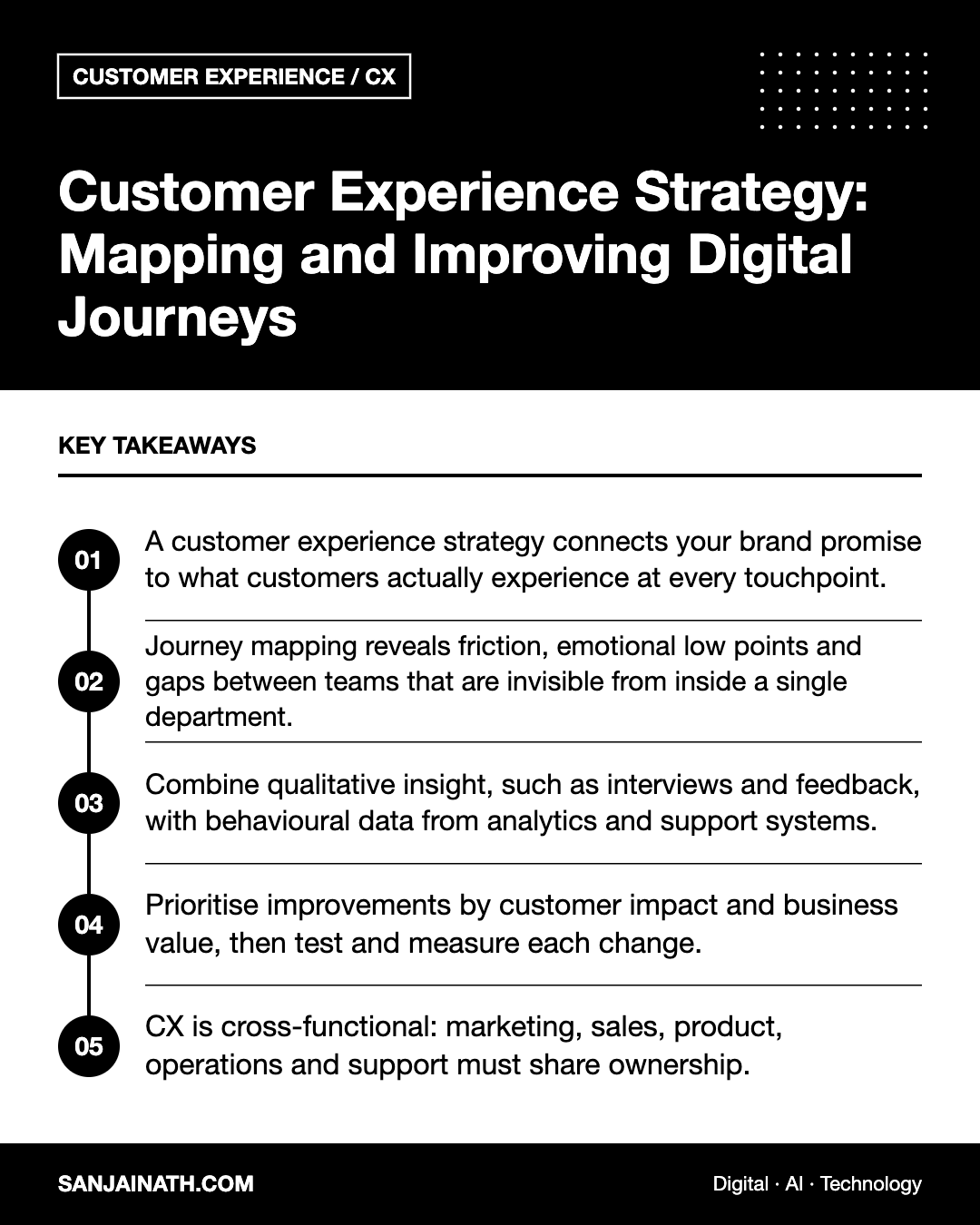
- A customer experience strategy connects your brand promise to what customers actually experience at every touchpoint.
- Journey mapping reveals friction, emotional low points and gaps between teams that are invisible from inside a single department.
- Combine qualitative insight, such as interviews and feedback, with behavioural data from analytics and support systems.
- Prioritise improvements by customer impact and business value, then test and measure each change.
- CX is cross-functional: marketing, sales, product, operations and support must share ownership.
What is a customer experience strategy?
Customer experience, often shortened to CX, is the sum of every perception a customer forms while dealing with your business. A CX strategy is the plan that defines what experience you want to deliver, for whom, and how you will design, deliver and measure it.
A good strategy answers four questions:
- Who are our key customer segments, and what do they need to achieve?
- What experience do we promise, for example fast, personal, premium or effortless?
- Where do we currently fall short of that promise?
- How will we close the gaps, and how will we know it is working?
It differs from customer service, which is one part of CX. Service handles problems after they occur; CX strategy aims to design journeys so that fewer problems arise in the first place.
Step 1: Define your customer segments and goals
Journeys vary by customer type. A first-time buyer, a loyal repeat customer and a corporate account each follow different paths and value different things. Start by selecting a small number of priority segments based on revenue, growth potential or strategic importance.
For each segment, describe:
- The job they are trying to get done.
- Their main motivations and concerns.
- The channels and devices they prefer.
- Language, cultural or accessibility needs. In the UAE and GCC, for example, bilingual Arabic and English journeys and mobile-first behaviour are often essential.
Base these profiles on research and data, not assumptions made in a meeting room.
Step 2: Map the current customer journey
A customer journey map is a visual representation of the steps a customer takes to achieve a goal, along with what they do, think and feel at each step.
Typical journey stages
- Awareness: discovering the brand through search, social, referrals or advertising.
- Consideration: researching options, comparing prices and reading reviews.
- Purchase or sign-up: checkout, contracts, account creation and payment.
- Onboarding: first use, setup and early value.
- Ongoing use and support: everyday interactions, help requests and account changes.
- Loyalty and advocacy: renewal, repeat purchase, referrals and reviews.
What to capture at each stage
| Layer | Questions to answer |
|---|---|
| Actions | What is the customer doing? |
| Touchpoints | Which channels, pages, messages or people are involved? |
| Thoughts and questions | What are they trying to find out? |
| Emotions | Are they confident, confused, frustrated or delighted? |
| Pain points | Where do delays, errors or effort occur? |
| Internal owners | Which team is responsible for this step? |
Map what happens today, not what the process document says should happen. Walk through the journey yourself as a customer would, on a mobile phone as well as a desktop.
Step 3: Gather evidence from customers and data
Journey maps are only as good as the evidence behind them. Combine several sources:
- Customer interviews to understand motivations and emotions.
- Surveys such as Customer Satisfaction (CSAT), Net Promoter Score (NPS) and Customer Effort Score (CES), triggered at key moments.
- Web and product analytics to see where people drop off in funnels.
- Session recordings and heatmaps, used in line with privacy rules, to observe behaviour.
- Support tickets, chat logs and call notes to identify recurring problems.
- Reviews and social comments for unfiltered opinions.
- Front-line staff, who often know exactly where customers struggle.
Step 4: Identify moments that matter and prioritise
Not every touchpoint deserves equal attention. Look for moments of truth, where a customer decides whether to continue, trust you or leave. Common examples include the first visit to a pricing page, the checkout, the first login and the first time something goes wrong.
Score each pain point on two dimensions:
- Customer impact: how much does this frustrate or block customers, and how many are affected?
- Business value: how strongly does it affect conversion, retention, cost to serve or reputation?
Then consider effort. Quick wins with high impact and low effort, such as clarifying confusing copy or removing an unnecessary form field, build momentum while larger projects are planned.
Step 5: Design, test and implement improvements
For each priority, design a better future-state journey. Useful principles include:
- Reduce effort: fewer steps, pre-filled information and clear next actions.
- Set expectations: tell customers what will happen, when and what they need.
- Personalise sensibly: use known data to make interactions relevant, without feeling intrusive.
- Connect channels: let customers switch from app to chat to phone without repeating themselves.
- Design for recovery: when things go wrong, respond quickly, apologise and fix the root cause.
Prototype changes and test them with real users before full rollout. Where possible, run A/B tests on digital journeys to confirm the improvement.
Step 6: Measure your customer experience strategy
Choose a balanced set of measures that link experience to results:
- Perception metrics: CSAT, NPS and CES.
- Behavioural metrics: conversion rates, task completion, repeat purchase, churn and retention.
- Operational metrics: first response time, resolution time and contact volume per customer.
- Financial metrics: customer lifetime value, cost to serve and revenue retention.
Report these by journey and segment rather than as a single company-wide number, so teams can see the effect of their changes.
Making CX a shared responsibility
Journeys cross departmental boundaries, so improvements often stall when no one owns the whole experience. Appoint journey owners, hold regular cross-functional reviews, share customer feedback widely and celebrate improvements. Leadership sponsorship is essential, because CX changes often require trade-offs between teams.
Frequently asked questions
How often should we update our journey maps?
Review them at least annually and whenever you launch a significant product, channel or process change. Treat maps as living documents.
What is the difference between CX and UX?
User experience focuses on the usability of a specific product or interface. Customer experience covers every interaction with the brand, including marketing, sales, billing and support.
Do small businesses need a formal CX strategy?
A lightweight version is valuable at any size. Even a simple one-page journey map and a few feedback measures can reveal quick, high-impact improvements.
Which CX metric matters most?
No single metric tells the full story. Pair a perception measure with behavioural and financial metrics tied to the journeys you are improving.
Final thoughts
A strong customer experience strategy turns good intentions into a repeatable discipline: understand your customers, map their real journeys, fix what matters most and measure the results. Start with one priority journey, prove the value and expand from there. Over time, consistently better experiences become one of the hardest advantages for competitors to copy.