

Staring at a blank page is one of the least productive moments in marketing. Copywriting formulas give you a proven structure to start from, so you can spend your energy on insight and wording rather than reinventing the order of a persuasive message every time. Used well, they make landing pages, emails and ads clearer and more convincing; used lazily, they produce formulaic copy that readers skim past.
Key takeaways
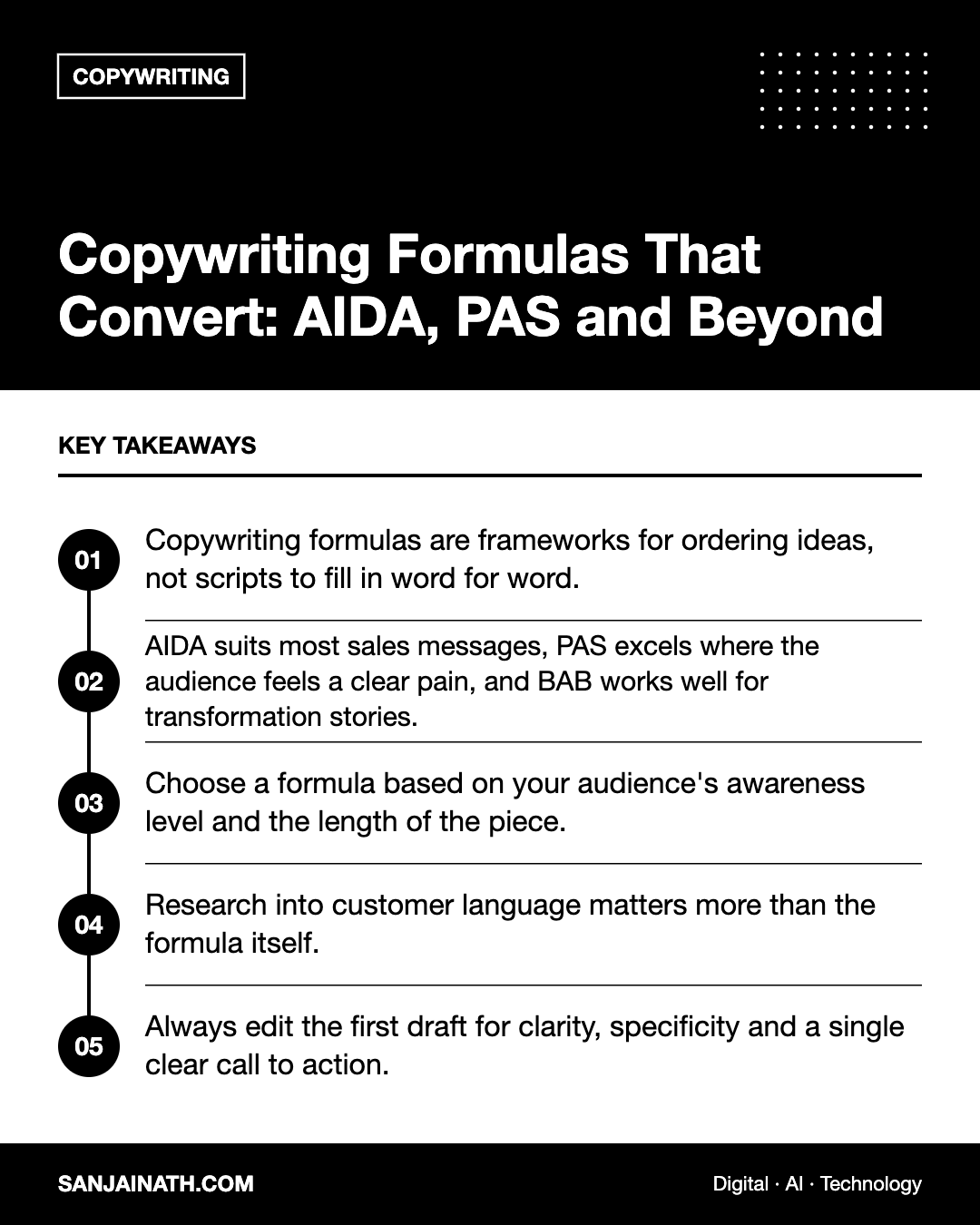
- Copywriting formulas are frameworks for ordering ideas, not scripts to fill in word for word.
- AIDA suits most sales messages, PAS excels where the audience feels a clear pain, and BAB works well for transformation stories.
- Choose a formula based on your audience’s awareness level and the length of the piece.
- Research into customer language matters more than the formula itself.
- Always edit the first draft for clarity, specificity and a single clear call to action.
Why copywriting formulas work
Persuasion tends to follow a predictable psychological path. People need to notice a message, see why it matters to them, believe it and then know exactly what to do next. Copywriting formulas simply encode that path into memorable steps.
The benefits for busy teams
- Speed: a structure turns research notes into a draft much faster.
- Consistency: multiple writers can produce copy that follows the same logic.
- Diagnosis: when copy underperforms, you can check which step is weak.
- Briefing: formulas give designers, clients and stakeholders a shared vocabulary.
AIDA: Attention, Interest, Desire, Action
AIDA is one of the oldest and most widely used frameworks in advertising. It moves the reader from noticing your message to acting on it.
- Attention: a headline or opening that stops the scroll, often by naming the reader or a surprising benefit.
- Interest: relevant details that show you understand the reader’s situation.
- Desire: benefits, proof and outcomes that make the reader want what you offer.
- Action: a specific, low-friction call to action.
Example: a project management tool
Attention: “Your team is busy. Is it productive?” Interest: “Most delays come from unclear owners and scattered updates, not lazy people.” Desire: “See every task, owner and deadline in one place, with automatic reminders so nothing slips.” Action: “Start your free trial and set up your first project in minutes.”
AIDA is versatile enough for landing pages, sales emails, brochures and longer ads.
PAS: Problem, Agitate, Solution
PAS is ideal when your audience already feels a problem. It names the pain, deepens the reader’s awareness of its consequences and then presents your offer as the answer.
- Problem: describe the pain in the reader’s own words.
- Agitate: explore what happens if it continues, such as lost time, money or opportunities.
- Solution: introduce your product or service and how it resolves the issue.
Example: website maintenance service
“Your website hasn’t been updated in months. Every outdated plugin is a potential security gap, and a slow site quietly sends visitors to competitors. Our monthly care plan keeps your site updated, backed up and fast, so you can focus on running the business.”
A word of caution: agitation should be honest and proportionate. Exaggerated fear tactics damage trust and can breach advertising standards.
Other copywriting formulas worth knowing
Beyond AIDA and PAS, several other copywriting formulas are useful for specific situations.
| Formula | Steps | Best for |
|---|---|---|
| BAB | Before, After, Bridge | Transformation stories, case studies, social posts |
| FAB | Features, Advantages, Benefits | Product descriptions and technical offers |
| 4 Ps | Promise, Picture, Proof, Push | Sales pages and launch emails |
| 4 Us | Useful, Urgent, Unique, Ultra-specific | Headlines and subject lines |
| PASTOR | Problem, Amplify, Story, Transformation, Offer, Response | Long-form sales pages and webinars |
| QUEST | Qualify, Understand, Educate, Stimulate, Transition | Considered B2B purchases |
BAB in practice
“Before: spreadsheets everywhere and month-end takes a week. After: real-time reports at the click of a button. Bridge: our accounting integration connects your systems so the numbers update themselves.”
FAB in practice
Feature: “Stainless steel, double-walled bottle.” Advantage: “Keeps drinks cold for hours.” Benefit: “Enjoy iced water even on a summer afternoon in Dubai.”
How to choose the right formula
The best choice depends on how aware your audience is and how much they need to hear before acting.
- Unaware audiences: start with a story or a curiosity-led hook, then educate. BAB or AIDA work well.
- Problem-aware audiences: PAS connects immediately with the pain they already feel.
- Solution-aware audiences: FAB or the 4 Ps help them compare options and see your advantages.
- Product-aware audiences: short copy with proof, an offer and a clear call to action is often enough.
Length matters too. Short social posts suit compact frameworks such as BAB, while high-value purchases may need a longer structure such as PASTOR with detailed proof and objection handling.
A step-by-step process for using formulas well
- Research first: read reviews, support tickets, sales call notes and forum discussions to capture real customer language.
- Define one reader and one goal: who is this for and what single action should they take?
- Pick a formula that matches their awareness level.
- Draft quickly: fill each step with raw ideas without editing.
- Add proof: testimonials, guarantees, demonstrations or credentials that support your claims.
- Edit ruthlessly: remove jargon, shorten sentences and replace vague words with specifics.
- Test: compare headlines, offers or structures and keep what works.
Common mistakes to avoid
- Forcing every step even when it makes the copy longer than it needs to be.
- Writing about the company rather than the customer.
- Using the same formula for every piece until readers recognise the pattern.
- Ending with multiple calls to action that compete for attention.
For bilingual markets such as the GCC, remember that a formula translates but phrasing often does not. Adapt hooks, idioms and tone for Arabic readers rather than translating English copy literally.
Adapting copywriting formulas to different channels
The same framework needs to flex depending on where it appears. A landing page can give every step its own section, while a paid social ad may compress an entire formula into a headline, one line of body copy and a button.
- Email: use the subject line for attention, the opening lines for interest and keep one clear call to action near the top and again at the end.
- Search ads: focus on the problem or benefit that matches the search query, then a specific action.
- Product pages: FAB structures descriptions, while reviews and guarantees supply the proof.
- Video scripts: the first few seconds carry the attention step, so open with the problem or the result rather than a logo.
Frequently asked questions
What is the most effective copywriting formula?
There is no single best option. AIDA is the most versatile, PAS is often strongest for pain-driven offers, and BAB works well for transformation. The right choice depends on your audience, offer and format.
Can copywriting formulas be used for SEO content?
Yes, particularly in introductions, calls to action and landing pages. For long informational articles, use formulas to shape key sections while keeping the main structure focused on answering the reader’s questions clearly.
Do formulas make copy sound generic?
Only if the content inside them is generic. Specific customer insight, concrete details and a distinctive brand voice keep formula-based copy fresh.
Should I combine different formulas?
Often, yes. A PAS email might use a 4 Us subject line, or an AIDA landing page might include a BAB testimonial section.
Final thoughts
Copywriting formulas are scaffolding, not the building. They help you organise persuasive ideas quickly and consistently, but the results come from deep customer understanding, honest proof and careful editing. Learn a handful of frameworks, match them to your audience’s awareness and keep testing, and your copy will become clearer and more effective with every project.