

Most people would rather send a quick message than fill in a long form or wait on hold. Conversational marketing meets them there, using chatbots, AI chat assistants and messaging apps to answer questions, qualify interest and move buyers forward in real time. Done well, it feels like a helpful conversation rather than a sales funnel, and it can turn a passive website visit into a meeting, a booking or a sale.
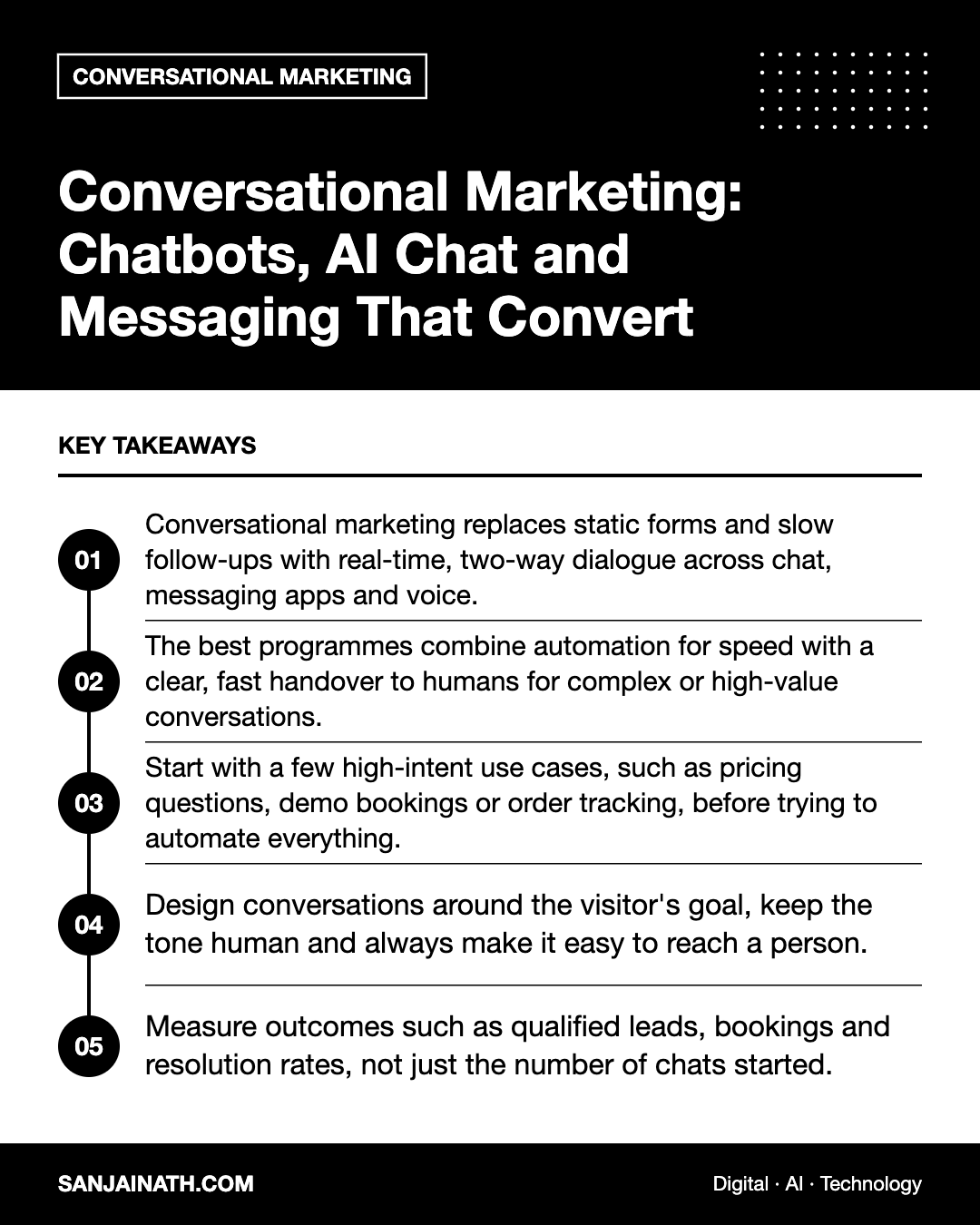
Key takeaways
- Conversational marketing replaces static forms and slow follow-ups with real-time, two-way dialogue across chat, messaging apps and voice.
- The best programmes combine automation for speed with a clear, fast handover to humans for complex or high-value conversations.
- Start with a few high-intent use cases, such as pricing questions, demo bookings or order tracking, before trying to automate everything.
- Design conversations around the visitor’s goal, keep the tone human and always make it easy to reach a person.
- Measure outcomes such as qualified leads, bookings and resolution rates, not just the number of chats started.
What is conversational marketing?
Conversational marketing is an approach that uses real-time, one-to-one conversations to engage prospects and customers. Instead of asking a visitor to download a brochure and wait for a sales call days later, you invite them to ask a question right now and give them a useful answer immediately.
It typically runs across several channels:
- Website live chat and chatbots that greet visitors, answer common questions and route enquiries.
- AI chat assistants trained on your own content, able to handle open-ended questions in natural language.
- Messaging apps such as WhatsApp, Facebook Messenger and Instagram direct messages, which many customers already use daily.
- SMS and in-app messaging for reminders, updates and re-engagement.
In the UAE and wider GCC, WhatsApp in particular is a natural channel for customer conversations, from property enquiries to restaurant bookings, so it deserves a place in most regional strategies.
Why conversational marketing converts
The appeal is simple: it removes friction at the moment a buyer is most interested. Several factors drive better results.
Speed at the point of intent
When someone is reading your pricing page, their interest is at its peak. A prompt answer while they are still on the page is far more valuable than a reply the next morning, by which time they may have contacted a competitor.
Qualification without forms
A well-designed chat flow can ask the same questions a form would, such as company size, budget or timeline, but in a natural sequence. Visitors tend to find a short exchange less daunting than a wall of fields.
Context for sales and support
Every conversation is a record of what the customer asked in their own words. Sales teams arrive at calls better informed, and marketers gain a steady stream of insight into objections, missing content and product questions.
Chatbots, AI chat and human agents: choosing the right mix
Not every conversation should be automated, and not every conversation needs a person. The right mix depends on complexity and value.
| Approach | Best for | Watch out for |
|---|---|---|
| Rule-based chatbot | Predictable flows such as booking, FAQs, order status and lead routing | Rigid menus that frustrate people with unusual questions |
| AI chat assistant | Open-ended questions answered from your knowledge base, product details and policies | Inaccurate answers if content is outdated or guardrails are weak |
| Live human agent | Complex, sensitive or high-value conversations and complaints | Staffing costs and slow replies outside working hours |
Most mature setups are hybrid. Automation handles the first response and routine tasks, while a clear escalation path hands the conversation, with its full history, to a person when needed.
How to build a conversational marketing strategy
Treat conversational marketing as a programme, not a widget you switch on. The following steps give you a practical starting point.
- Pick high-intent pages and moments. Pricing pages, product comparison pages, checkout and contact pages are strong candidates. Avoid pop-ups on every page from the first second.
- Define the goal of each conversation. A chat on the pricing page might aim to book a demo; one on a help page might aim to resolve an issue without a ticket.
- Map the questions people actually ask. Review sales call notes, support tickets and search queries. Build your first flows around the ten or so most common questions.
- Write short, human scripts. Use plain language, one question at a time and buttons for common answers, while still allowing free text.
- Design the handover. Decide which triggers route a chat to a person, such as a large deal size, a complaint or a request to speak to someone, and set expectations about response times.
- Connect your systems. Pass captured details into your CRM, calendar and helpdesk so nothing needs to be re-typed.
- Test, review and refine. Read transcripts every week in the early stages. They reveal where people drop off and which answers need improving.
Writing chat experiences that feel helpful, not pushy
The difference between a chat that converts and one that irritates is usually the writing. A few principles help.
- Lead with value. Open with an offer of help relevant to the page, such as “Comparing plans? I can help you pick the right one”, rather than a generic “Hi there!”.
- Be honest about automation. Make it clear when visitors are talking to a bot, and never pretend a bot is a named human.
- Keep messages short. Two or three short lines per message read better on mobile than long paragraphs.
- Offer a way out. Always include an option to talk to a person, leave a message or return later.
- Respect timing. Delay proactive prompts until a visitor has shown interest, for example after scrolling or spending some time on a page.
Guardrails for AI chat
AI assistants can answer a much wider range of questions, but they need boundaries. Limit them to approved sources, instruct them to say when they do not know, keep pricing and policy answers tied to current documentation, and route legal, medical or financial questions to qualified staff. Review a sample of answers regularly.
Messaging apps, consent and compliance
Messaging channels feel personal, which makes trust essential. Only message people who have opted in, make it easy to unsubscribe and follow each platform’s business policies, which typically restrict the type and timing of promotional messages. Be clear about how you store and use conversation data, and follow the data protection laws that apply to your audience, such as the UAE’s federal data protection law or GDPR for European customers. When in doubt, take specialist legal advice.
Measuring conversational marketing performance
Volume of chats is a vanity metric on its own. Focus on measures that connect to business outcomes.
- Engagement rate: the share of visitors who start a conversation when prompted.
- Qualified leads and meetings booked from chat, tracked through to pipeline in your CRM.
- Containment or resolution rate: how many support queries are resolved without escalation.
- Time to first response and time to resolution when a human is involved.
- Customer satisfaction, captured with a simple rating at the end of a chat.
- Drop-off points within flows, which show where scripts need work.
Compare conversion rates for visitors who chatted against similar visitors who did not, and be careful not to over-credit chat for sales that would have happened anyway.
Frequently asked questions
Is conversational marketing only for large companies?
No. Small businesses often benefit most, because a simple chatbot or a well-managed WhatsApp Business account lets a small team respond quickly without being online all day. Start small and expand as you learn.
Will a chatbot replace my sales or support team?
It should not. The aim is to remove repetitive work and speed up first responses so your team can focus on the conversations where human judgement matters most.
Which channel should I start with?
Start where your customers already are. For many B2B websites that is on-site chat; for consumer brands in the GCC it is often WhatsApp or Instagram. Check your own enquiry data before deciding.
How do I stop an AI chatbot giving wrong answers?
Restrict it to approved, up-to-date content, instruct it to admit uncertainty and hand over to a person, test it with difficult questions before launch and review transcripts regularly.
Final thoughts
Conversational marketing works because it respects how people prefer to buy: quickly, on their terms and with real answers. Begin with a handful of high-intent moments, write conversations that genuinely help, make human support easy to reach and measure what matters. Improve steadily from real transcripts, and chat can become one of your most dependable sources of qualified demand.