

AI marketing has moved well beyond experimentation. Teams now use artificial intelligence to personalise customer experiences, speed up content production and uncover insights hidden in their data. Yet the most successful organisations are not the ones using the most tools; they are the ones applying AI to clearly defined problems. This article explores practical AI marketing use cases across personalisation, content and analytics, and how to adopt them responsibly.
Key takeaways
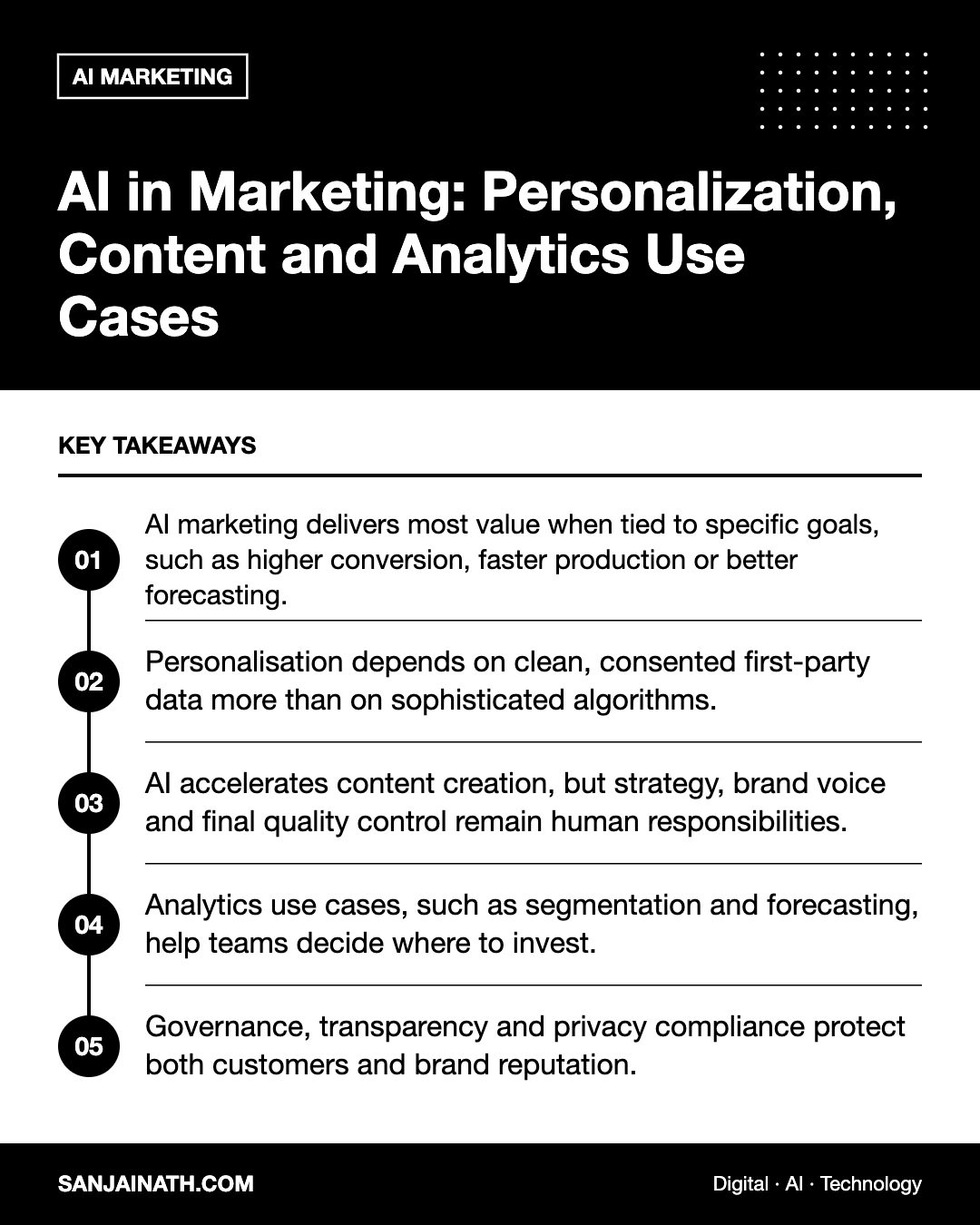
- AI marketing delivers most value when tied to specific goals, such as higher conversion, faster production or better forecasting.
- Personalisation depends on clean, consented first-party data more than on sophisticated algorithms.
- AI accelerates content creation, but strategy, brand voice and final quality control remain human responsibilities.
- Analytics use cases, such as segmentation and forecasting, help teams decide where to invest.
- Governance, transparency and privacy compliance protect both customers and brand reputation.
What AI marketing really means
AI marketing is the use of machine learning, natural language processing and generative AI to plan, execute and measure marketing activity. It includes predictive models that score leads, recommendation engines that suggest products, generative tools that draft copy and analytical systems that detect patterns across channels. Many of these capabilities are now built into mainstream marketing platforms, so adoption often starts with features you already pay for.
Personalisation use cases
Product and content recommendations
Recommendation models analyse browsing and purchase behaviour to suggest relevant products, articles or services. E-commerce sites use them on product pages and in basket reminders, while B2B companies can recommend case studies or guides based on the pages a visitor has viewed.
Dynamic email content
Instead of sending one version of a newsletter, AI can tailor blocks of content, product selections or offers to each segment or individual, based on their interests and history.
Send-time and channel optimisation
Some platforms predict when each subscriber is most likely to engage and which channel they prefer, whether email, SMS, push notifications or messaging apps.
Website personalisation
Headlines, banners and calls to action can adapt based on factors such as industry, location, referral source or returning-visitor status. For GCC businesses, this might include showing Arabic or English content by preference, or highlighting offers relevant to particular emirates or countries.
What personalisation requires
- Clean, unified customer data from your CRM, website and commerce systems.
- Clear consent and privacy notices that explain how data is used.
- A testing framework to confirm personalisation actually improves results.
Content use cases
Ideation and research
AI assistants can generate topic ideas, summarise competitor content, cluster keywords and outline articles. This shortens the planning phase and helps teams spot gaps.
Drafting and adaptation
Generative AI can draft blog posts, ad variations, product descriptions and social captions. It is particularly effective at adapting existing content into new formats, for example turning a webinar transcript into an article, an email and a series of social posts.
Localisation and translation
AI translation has improved significantly, making it easier to produce multilingual campaigns. For Arabic content, however, a native-speaking reviewer remains essential to ensure cultural nuance, tone and accuracy.
Creative testing
Generating multiple headlines, visuals or calls to action lets teams run more A/B tests and learn faster what resonates with each audience.
Keeping content quality high
- Provide detailed briefs, brand guidelines and examples.
- Fact-check every claim, figure and reference.
- Add original insight, experience and examples that only your business can offer.
- Edit for voice and clarity before publishing.
Analytics use cases
Customer segmentation
Clustering algorithms group customers by behaviour and value rather than simple demographics, revealing segments you might not have identified manually.
Predictive lead scoring
Models trained on historical conversions can estimate which leads are most likely to buy, helping sales teams prioritise follow-up.
Churn prediction
For subscription and repeat-purchase businesses, AI can flag customers showing signs of disengagement so you can intervene with retention offers or support.
Marketing mix and attribution insights
Advanced analytics help estimate how different channels contribute to results, supporting better budget allocation, especially as tracking individual users becomes more restricted.
Natural-language reporting
Many analytics platforms now let you ask questions in plain language, such as “Which campaigns drove the most qualified leads last quarter?”, and receive a summary or chart in response.
Choosing where to start
| Goal | Starter use case | Data needed |
|---|---|---|
| Increase conversions | Product or content recommendations | Behavioural and purchase data |
| Produce more content | AI-assisted drafting and repurposing | Brand guidelines, existing content |
| Improve sales efficiency | Predictive lead scoring | CRM history with outcomes |
| Reduce churn | Churn prediction and triggered campaigns | Engagement and transaction history |
| Better decisions | Natural-language reporting | Connected analytics sources |
Responsible AI marketing
- Privacy: comply with applicable data protection laws, including regional frameworks in the UAE and Saudi Arabia, and collect only the data you need.
- Transparency: be honest with customers about automated interactions where appropriate.
- Bias: review models and targeting to avoid unfairly excluding groups.
- Accuracy: never publish AI-generated claims without verification.
- Brand safety: set clear rules for tone, topics and approval workflows.
Building an AI marketing roadmap
Once a first use case proves its value, a simple roadmap helps you expand without losing control. Think in three phases.
Phase 1: Assist
Use AI to support existing work, such as drafting copy, summarising reports and generating ideas. Humans remain responsible for every output. The aim is to build familiarity, define quality standards and identify where time savings are greatest.
Phase 2: Integrate
Connect AI features to your data and workflows: personalised email blocks driven by CRM data, lead scores visible to sales, or automated reports delivered weekly. At this stage, invest in data quality, consent management and clear ownership of each system.
Phase 3: Optimise
Use testing and analytics to refine models, messaging and budget allocation continuously. Review which AI marketing initiatives deliver measurable results and retire those that do not.
Skills your team will need
- Clear briefing and prompt writing for generative tools.
- Basic data literacy to interpret model outputs and test results.
- Strong editing and brand judgement to maintain quality.
- An understanding of privacy obligations when using customer data.
Frequently asked questions
What is the best first step in AI marketing?
Identify one measurable problem, such as slow content production or low email engagement, and test an AI feature within tools you already use. Measure results before expanding.
Will AI replace marketing teams?
AI changes marketing roles rather than removing the need for them. Strategy, creativity, relationships and judgement remain human strengths, while AI handles repetitive and data-heavy tasks.
Do small businesses benefit from AI marketing?
Yes. Many email, social media and website platforms include AI features at no extra cost, giving small teams capabilities that once required specialist staff.
How do I measure the ROI of AI marketing?
Compare key metrics, such as time spent, conversion rates, engagement and cost per lead, before and after implementation, ideally using controlled tests.
Final thoughts
AI marketing works best as a practical toolkit applied to clear objectives. Start with a single use case in personalisation, content or analytics, build on clean data, keep humans responsible for strategy and quality, and scale what proves its value.