

Artificial intelligence is changing both sides of the security equation. Attackers are using it to write more convincing phishing emails, clone voices and automate reconnaissance, while defenders are using it to spot anomalies, triage alerts and respond faster than any human team could alone. Understanding AI cybersecurity, meaning both the new threats AI creates and the defences it enables, is now a business priority rather than a niche technical topic.
Key takeaways
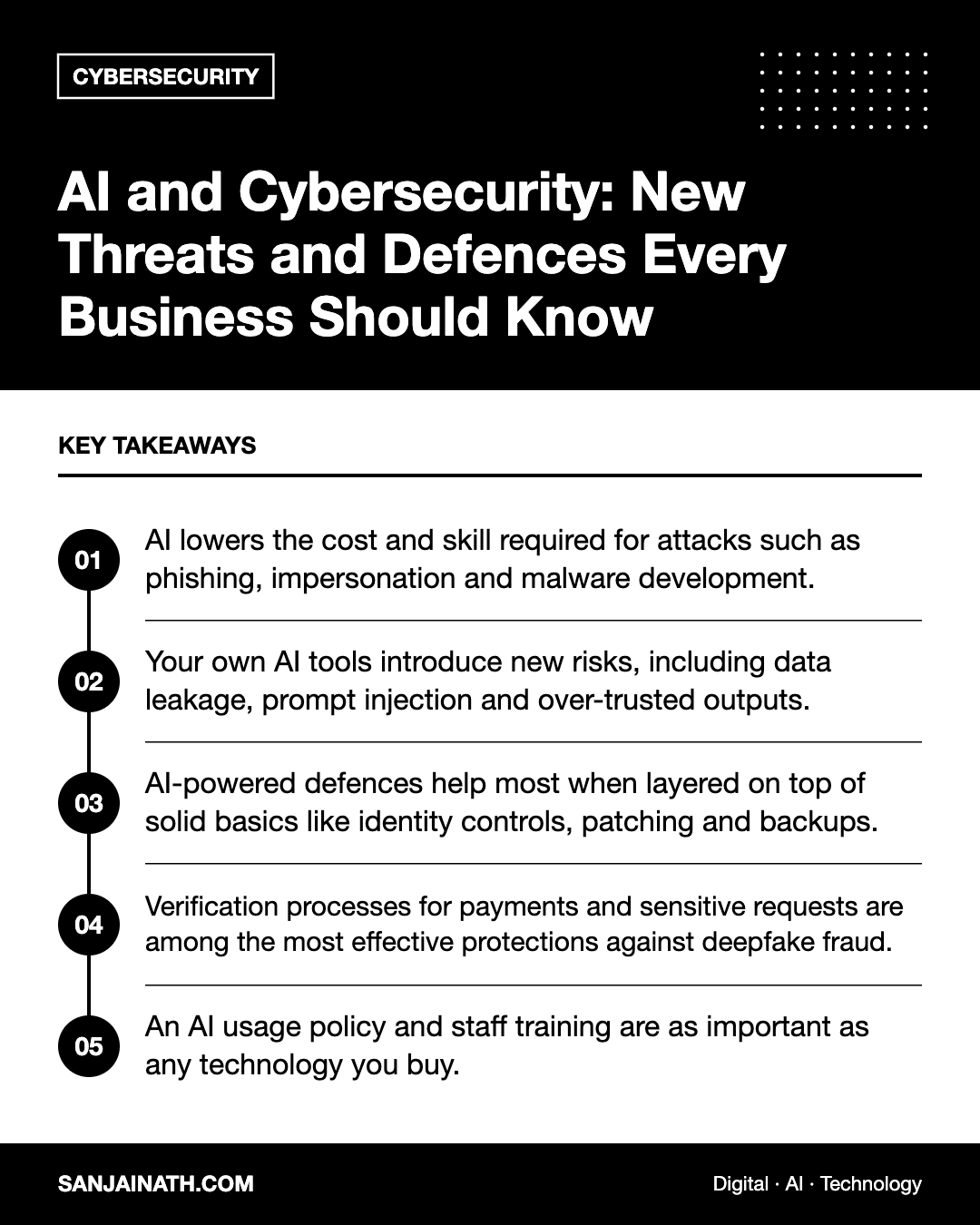
- AI lowers the cost and skill required for attacks such as phishing, impersonation and malware development.
- Your own AI tools introduce new risks, including data leakage, prompt injection and over-trusted outputs.
- AI-powered defences help most when layered on top of solid basics like identity controls, patching and backups.
- Verification processes for payments and sensitive requests are among the most effective protections against deepfake fraud.
- An AI usage policy and staff training are as important as any technology you buy.
How attackers are using AI
Most AI-enabled attacks are not entirely new. They are familiar techniques made faster, cheaper and more convincing. That is exactly why they matter: attacks that once required skilled operators can now be carried out at scale.
More convincing phishing and social engineering
Poor grammar and awkward phrasing used to be reliable warning signs of phishing. Generative AI removes those clues, producing fluent, personalised messages in any language, including polished Arabic and English for Gulf targets. Attackers can scrape public profiles and company websites to tailor messages to a specific role, project or supplier relationship.
Deepfake voice and video impersonation
Voice cloning and synthetic video allow criminals to impersonate executives, suppliers or colleagues. A short audio sample from a webinar or social media clip can be enough to create a plausible imitation. The typical goal is to pressure an employee into approving a payment, changing bank details or sharing credentials.
Automated reconnaissance and malware assistance
AI can help attackers summarise leaked data, map an organisation’s exposed systems and generate or modify malicious code. While mainstream AI services include safeguards, less restricted models and tools circulate in criminal communities.
New risks from your own AI tools
AI cybersecurity is not only about external attackers. The AI tools your teams adopt create their own exposure if they are introduced without governance.
- Data leakage: staff may paste confidential contracts, customer data or source code into public AI services without understanding how that data is stored or used.
- Prompt injection: AI assistants that read emails, documents or web pages can be manipulated by hidden instructions embedded in that content, potentially causing them to leak data or take unintended actions.
- Over-trusted outputs: AI-generated code, configurations or advice can contain errors or insecure patterns that slip through if nobody reviews them.
- Shadow AI: unapproved tools, browser extensions and plug-ins connected to company accounts can quietly gain access to sensitive systems.
- Excessive permissions: AI agents given broad access to mailboxes, drives or admin consoles become attractive targets.
AI cybersecurity defences that make a difference
On the defensive side, AI is well suited to problems involving large volumes of data and subtle patterns. Many modern security products already embed machine learning, whether or not they advertise it prominently.
| Defensive capability | What AI adds | Where it fits |
|---|---|---|
| Email security | Detects unusual language, sender behaviour and impersonation patterns | Phishing and business email compromise prevention |
| Endpoint detection and response | Flags suspicious process behaviour rather than relying only on known signatures | Laptops, servers and mobile devices |
| Identity threat detection | Spots impossible travel, unusual login times and risky sign-in patterns | Cloud applications and single sign-on |
| Security operations | Summarises alerts, correlates events and suggests response steps | SOC teams and managed security providers |
| Vulnerability management | Prioritises which weaknesses are most likely to be exploited | Patching and asset management |
The value of these tools depends on good data and human oversight. AI can reduce noise and speed up investigation, but people still need to make judgement calls, tune detections and respond to incidents.
A practical defence plan for businesses
You do not need a large security budget to reduce AI-driven risk meaningfully. Start with the steps below and build from there.
- Strengthen identity. Enforce multi-factor authentication everywhere, preferring phishing-resistant methods such as passkeys or hardware keys for administrators and finance staff.
- Introduce out-of-band verification. Any request to change bank details, make an urgent payment or share credentials should be confirmed through a separate, known channel, such as calling a number already on file. No exceptions for senior leaders.
- Create an AI acceptable use policy. Define which AI tools are approved, what data may never be entered into them and who must review AI-generated work before it is used.
- Apply least privilege to AI integrations. Give AI assistants and agents only the access they genuinely need, and log what they do.
- Update security awareness training. Show staff examples of AI-generated phishing and explain deepfake risks so they know that a familiar voice alone is not proof of identity.
- Keep the fundamentals strong. Patch promptly, maintain tested offline backups, segment networks and monitor for unusual activity.
- Review vendors. Ask suppliers how they use AI, where your data is processed and what controls protect it, keeping in mind local data protection requirements in the UAE and wider GCC.
Building an AI-aware security culture
Make it safe to pause
Many successful impersonation attacks rely on urgency and hierarchy. Leaders should state clearly that employees will never be criticised for pausing to verify a request, even one that appears to come from the chief executive.
Agree code words for high-risk requests
Some organisations use pre-agreed verification phrases between executives and finance teams. It is a simple, low-tech control that works well against voice cloning.
Encourage reporting
Make it easy to report suspicious messages with one click, and share anonymised examples internally so everyone learns from near misses.
Frequently asked questions
What is AI cybersecurity?
AI cybersecurity refers to the use of artificial intelligence to defend systems and data, as well as the practice of protecting against threats that AI creates or amplifies, including deepfakes, automated phishing and attacks on AI systems themselves.
Can AI stop phishing completely?
No single tool stops all phishing. AI-powered email filters catch many threats, but layered defences, strong authentication and trained, sceptical staff remain essential.
How can we spot a deepfake call?
Detection by ear is unreliable. The better approach is process-based: verify any sensitive or unusual request through a separate, trusted channel before acting on it.
Is it safe to let employees use generative AI tools?
It can be, with the right controls. Use approved business-grade tools with clear data-handling terms, set rules about sensitive information, and require human review of important outputs.
Final thoughts
AI is accelerating attacks, but it is also giving defenders powerful new capabilities. The organisations that fare best treat AI cybersecurity as a combination of technology, process and people: strong identity controls, verification habits that defeat impersonation, careful governance of internal AI tools and staff who feel confident to question the unexpected. Start with the basics, add AI-enhanced defences where they fill real gaps, and review your approach regularly as the threat landscape evolves.