

“Digital transformation” is one of the most overused phrases in business, yet the underlying need is real: organisations must use technology to serve customers better, operate more efficiently and adapt faster. A practical digital transformation strategy cuts through the buzzwords by linking technology investments to specific business outcomes, sequencing work sensibly and measuring progress honestly. This guide explains where to start and how to know whether it is working.
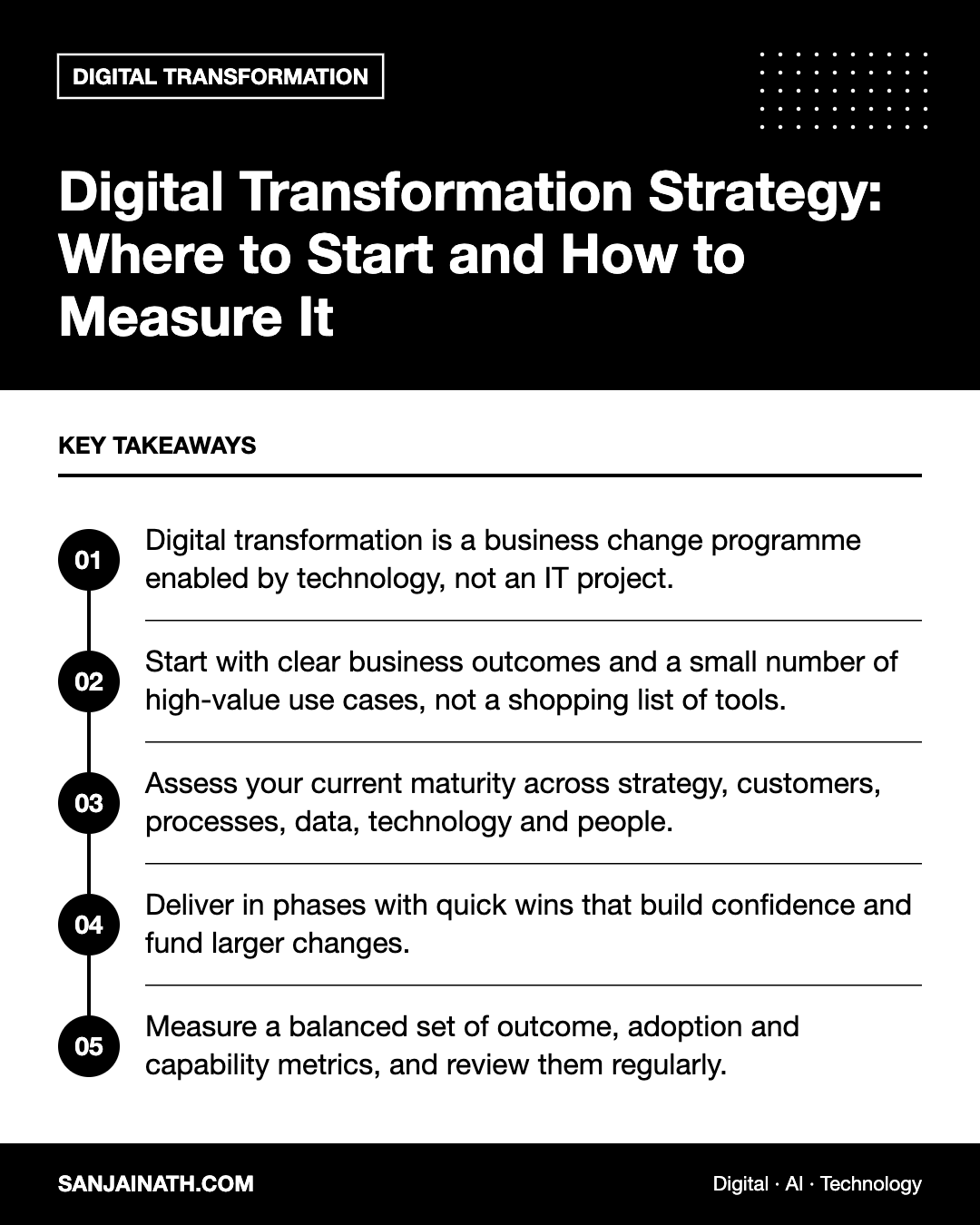
Key takeaways
- Digital transformation is a business change programme enabled by technology, not an IT project.
- Start with clear business outcomes and a small number of high-value use cases, not a shopping list of tools.
- Assess your current maturity across strategy, customers, processes, data, technology and people.
- Deliver in phases with quick wins that build confidence and fund larger changes.
- Measure a balanced set of outcome, adoption and capability metrics, and review them regularly.
What digital transformation really means
Digital transformation is the process of rethinking how an organisation creates value using digital technology, data and new ways of working. It can include:
- Moving customer interactions online, such as self-service portals, apps and digital payments.
- Automating manual processes and paperwork.
- Replacing ageing systems with cloud-based platforms.
- Using data and analytics to make faster, better decisions.
- Introducing AI where it clearly improves quality, speed or cost.
- Building new digital products or business models.
The crucial word is transformation. Digitising a paper form without changing the process behind it is useful, but it is not transformation. The goal is to redesign how work gets done.
In the UAE and wider GCC, national agendas focused on digital government, smart cities and economic diversification have made transformation a priority across both public and private sectors, raising customer expectations for fast, digital-first services.
Step 1: Anchor the strategy in business outcomes
Begin by asking what the business needs to achieve over the next three to five years. Typical outcomes include:
- Growing revenue through new channels or markets.
- Improving customer experience and retention.
- Reducing operating costs and processing times.
- Improving compliance, risk management and resilience.
- Increasing speed of decision-making and innovation.
Translate each outcome into a clear problem statement. For example, “Customers wait several days for quotes because the process relies on emails and spreadsheets” is far more actionable than “we need a new CRM”.
Step 2: Assess your current digital maturity
An honest baseline shows where the biggest gaps are. Assess each dimension on a simple scale, such as basic, developing, established and advanced.
| Dimension | Questions to ask |
|---|---|
| Strategy and leadership | Is there a shared vision, executive sponsorship and funding? |
| Customer | Can customers do what they need digitally, easily and on mobile? |
| Processes | Which core processes are manual, duplicated or error-prone? |
| Data | Is data accurate, accessible, governed and used in decisions? |
| Technology | Are systems modern, integrated, secure and scalable? |
| People and culture | Do teams have digital skills and a willingness to change? |
Gather input from staff at all levels, customers and partners, not just senior managers. Front-line teams often know exactly where processes break down.
Step 3: Choose where to start
Trying to transform everything at once is a common reason programmes stall. Instead, build a list of candidate initiatives and prioritise them.
A simple prioritisation framework
Score each initiative from one to five on:
- Business value: contribution to the target outcomes.
- Customer or employee impact: how many people benefit, and how much.
- Feasibility: technical complexity, data readiness and required skills.
- Time to value: how quickly benefits can be realised.
- Risk: operational, security and change risks.
Good first initiatives are usually high in value and feasibility, with visible benefits within months. Examples include automating invoice processing, launching online booking, consolidating customer data into a single CRM or building a management dashboard that replaces manual reports.
Step 4: Build the foundations
Alongside early wins, invest in foundations that later initiatives depend on:
- Cloud and integration architecture so systems can share data reliably.
- Data governance, including ownership, quality standards and privacy compliance.
- Cyber security controls proportionate to your risk, from identity management to backups.
- Digital skills through training, hiring and partnerships.
- Delivery practices such as agile teams, product ownership and continuous improvement.
Foundations are rarely exciting, but neglecting them creates technical debt that slows every future project.
Step 5: Lead the people side of change
Technology is often the easier part. Adoption determines whether benefits are realised. Effective change management includes:
- Visible executive sponsorship and a clear story about why change is needed.
- Involving users in design and testing so solutions fit real work.
- Training that is practical, role-specific and timed close to launch.
- Champions within teams who support colleagues.
- Retiring old processes and systems, so people do not keep workarounds alive.
- Recognising and celebrating progress.
How to measure your digital transformation strategy
Measure at three levels to get a complete picture.
Outcome metrics
These show business impact: revenue from digital channels, customer satisfaction, retention, cost per transaction, processing time and error rates.
Adoption metrics
These show whether people are using new tools and processes: active users, percentage of transactions completed digitally, self-service rates and usage of dashboards.
Capability metrics
These show whether the organisation is becoming more capable: release frequency, time to launch new features, data quality scores, security posture and staff digital skills.
Set a baseline before each initiative, define targets and review progress quarterly. Be willing to stop or rework initiatives that are not delivering, and reallocate funding to those that are.
Common pitfalls to avoid
- Starting with technology purchases rather than business problems.
- Treating transformation as a one-off project with a fixed end date.
- Underinvesting in data quality and integration.
- Ignoring change management and training.
- Measuring activity, such as systems launched, instead of outcomes.
- Running too many initiatives at once and spreading resources thin.
Build a simple transformation roadmap
Once initiatives are prioritised, set them out on a roadmap covering the next twelve to eighteen months. Group work into phases, show dependencies between foundations and use cases, and name an accountable owner for each item. Keep the roadmap visible, review it every quarter and adjust it as you learn. A roadmap that never changes is usually a sign that nobody is using it.
Frequently asked questions
How long does digital transformation take?
There is no fixed timeline. Early initiatives can deliver value within months, while broader transformation is an ongoing capability rather than a project with an end date.
Who should lead digital transformation?
It needs senior business leadership, often the chief executive or a dedicated transformation leader, working closely with technology leaders. IT alone cannot drive business change.
Is digital transformation only for large companies?
No. Small and mid-sized businesses can transform effectively with cloud software, automation and better use of data, often moving faster than larger competitors.
Where does AI fit into digital transformation?
AI is a powerful enabler when applied to well-defined problems with good data. Treat it as one tool within the strategy, not a strategy in itself.
Final thoughts
A successful digital transformation strategy starts with business outcomes, focuses on a few high-value initiatives, builds solid foundations and brings people along. Measure outcomes, adoption and capability, learn from each phase and keep improving. Transformation is less a destination than a lasting ability to adapt, and that ability is a genuine competitive advantage.