

Choosing a frontend framework shapes how quickly your team can ship, who you can hire and how easy your application will be to maintain for years. React vs Vue remains one of the most common comparisons, because both are mature, well-supported and capable of powering everything from marketing sites to complex web applications. This guide compares them on the factors that matter to technical leads and business decision-makers, rather than on hype.
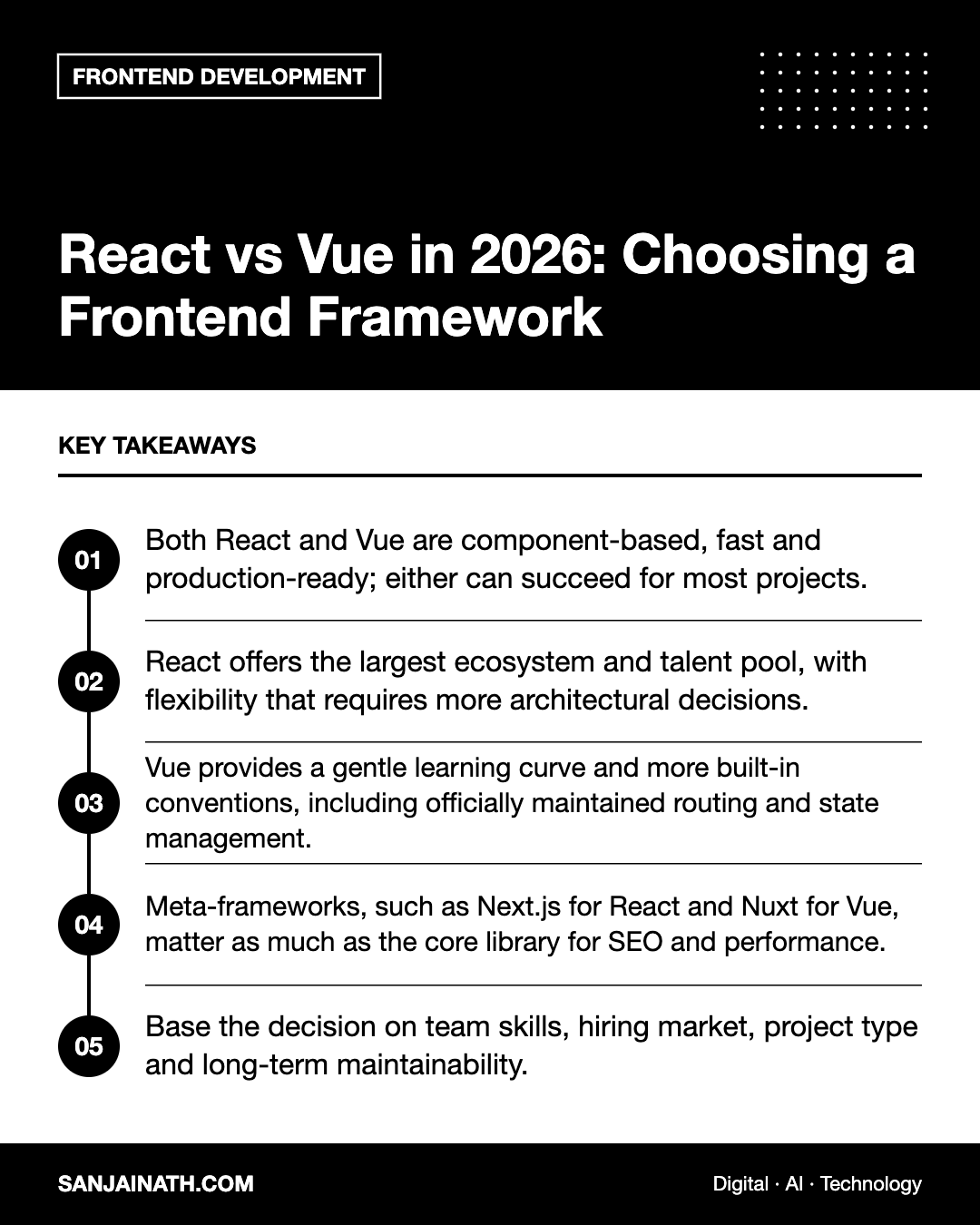
Key takeaways
- Both React and Vue are component-based, fast and production-ready; either can succeed for most projects.
- React offers the largest ecosystem and talent pool, with flexibility that requires more architectural decisions.
- Vue provides a gentle learning curve and more built-in conventions, including officially maintained routing and state management.
- Meta-frameworks, such as Next.js for React and Nuxt for Vue, matter as much as the core library for SEO and performance.
- Base the decision on team skills, hiring market, project type and long-term maintainability.
A quick overview of React and Vue
React
React is a JavaScript library for building user interfaces, originally created at Facebook and now maintained by Meta and a large open-source community. It uses JSX, a syntax that mixes HTML-like markup with JavaScript, and encourages building interfaces from small, reusable components. React itself focuses on the view layer, leaving choices about routing, data fetching and state to the wider ecosystem or to a framework built on top of it.
Vue
Vue is a progressive JavaScript framework created by Evan You and maintained by an independent core team and community. It uses HTML-based templates by default, with the option of JSX, and organises each component into a single file containing template, logic and styles. Vue can be added to a single page of an existing site or scaled up into a full application, and its official ecosystem covers routing and state management.
React vs Vue: side-by-side comparison
| Factor | React | Vue |
|---|---|---|
| Type | UI library with a large ecosystem | Progressive framework with official companion libraries |
| Templating | JSX | HTML-based templates (JSX optional) |
| Learning curve | Moderate; requires learning ecosystem choices | Gentle; conventions guide beginners |
| Reactivity model | State updates trigger re-renders; hooks manage state and effects | Fine-grained reactive system tracks dependencies automatically |
| Routing and state | Community libraries or framework-provided | Official Vue Router and Pinia |
| Full-stack framework | Next.js, Remix/React Router and others | Nuxt |
| Mobile apps | React Native is a mature option | Options exist but are less widely adopted |
| Talent pool | Very large | Solid, smaller in many markets |
Developer experience and learning curve
Vue is often praised for how approachable it feels. Developers with HTML, CSS and basic JavaScript knowledge can become productive quickly, and the official documentation is widely regarded as clear. Its Composition API offers a more flexible way to organise logic in larger applications, while the Options API remains available and beginner-friendly.
React has a slightly steeper start, mainly because of JSX, hooks and the number of decisions involved in assembling a stack. Once learned, however, its “it is just JavaScript” approach is powerful, and its patterns transfer well across projects. React’s move towards server components and framework-led architecture adds capability but also new concepts to master.
Performance
For the vast majority of business applications, both frameworks are more than fast enough. Real-world performance depends far more on how the application is built than on the framework chosen. Common factors include:
- Bundle size and how much JavaScript is shipped to the browser.
- Whether pages are server-rendered or statically generated.
- Efficient data fetching and caching.
- Image optimisation and third-party scripts.
- Avoiding unnecessary re-renders in complex interfaces.
Vue’s reactivity system can reduce the need for manual optimisation in some cases, while React offers tools and compiler-level improvements to address re-rendering. Benchmark your own use case if performance is critical.
SEO and meta-frameworks
Single-page applications that render entirely in the browser can present challenges for search engines and for initial load speed. For content-heavy or marketing-driven sites, use a meta-framework that supports server-side rendering or static generation.
- Next.js is the most widely used React framework, offering server rendering, static generation, routing and API routes.
- Nuxt provides similar capabilities for Vue, with conventions that many teams find intuitive.
Both approaches can deliver fast, crawlable pages and good Core Web Vitals when implemented well. Hosting options and deployment workflows are an important secondary consideration.
Ecosystem, hiring and long-term support
Ecosystem
React’s ecosystem is enormous. Almost every UI kit, analytics tool, headless CMS and SaaS product offers a React integration first. Vue’s ecosystem is smaller but high quality, and its official libraries reduce the risk of choosing abandoned packages.
Hiring
In most markets, including the UAE and wider GCC, React developers are generally easier to find because of the framework’s broad adoption. Vue developers are available, and many React developers can learn Vue quickly, but check your local market and agency partners before committing.
Long-term maintainability
Both projects have long track records and active communities. Maintainability depends mainly on code standards, testing, documentation and upgrade discipline. Vue’s more opinionated structure can help teams stay consistent; React teams benefit from agreeing clear conventions early.
Which should you choose?
Choose React if:
- You need access to the largest hiring pool and third-party ecosystem.
- You plan to share knowledge or code with a React Native mobile app.
- Your team already has React experience.
- You are building a large, complex application and want maximum flexibility.
Choose Vue if:
- You want a gentle learning curve and strong built-in conventions.
- Your team includes developers coming from HTML, CSS or backend frameworks.
- You are progressively enhancing an existing server-rendered site.
- You value official, cohesive tooling over assembling your own stack.
A simple decision process
- List your project requirements: SEO needs, interactivity, mobile plans and integrations.
- Assess your current team skills and local hiring options.
- Build a small prototype of a representative feature in your leading option.
- Evaluate developer productivity, performance and code clarity.
- Decide, document your conventions and commit.
Frequently asked questions
Is React better than Vue?
Neither is objectively better. React leads on ecosystem and adoption; Vue is often easier to learn and more cohesive. The best choice depends on your team and project.
Is Vue suitable for large enterprise applications?
Yes. With the Composition API, TypeScript support, Pinia and Nuxt, Vue scales well to large applications when teams follow good architectural practices.
Can I switch from Vue to React later?
You can, but it usually means rewriting components. Keeping business logic separate from UI code makes any future migration easier.
Should I use TypeScript with React or Vue?
For most professional projects, yes. Both have strong TypeScript support, which improves reliability and maintainability in larger codebases.
Final thoughts
The React vs Vue decision in 2026 is less about which technology is superior and more about fit. Both are proven, fast and well supported. Weigh your team’s skills, hiring market, project needs and preferred level of structure, test with a real prototype and then commit. A well-built application in either framework will serve your business far better than a poorly built one in the “right” framework.