

Across the GCC, millions of people search in Arabic every day, yet many regional brands still treat their Arabic website as a quick translation of the English one. Arabic SEO is about more than swapping languages: it requires understanding how people actually phrase their searches, which dialects and spellings they use, and how to build a technically sound right-to-left site that search engines can crawl and rank. This guide explains how to plan, localise and optimise Arabic content that performs.
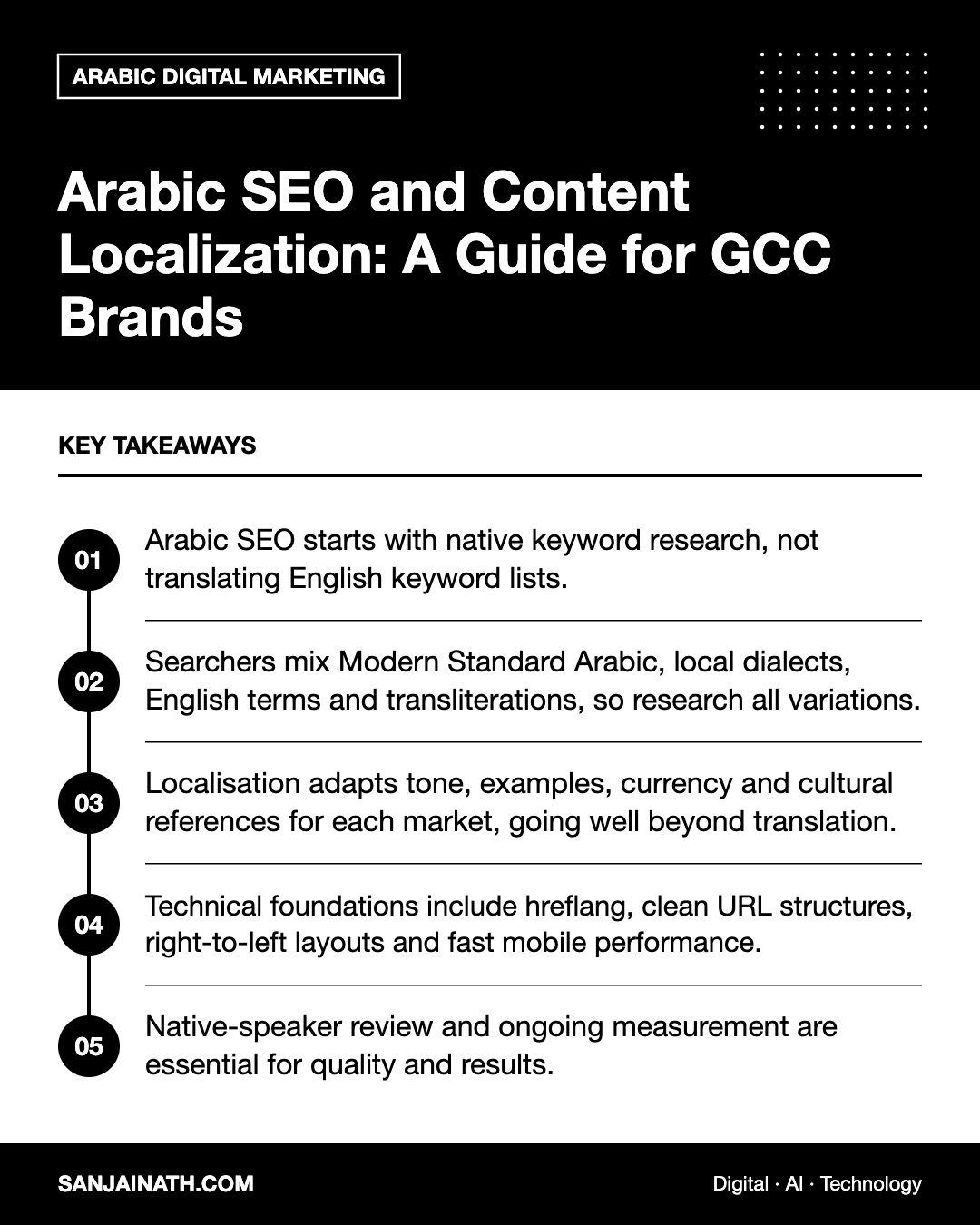
Key takeaways
- Arabic SEO starts with native keyword research, not translating English keyword lists.
- Searchers mix Modern Standard Arabic, local dialects, English terms and transliterations, so research all variations.
- Localisation adapts tone, examples, currency and cultural references for each market, going well beyond translation.
- Technical foundations include hreflang, clean URL structures, right-to-left layouts and fast mobile performance.
- Native-speaker review and ongoing measurement are essential for quality and results.
Why Arabic SEO deserves its own strategy
Competition for Arabic keywords is often lower than for equivalent English terms, and the volume of high-quality Arabic content on many topics remains limited. That creates a real opportunity for brands willing to invest properly.
However, Arabic search behaviour is distinctive. A single concept may be searched in several ways depending on the country, the user’s age, the device keyboard and whether they are thinking in Arabic or English. A translated keyword list will miss much of that variety.
Common challenges
- Dialect variation: Gulf, Levantine and Egyptian Arabic can use different words for the same thing.
- Spelling variations: letters such as different forms of alif, taa marbuta and haa, or yaa and alif maqsura, are often typed interchangeably.
- Mixed-language queries: people commonly combine Arabic words with English brand or product names.
- Transliteration: some users type Arabic words using Latin characters and numbers.
- Machine translation: literal translations can sound unnatural and fail to match real queries.
Keyword research for Arabic SEO
Treat Arabic keyword research as a separate project with its own seed ideas, tools and validation.
- Brainstorm with native speakers: ask colleagues or customers how they would search for your product or service.
- Use keyword tools set to Arabic and the target country: check each market separately, as search terms in Saudi Arabia may differ from those in the UAE or Kuwait.
- Explore search suggestions: autocomplete and related searches reveal natural phrasing and popular modifiers.
- Record variations: capture dialect terms, spelling variants, English loanwords and mixed-language forms.
- Review the results pages: search each keyword to see what content ranks and what intent it serves.
- Group by intent: cluster keywords into informational, commercial and transactional topics.
Choosing Modern Standard Arabic or dialect
Most brands write core website content in Modern Standard Arabic because it is widely understood and appropriate for formal content. Dialect can work well in social media, advertising and conversational content aimed at one specific market. Where search data shows strong demand for a dialect term, include it naturally in headings, FAQs or supporting copy.
From translation to true localisation
Translation converts words; localisation adapts meaning. For Arabic SEO to succeed, content must feel as if it were written for the reader from the start.
| Element | Translation only | Localised approach |
|---|---|---|
| Keywords | Direct translation of English terms | Native research per country and dialect |
| Examples | References to Western holidays or places | Regional events, cities and seasonal moments such as Ramadan and Eid |
| Units and formats | Original currency and formats | Local currency, date formats and phone numbers |
| Tone | Literal and sometimes stiff | Natural, culturally appropriate phrasing |
| Imagery | Same visuals as the English site | Visuals that reflect local audiences and norms |
A practical localisation workflow
- Create an Arabic brief that includes target keywords, audience and purpose.
- Have a native copywriter write or transcreate the content rather than translate line by line.
- Ask a second native speaker to review for accuracy, tone and readability.
- Check that the primary keyword appears naturally in the title, first paragraph, a heading and the meta description.
- Maintain an Arabic glossary so product names and key terms stay consistent.
Technical SEO for Arabic websites
Great content will not rank if search engines cannot understand which language and country each page targets.
Site structure and hreflang
- URL structure: subfolders such as /ar/ are a common and manageable choice; subdomains or country domains also work but require more effort.
- Hreflang tags: tell search engines which pages are language or regional alternatives, for example Arabic for the UAE versus English for the UAE.
- Self-referencing canonicals: each language version should point to itself, not to the English page.
- Language attributes: set the correct lang and dir attributes so browsers render right-to-left text properly.
Right-to-left design and performance
- Mirror layouts so navigation, icons and alignment flow naturally from right to left.
- Choose web-optimised Arabic fonts and check they load quickly on mobile.
- Test forms, menus, sliders and checkout flows in Arabic, as these often break in right-to-left mode.
- Decide on a URL approach: Arabic characters in URLs are readable for users but become long encoded strings when shared, so many sites use short transliterated or English slugs.
On-page optimisation essentials
The fundamentals of on-page SEO still apply, but with attention to Arabic specifics.
- Title tags: front-load the main keyword and keep titles concise, as Arabic characters can take more visual width.
- Meta descriptions: write original Arabic descriptions with a clear benefit and call to action.
- Headings: use natural Arabic questions and phrases people actually search.
- Structured data: add localised schema such as organisation, product, local business and FAQ where appropriate.
- Image alt text: describe images in Arabic on Arabic pages.
- Internal links: link between Arabic pages with Arabic anchor text, and avoid sending Arabic readers to English pages without warning.
Building authority and measuring results
Earning links and mentions from reputable Arabic-language publications, directories and partners strengthens authority in regional search. Consider Arabic press releases, guest contributions to regional industry sites and partnerships with local organisations.
Track Arabic performance separately. Segment analytics and search console data by language folder and country, monitor rankings for Arabic keyword clusters and review which pages convert Arabic-speaking visitors. Use the findings to expand content on topics that show demand.
Frequently asked questions
Is Arabic SEO different from English SEO?
The principles are the same, but the execution differs. Arabic SEO requires native keyword research, handling dialects and spelling variants, right-to-left technical setup and culturally localised content.
Should GCC brands create separate pages for each country?
Only when content genuinely differs, such as pricing, delivery, regulations or product ranges. Otherwise, one Arabic version targeting the region may be simpler to maintain. Use hreflang correctly whichever approach you choose.
Can machine translation be used for Arabic content?
It can speed up a first draft, but content should always be edited and approved by a native speaker. Unedited machine translation often reads awkwardly and misses the terms people actually search.
How long does Arabic SEO take to show results?
As with any SEO, results build over months rather than days. Lower competition for some Arabic topics can help, but consistent publishing and technical quality are what sustain growth.
Final thoughts
For GCC brands, Arabic SEO is one of the most valuable and under-used growth channels. Research keywords natively, localise rather than translate, build a technically sound right-to-left site and measure Arabic performance on its own terms. Brands that treat Arabic content as a first-class experience earn both better rankings and deeper trust with the audiences that matter most in the region.