

For many customers, WhatsApp is where conversations already happen — with friends, family and increasingly with brands. WhatsApp Business marketing lets companies meet customers in that familiar space, answering questions, sending updates and even completing sales inside the chat. Done well, it feels like helpful service; done badly, it feels like spam. This guide shows you how to get it right.
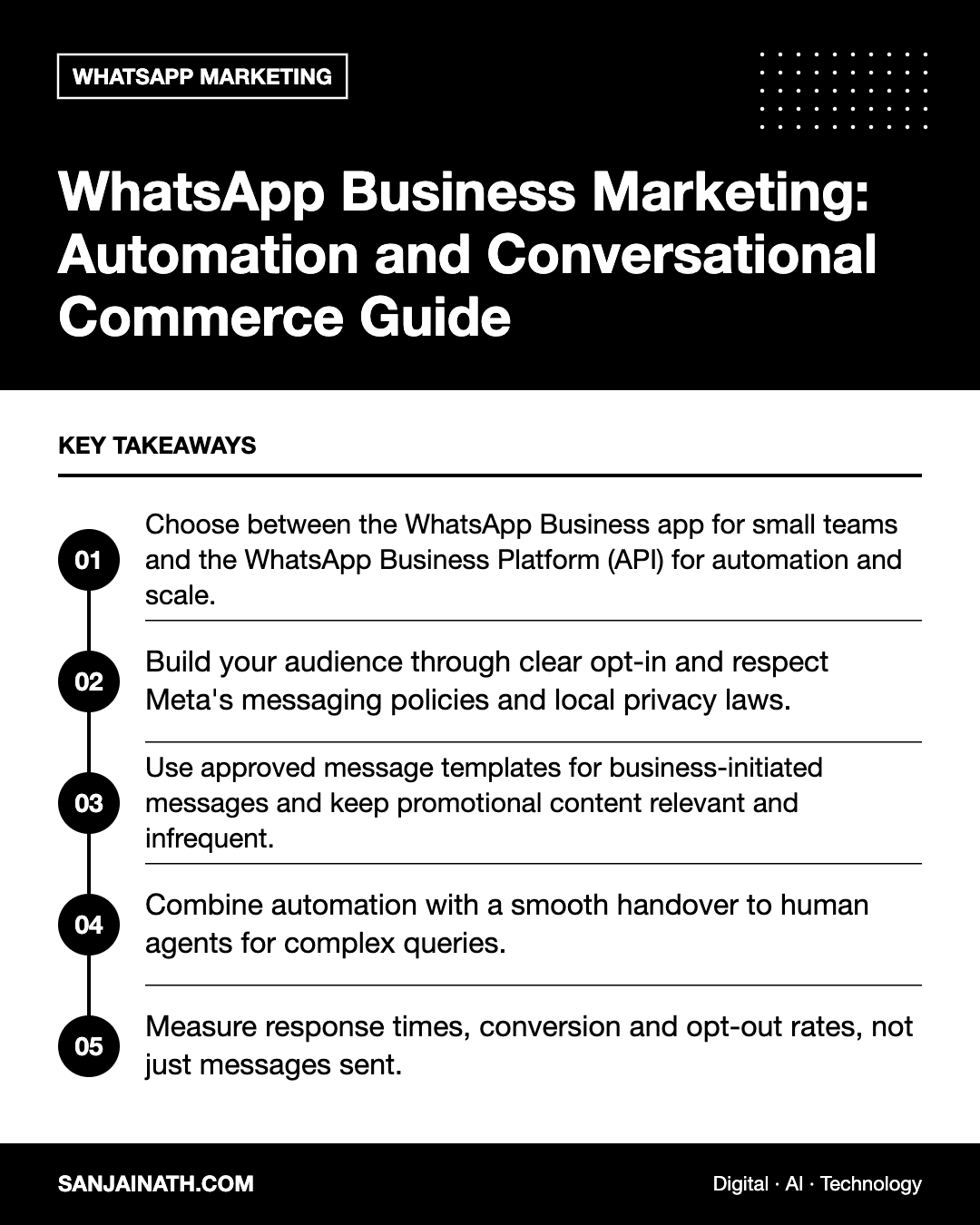
Key takeaways
- Choose between the WhatsApp Business app for small teams and the WhatsApp Business Platform (API) for automation and scale.
- Build your audience through clear opt-in and respect Meta’s messaging policies and local privacy laws.
- Use approved message templates for business-initiated messages and keep promotional content relevant and infrequent.
- Combine automation with a smooth handover to human agents for complex queries.
- Measure response times, conversion and opt-out rates, not just messages sent.
Why WhatsApp matters for customer engagement
WhatsApp is one of the world’s most widely used messaging apps and is deeply embedded in daily life across the GCC, South Asia, Latin America, Africa and much of Europe. In the UAE and Saudi Arabia, customers commonly expect to message a business on WhatsApp to ask about a property viewing, confirm an appointment or check an order.
The channel’s strengths are clear:
- Immediacy: messages are typically read far more quickly than email.
- Conversation: customers can reply, ask questions and share photos or locations.
- Trust: verified business profiles, catalogues and consistent branding reassure customers.
- Rich media: images, documents, voice notes, buttons and lists support richer interactions than SMS.
WhatsApp Business app vs WhatsApp Business Platform
Your first decision in WhatsApp Business marketing is which version to use. Features and pricing evolve, so check Meta’s current documentation, but the broad distinction is stable.
| Aspect | WhatsApp Business app | WhatsApp Business Platform (API) |
|---|---|---|
| Best for | Sole traders and small teams | Growing and large businesses |
| Setup | Free mobile app, quick to start | Via Meta directly or a Business Solution Provider |
| Users | A small number of linked devices | Many agents through a shared inbox |
| Automation | Greeting, away messages and quick replies | Chatbots, CRM integration, triggered notifications |
| Costs | Free app | Charges for certain message types, plus provider fees |
If you handle more than a few dozen conversations a day, need several agents or want to connect WhatsApp to your CRM and e-commerce platform, the Business Platform is usually the right route.
Building an opted-in audience
WhatsApp requires businesses to obtain opt-in before sending messages, and privacy laws such as the UAE’s Personal Data Protection Law, Saudi Arabia’s PDPL and the GDPR set further expectations. Treat consent as the foundation of your programme.
Effective opt-in methods
- Click-to-chat links and QR codes on your website, packaging, brochures, showroom displays and event stands.
- Click-to-WhatsApp ads on Facebook and Instagram that open a conversation directly.
- Checkbox opt-ins at checkout or on lead forms, with clear wording about what messages the customer will receive.
- Existing conversations: invite customers who contact you to opt in to updates, rather than assuming consent.
Always make it easy to opt out, for example by replying “STOP”, and honour those requests promptly.
Designing messages that customers welcome
Understand conversation types
On the Business Platform, when a customer messages you, a customer service window opens during which you can reply freely. Outside that window, business-initiated messages must use pre-approved templates, which Meta categorises broadly as marketing, utility and authentication. Categories affect cost and approval, so write templates carefully.
Messaging principles
- Be relevant: segment by interest, purchase history or location instead of broadcasting to everyone.
- Be brief: lead with the value and a single clear call to action.
- Be personal: use names and context, such as the property or product the customer enquired about.
- Be respectful of timing: avoid late-night messages and be mindful of local weekends, prayer times and Ramadan schedules.
- Use interactive elements: quick-reply buttons and list messages reduce typing and increase replies.
Automation that improves the experience
Automation should remove friction, not humans. The most useful flows include:
- Welcome and triage: a greeting with buttons such as “New enquiry”, “Existing order” or “Speak to an agent”.
- FAQs: instant answers about opening hours, locations, delivery areas or pricing ranges.
- Lead qualification: collecting budget, timeline and preferences before routing to a salesperson.
- Transactional updates: order confirmations, delivery notifications, appointment reminders and payment receipts.
- Re-engagement: abandoned basket reminders or follow-ups after a viewing, sent only to opted-in customers.
Design a clear path to a human. Customers should never feel trapped in a bot loop, and agents should see the conversation history when they take over. Connecting WhatsApp to your CRM ensures every conversation is logged against the right contact.
Conversational commerce: selling inside the chat
Conversational commerce means guiding customers from question to purchase within the conversation. Depending on your region and setup, WhatsApp supports product catalogues, multi-product messages and carts, and some markets offer in-chat payment options. Where native payments are not available, businesses commonly send secure payment links from their payment provider.
A typical flow looks like this:
- A customer clicks a WhatsApp ad for a new collection.
- An automated message shows featured products from the catalogue.
- The customer asks about sizing; an agent answers and suggests an alternative.
- The customer adds items to a cart and receives a payment link.
- A utility message confirms the order and later shares delivery tracking.
This approach works particularly well for fashion, beauty, food delivery, automotive services, education and real estate enquiries, where customers value reassurance before committing.
Measuring WhatsApp Business marketing performance
Track metrics across the whole journey:
- Reach and delivery: messages delivered and read.
- Engagement: reply rate and button click-through rate.
- Service quality: first response time, resolution time and customer satisfaction.
- Commercial outcomes: leads qualified, bookings made, orders and revenue attributed to WhatsApp.
- Health: opt-out and block rates, which also influence your account’s quality rating.
Use UTM-tagged links and CRM attribution to connect conversations to sales, and review template performance regularly to retire underperforming messages.
Frequently asked questions
Is WhatsApp Business free?
The WhatsApp Business app is free to download. The Business Platform charges for certain conversations or messages based on category and country, and solution providers usually add their own fees. Check current pricing before budgeting.
Can I send bulk promotional messages on WhatsApp?
You can send marketing templates to customers who have opted in, but mass unsolicited messaging breaches policy and risks your number being restricted. Segment carefully and keep frequency reasonable.
Do I need a developer to use the WhatsApp Business Platform?
Not necessarily. Many Business Solution Providers offer no-code inboxes, chatbot builders and CRM integrations. Custom integrations do require development resources.
How do I get a verified badge?
Meta offers verification options that vary over time and by programme. Maintain a complete business profile, a consistent display name and good messaging quality, then follow Meta’s current verification process.
Final thoughts
WhatsApp Business marketing succeeds when it behaves like great customer service with a commercial purpose. Earn consent, send fewer and better messages, automate the routine and keep people available for moments that matter. Brands that treat the chat as a relationship rather than a broadcast channel will see the strongest long-term results.