
Sending the same email to your entire list is the fastest way to train subscribers to ignore you. Email segmentation, the practice of dividing your audience into groups based on shared characteristics or behaviour, lets you send messages that feel relevant to each reader. Relevance is what drives opens, clicks and conversions, and it also protects your sender reputation by reducing complaints and unsubscribes.
Key takeaways
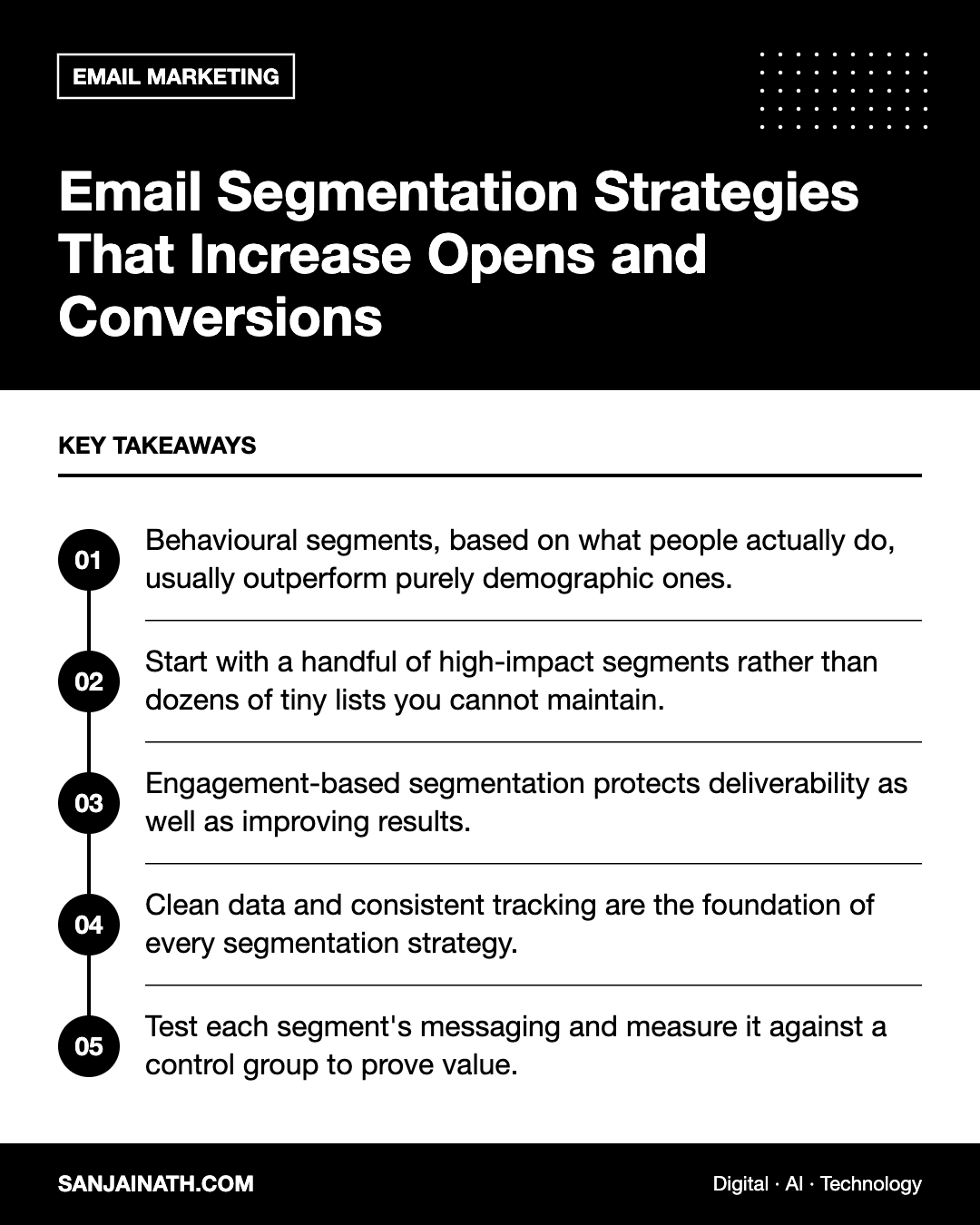
- Behavioural segments, based on what people actually do, usually outperform purely demographic ones.
- Start with a handful of high-impact segments rather than dozens of tiny lists you cannot maintain.
- Engagement-based segmentation protects deliverability as well as improving results.
- Clean data and consistent tracking are the foundation of every segmentation strategy.
- Test each segment’s messaging and measure it against a control group to prove value.
Why email segmentation works
Inbox providers increasingly judge senders by how recipients react. When people open, read, reply and click, your future emails are more likely to reach the inbox. When they ignore, delete or mark messages as spam, deliverability suffers. Email segmentation improves those signals because each message is closer to what the recipient actually wants.
Segmentation also improves commercial results. A first-time buyer, a loyal repeat customer and someone who has not opened an email in six months need completely different messages. Treating them the same wastes the opportunity to move each one forward.
The main types of segmentation
| Segment type | Based on | Example uses |
|---|---|---|
| Demographic | Age, role, company size, industry | Tailoring B2B content by job function |
| Geographic | Country, city, time zone, language | Local events, delivery offers, send-time optimisation |
| Behavioural | Opens, clicks, site visits, downloads | Follow-ups on content viewed, product interest |
| Purchase history | What, how often and how much people buy | Cross-sells, replenishment reminders, VIP offers |
| Lifecycle stage | New subscriber, lead, customer, lapsed | Onboarding, nurture, win-back |
| Engagement level | Recency and frequency of interaction | Protecting deliverability, re-engagement |
Seven email segmentation strategies that deliver results
1. Segment new subscribers for onboarding
New subscribers are typically at their most attentive. Place them into a dedicated welcome segment that receives a short series introducing your brand, setting expectations about frequency and guiding them towards a first action. Keep them out of your regular promotional sends until the welcome sequence is complete, so the first impressions are coherent.
2. Use engagement tiers
Group subscribers by how recently they have engaged, for example active in the last 30 days, 31 to 90 days and more than 90 days. Send your most frequent campaigns to active subscribers, reduce frequency for the middle tier and run a re-engagement campaign for the least active. If they still do not respond, suppress them. A smaller, engaged list almost always outperforms a larger, disengaged one.
Because some privacy features can make open tracking less reliable, combine opens with clicks, site visits and purchases when defining engagement.
3. Segment by interest or content consumed
Track which topics, product categories or pages each subscriber clicks on. Someone who repeatedly reads your SEO articles should receive SEO-related content and offers, not your social media webinar invitation. Preference centres, where subscribers choose their interests directly, are a simple way to collect this data.
4. Segment by purchase behaviour
- First-time buyers: thank them, reduce buyer’s remorse and encourage a second purchase.
- Repeat customers: reward loyalty with early access or exclusive content.
- High-value customers: offer premium service, personal outreach or VIP perks.
- Replenishment buyers: remind them when a consumable product is likely to run out.
- Lapsed buyers: win them back with a reason to return, such as new arrivals or a relevant offer.
5. Segment by lifecycle stage in B2B
For B2B companies, align segments with the sales funnel. Early-stage leads need educational content, mid-stage leads benefit from comparisons and case examples, and sales-ready leads should receive invitations to talk. Syncing your email platform with your CRM keeps these stages accurate.
6. Segment by location and language
Geographic segmentation matters more than many marketers realise. Send times should respect local time zones, promotions should reflect regional holidays and offers should only go to people who can actually use them. For audiences in the UAE and wider GCC, offering both Arabic and English versions, and planning around Ramadan and local weekends, can noticeably improve relevance.
7. Segment by cart and browse abandonment
People who viewed a product or left items in their basket have shown clear intent. Triggered emails to these segments, sent within a sensible window, remind them of what they were considering and address common objections such as delivery times or returns.
How to build your segmentation plan
- Define your goals. Decide whether you are trying to increase repeat purchases, generate more demos, reduce unsubscribes or something else.
- Audit your data. List what you reliably collect: sign-up source, interests, location, purchases and engagement. Segments built on incomplete data will misfire.
- Choose three to five priority segments. Pick the ones most closely tied to your goals and easiest to act on.
- Create tailored content. Adjust subject lines, messaging, offers and calls to action for each segment. Changing only the first name is personalisation, not segmentation.
- Automate where possible. Use dynamic segments that update automatically as people meet or leave the criteria.
- Test and measure. Compare segmented campaigns against a broad send or a holdout group to confirm the uplift.
- Refine regularly. Merge segments that behave similarly and split those that contain very different groups.
Common email segmentation mistakes
- Over-segmenting: creating so many micro-segments that you cannot produce enough content or reach meaningful sample sizes.
- Relying on stale data: job titles, interests and locations change, so refresh data through preference centres and progressive profiling.
- Ignoring suppression: continuing to mail people who never engage drags down deliverability for everyone else.
- Forgetting overlap: the same person can qualify for several segments, so set rules to prevent them receiving conflicting or excessive emails.
- Collecting data without consent: make sure data collection and use comply with applicable privacy laws and your own privacy policy.
Frequently asked questions
What is email segmentation?
Email segmentation is dividing your subscriber list into smaller groups based on shared traits or behaviours, so you can send more relevant messages to each group rather than one generic email to everyone.
How many segments should I start with?
Three to five is a practical starting point. New subscribers, engaged customers, lapsed customers and one or two interest-based groups cover a lot of value without overwhelming your team.
Does segmentation help deliverability?
Yes. Sending relevant content to engaged recipients generates positive signals such as opens, clicks and replies, while suppressing inactive contacts reduces complaints and bounces.
What is the difference between segmentation and personalisation?
Segmentation groups people and sends each group a tailored message. Personalisation adjusts elements within an individual email, such as the name or recommended products. The two work best together.
Final thoughts
Email segmentation turns a broadcast channel into a conversation. Start with a few high-impact segments tied to clear goals, build them on clean data, tailor the message rather than just the greeting, and measure the difference. As your data and confidence grow, layer in more sophisticated behavioural and lifecycle segments. The result is an email programme that subscribers value and that consistently contributes to revenue.