

Shoppers increasingly discover, evaluate and buy products without ever leaving the social apps they scroll every day. Social commerce turns feeds, short videos and live streams into storefronts, collapsing the traditional funnel into a few taps. For brands, that creates a huge opportunity, but it also demands a different way of thinking about content, creators, fulfilment and customer service.
Key takeaways
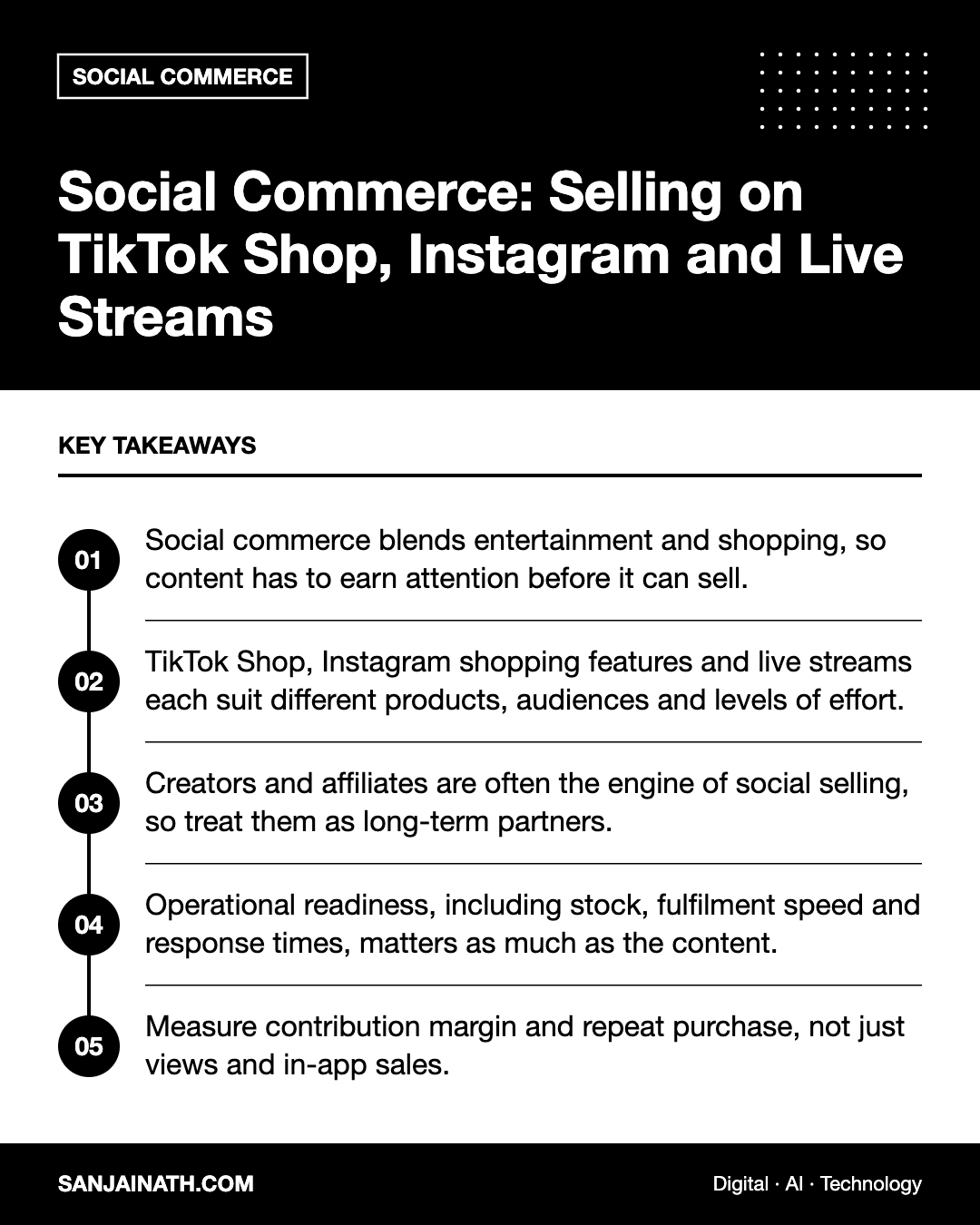
- Social commerce blends entertainment and shopping, so content has to earn attention before it can sell.
- TikTok Shop, Instagram shopping features and live streams each suit different products, audiences and levels of effort.
- Creators and affiliates are often the engine of social selling, so treat them as long-term partners.
- Operational readiness, including stock, fulfilment speed and response times, matters as much as the content.
- Measure contribution margin and repeat purchase, not just views and in-app sales.
What is social commerce?
Social commerce is the buying and selling of products directly within social media platforms. Instead of clicking an ad and landing on a separate website, a shopper might tap a product tag in a video, add an item to a basket inside the app, or buy during a live broadcast while chatting with the host.
It differs from traditional social media marketing in one important way: the platform is not just a source of traffic, it is the point of sale. That changes how you plan content, price products and serve customers.
Why it is growing
- Discovery happens in feeds: many people now find new products through short-form video rather than search.
- Less friction: in-app checkout removes steps where shoppers would otherwise drop off.
- Trust through people: recommendations from creators and real customers often feel more credible than brand advertising.
- Entertainment value: live shopping and creator content turn buying into an experience.
Comparing the main social commerce options
Platform features, availability and rules vary by country and change regularly, so always check current seller requirements in your market. At a strategic level, the main options look like this.
| Option | Best suited to | Typical content | Main demands |
|---|---|---|---|
| TikTok Shop | Impulse-friendly, visual, demonstrable products | Short videos, creator affiliate content, live sessions | High content volume, creator programmes, fast fulfilment |
| Instagram shopping features | Lifestyle, fashion, beauty and design-led brands | Product-tagged posts, Reels, Stories, collections | Strong visual identity, consistent posting, catalogue management |
| Live stream shopping | Products that benefit from demonstration, Q&A and urgency | Hosted broadcasts, launches, limited offers | Confident hosts, rehearsed run of show, real-time moderation |
Selling on TikTok Shop
TikTok rewards content that feels native to the platform: fast, authentic, often lo-fi and focused on a single idea. Polished brand advertisements frequently underperform compared with a creator simply showing a product solving a problem.
Practical steps
- Prepare your catalogue: accurate titles, clear images, competitive pricing and realistic delivery times.
- Build an affiliate programme: invite relevant creators, send samples and offer a clear commission structure.
- Create volume: post frequently and test different hooks in the first few seconds of each video.
- Go live regularly: consistent live sessions build a returning audience over time.
- Respond fast: answer comments and messages quickly, since responsiveness influences both sales and seller standing.
Content formats that tend to sell
- Before and after demonstrations.
- “Things I wish I had bought sooner” style recommendations.
- Unboxing and first impressions from creators.
- Honest comparisons and problem-solution stories.
Selling on Instagram
Instagram remains a powerful place for brand building and inspiration. Product tagging lets followers move from a post, Reel or Story to product details, and depending on your market, checkout may happen in-app or on your website.
How to make Instagram sell
- Connect a clean product catalogue so tags show accurate prices and availability.
- Tag products consistently in posts, Reels and Stories rather than occasionally.
- Use Reels for reach and Stories for conversion, with polls, questions and product stickers.
- Curate collections such as new arrivals, gift guides or seasonal edits.
- Partner with creators using branded content tools so partnerships are transparent.
Running live stream shopping
Live shopping combines demonstration, conversation and urgency. It works particularly well for beauty, fashion, gadgets, home products and food, where seeing and asking questions builds confidence.
A simple run of show
- Warm-up (first few minutes): welcome viewers, explain what is coming and tease the offer.
- Hero product: demonstrate the main product in detail and answer questions live.
- Supporting products: show bundles, accessories or complementary items.
- Offer moment: announce a time-limited deal or exclusive bundle clearly and honestly.
- Recap and close: summarise what was shown and remind viewers how to buy.
Always have a second person moderating comments, pinning products and handling questions so the host can stay focused. In the UAE and wider GCC, consider bilingual Arabic and English sessions and schedule around local evening viewing habits and seasonal peaks such as Ramadan and year-end sales.
Working with creators and affiliates
Creators are at the heart of social commerce. The most effective relationships are long-term, fairly paid and built on genuine fit between the creator’s audience and your product.
- Choose creators for audience relevance and engagement quality, not just follower counts.
- Give a clear brief with key messages, but let creators speak in their own voice.
- Offer commission, flat fees or a mix, and be transparent about terms.
- Ensure every partnership is clearly disclosed in line with platform rules and local advertising regulations.
- Reuse top-performing creator content in your own ads and product pages, with permission.
Operations, compliance and measurement
Viral moments can sell out stock in hours. Poor fulfilment, late shipments or slow replies can quickly damage seller ratings and reputation. Before scaling, confirm inventory levels, fulfilment capacity, returns processes and customer service coverage.
Metrics that matter
- Conversion rate from views or product clicks to orders.
- Contribution margin after platform fees, commissions, discounts and shipping.
- Return and cancellation rates by product and creator.
- Repeat purchase from social buyers over time.
- Creator performance including sales per video and cost per sale.
Frequently asked questions
Is social commerce right for every brand?
Not always. It works best for visual, demonstrable and reasonably priced products. High-consideration purchases can still benefit, but social content may play more of a discovery and trust-building role than a direct sales role.
Should I sell in-app or send traffic to my website?
In-app checkout usually reduces friction and can lift conversion, while your website gives you more control over data and the customer relationship. Many brands use both and compare margin and repeat purchase across each.
How often should brands go live?
Consistency matters more than frequency. A regular, predictable schedule, such as weekly, helps audiences return. Start with a manageable cadence and increase it once you have a reliable format and team.
Do I need big creators to succeed?
No. Many brands find that a larger group of smaller, highly relevant creators produces more authentic content and steadier sales than one or two large names.
Final thoughts
Social commerce rewards brands that entertain first and sell second. Pick the platforms that suit your products, invest in creators and consistent content, and make sure operations can keep up with demand. Measure profitability and loyalty rather than views alone, and social selling can become a durable channel instead of a series of one-off viral spikes.