

Direct-to-consumer brands have a rare advantage: they own the customer relationship, the data and the margin that wholesalers and marketplaces would otherwise take. The flip side is that every sale has to be earned, and rising acquisition costs mean that the ecommerce growth strategies that worked a few years ago rarely work on their own today. This guide sets out a practical, balanced approach to growing a DTC brand sustainably, from unit economics to retention, channels and operations.
Key takeaways
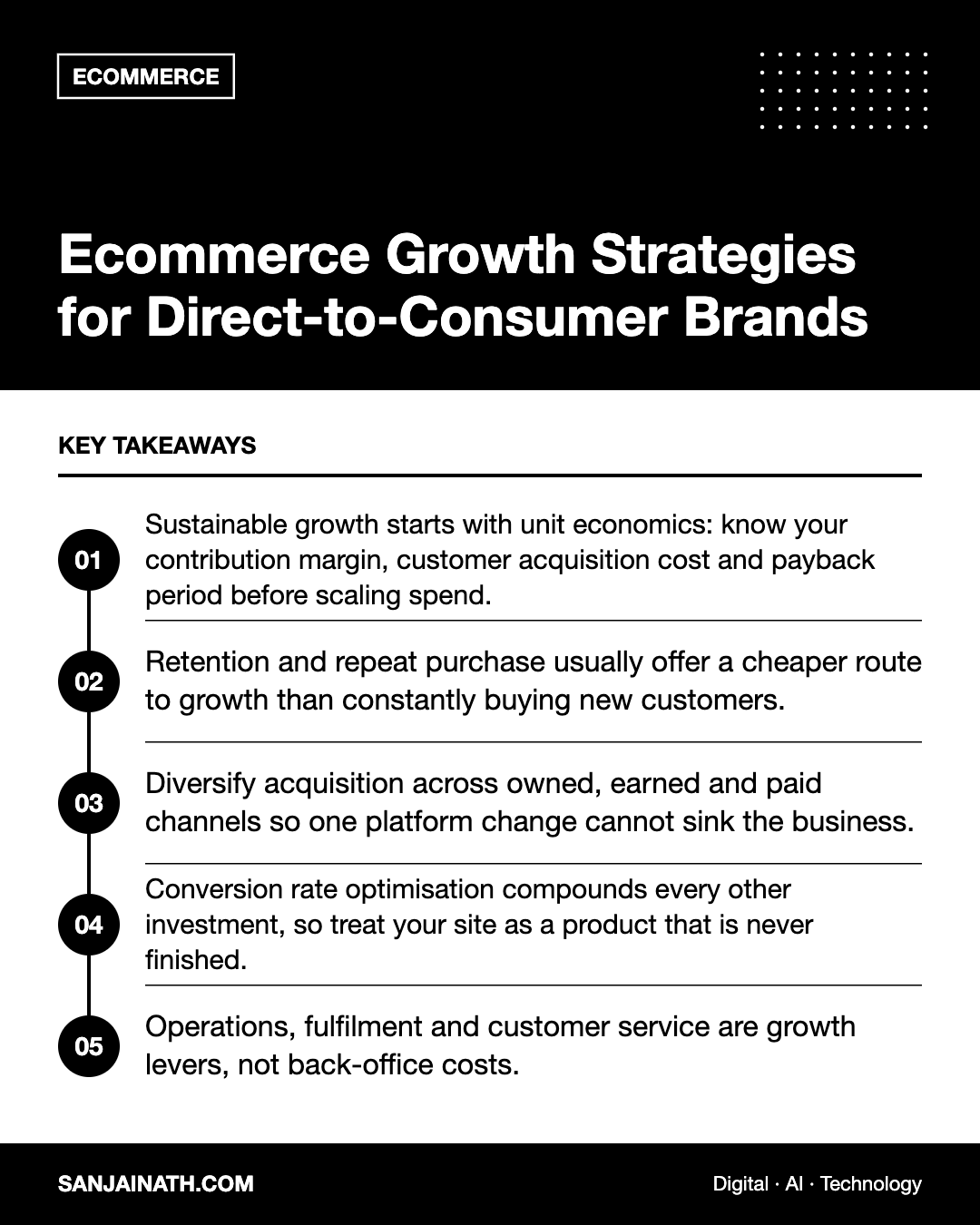
- Sustainable growth starts with unit economics: know your contribution margin, customer acquisition cost and payback period before scaling spend.
- Retention and repeat purchase usually offer a cheaper route to growth than constantly buying new customers.
- Diversify acquisition across owned, earned and paid channels so one platform change cannot sink the business.
- Conversion rate optimisation compounds every other investment, so treat your site as a product that is never finished.
- Operations, fulfilment and customer service are growth levers, not back-office costs.
Start with unit economics, not ad spend
Many DTC brands scale advertising before they understand whether each order actually makes money. Before choosing any of the ecommerce growth strategies below, build a simple model of what a typical order and a typical customer are worth.
The numbers every founder should know
- Average order value (AOV): revenue divided by number of orders over a period.
- Contribution margin per order: revenue minus product cost, shipping, packaging, payment fees, discounts and returns.
- Customer acquisition cost (CAC): total marketing and sales spend to acquire new customers, divided by the number of new customers.
- Customer lifetime value (LTV): the contribution margin a customer generates over their relationship with you, not just their revenue.
- Payback period: how long it takes for a new customer’s cumulative contribution margin to cover their CAC.
If the payback period is longer than your cash runway can support, growth will strain the business rather than strengthen it. Fixing margin, pricing or AOV often unlocks more growth than any new channel.
Build retention into the business model
Repeat customers already trust you, cost little to reach and tend to buy more over time. A growing base of loyal customers also makes paid acquisition safer, because each new customer is worth more.
Practical retention levers
- Post-purchase journey: clear order updates, delivery tracking and a thoughtful unboxing experience set the tone for a second purchase.
- Lifecycle email and SMS: welcome series, replenishment reminders, cross-sell flows and win-back campaigns triggered by behaviour rather than a fixed calendar.
- Subscriptions or auto-replenishment: ideal for consumables such as coffee, skincare, supplements or pet food.
- Loyalty and referral programmes: reward the behaviours that matter, such as repeat orders, reviews and referrals, rather than simply handing out discounts.
- Community: content, events or private groups that give customers a reason to stay connected between purchases.
Track cohort retention monthly: of the customers who first bought in a given month, what share bought again within 30, 60 and 90 days? That single view tells you whether your product and experience are genuinely improving.
Diversify customer acquisition channels
Relying on a single paid social platform is one of the biggest risks a DTC brand can take. Algorithm changes, privacy updates and auction pressure can all raise costs overnight. A resilient mix blends several channel types.
| Channel type | Examples | Strength | Watch out for |
|---|---|---|---|
| Owned | Email list, SMS, website content, app | Low marginal cost, full control | Takes time to build an audience |
| Earned | SEO, PR, reviews, word of mouth, creators who love the product | Credibility and compounding reach | Harder to predict and scale on demand |
| Paid | Paid social, search ads, shopping ads, affiliates | Fast, measurable, scalable | Rising costs and platform dependency |
| Partnerships | Co-branded launches, retail pop-ups, marketplaces | Access to new audiences | Brand control and margin trade-offs |
Creative is the new targeting
As ad platforms automate more of their targeting, the creative itself does much of the work of finding the right audience. Invest in a steady pipeline of varied creative: founder stories, product demonstrations, customer testimonials, comparisons and problem-solution videos. Test concepts, not just colours and headlines.
Treat conversion rate optimisation as a permanent discipline
Every improvement in conversion rate makes every channel more efficient. A structured optimisation programme often delivers more value than a bigger media budget.
A simple CRO checklist
- Fast mobile pages, since most DTC traffic arrives on phones.
- Clear value proposition above the fold: what it is, who it is for and why it is better.
- High-quality product photography and video, including scale and in-use shots.
- Visible reviews, ratings and user-generated content close to the add-to-cart button.
- Transparent shipping costs, delivery times and returns policy before checkout.
- A short checkout with guest checkout and popular wallets and local payment methods.
- Trust signals such as secure payment badges, contact details and real customer service options.
Use analytics and session recordings to find where people drop off, form a hypothesis, test one change at a time and document what you learn so the team builds knowledge rather than repeating experiments.
Increase average order value thoughtfully
Raising AOV improves margin per order and helps absorb shipping and acquisition costs. The best tactics add genuine value for the customer rather than feeling like a trick.
- Bundles and kits: curated sets that solve a complete problem, such as a starter routine or a gift box.
- Free shipping thresholds: set slightly above your current AOV to encourage one more item.
- Relevant cross-sells: accessories, refills or complementary products shown on product and cart pages.
- Tiered offers: better value at higher quantities for consumables.
Expand into new markets and channels carefully
Once the core is healthy, geographic expansion and additional sales channels can open new growth. For brands in the UAE and wider GCC, cross-border selling within the region is a natural next step, but it requires attention to local payment preferences, cash-on-delivery expectations in some markets, Arabic-language content, customs and delivery times.
Questions to answer before expanding
- Is there proven demand, such as organic traffic or enquiries from that market?
- Can you deliver reliably and at an acceptable cost?
- Do you need localised pricing, language, payment methods or product variants?
- Will marketplaces or retail partners help or cannibalise your direct channel?
Make operations a growth advantage
Growth exposes operational weaknesses quickly. Stock-outs waste marketing spend, slow shipping drives refunds and poor service erodes reviews. Invest early in inventory forecasting, dependable fulfilment partners, clear service standards and a help centre that answers common questions. Returns data is also a goldmine: recurring reasons such as sizing or damage point directly to product page or packaging fixes.
Frequently asked questions
What are the most effective ecommerce growth strategies for a new DTC brand?
Focus first on product-market fit, healthy unit economics and a high-converting website. Then combine one or two scalable paid channels with owned channels such as email, and build retention flows from day one so each customer is worth more over time.
Should DTC brands sell on marketplaces?
Marketplaces can add reach and credibility, but they reduce margin and customer data ownership. Many brands use them selectively for discovery or specific products while keeping their own site as the main home of the brand.
How do I know whether to prioritise acquisition or retention?
Look at your cohort retention and payback period. If customers rarely return, fix the product and post-purchase experience before scaling acquisition. If retention is strong, you can usually afford to invest more aggressively in acquiring new customers.
How often should I review growth metrics?
Review channel performance weekly, and unit economics, cohort retention and LTV to CAC ratios monthly. Quarterly reviews are a good moment to revisit pricing, product mix and channel strategy.
Final thoughts
The strongest ecommerce growth strategies are rarely a single hack. They are a system: sound unit economics, a product people want to buy again, a diversified channel mix, a constantly improving website and operations that keep promises. Build that system patiently, measure it honestly and your DTC brand will be able to grow without buying every sale at an ever-higher price.