
Performance Max is Google’s goal-based campaign type that uses automation to serve your ads across Search, Shopping, YouTube, Display, Discover, Gmail and Maps from a single campaign. Instead of building separate campaigns for every channel, you supply goals, creative assets and audience signals, and Google’s bidding and targeting systems decide where, when and to whom your ads appear. Used well, it can unlock reach and conversions you would struggle to find manually; used carelessly, it can spend your budget on low-value placements while you have little visibility into why.
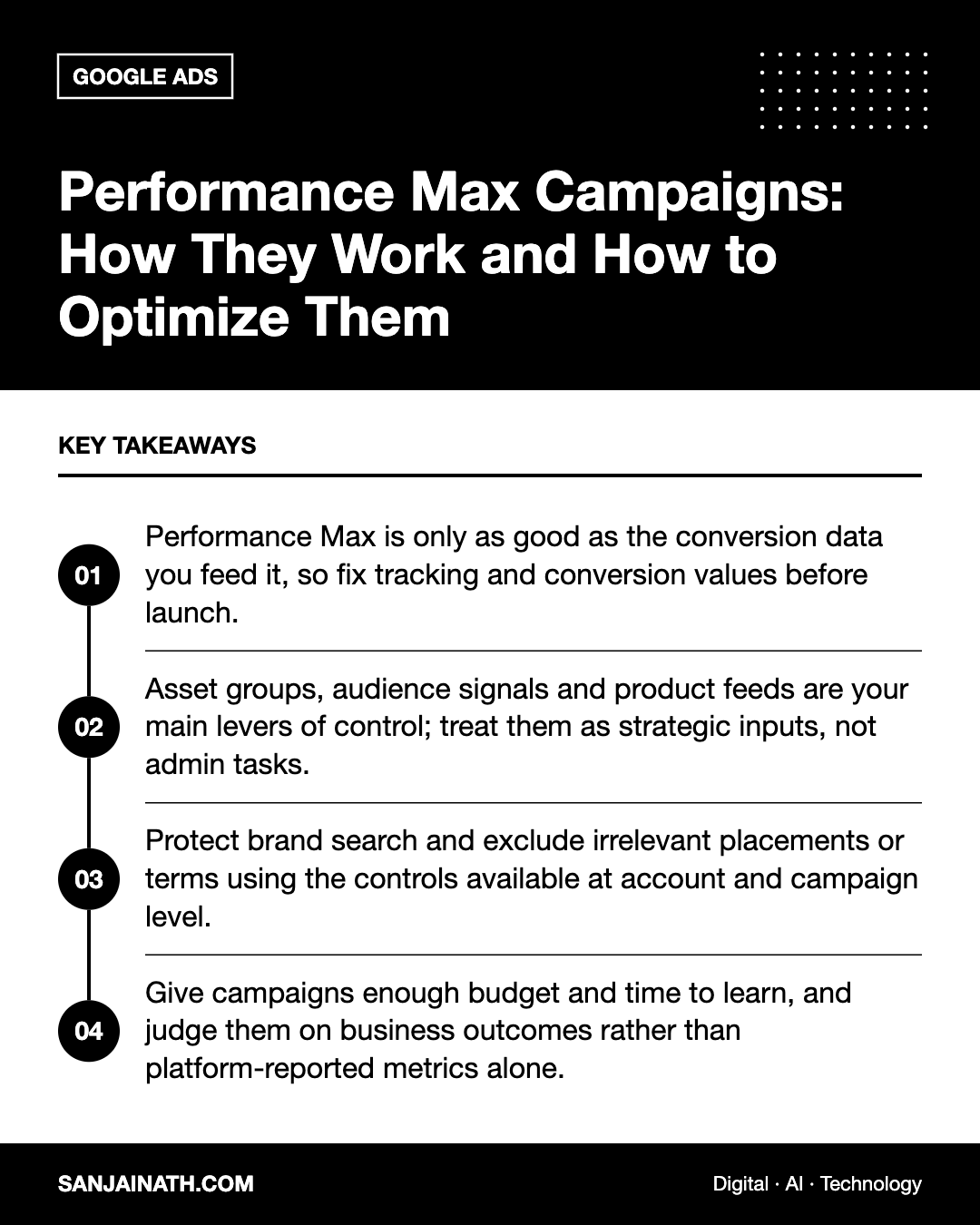
Key takeaways
- Performance Max is only as good as the conversion data you feed it, so fix tracking and conversion values before launch.
- Asset groups, audience signals and product feeds are your main levers of control; treat them as strategic inputs, not admin tasks.
- Protect brand search and exclude irrelevant placements or terms using the controls available at account and campaign level.
- Give campaigns enough budget and time to learn, and judge them on business outcomes rather than platform-reported metrics alone.
How Performance Max works
At its core, Performance Max combines three things: a conversion goal, a pool of creative assets, and Google’s machine learning. You tell Google what a valuable outcome looks like (a purchase, a lead, a store visit), give it headlines, descriptions, images, videos and logos, and optionally connect a Merchant Center product feed. The system then assembles ads on the fly for each placement and bids in real time based on the predicted likelihood of a conversion.
The building blocks
- Campaign settings: budget, bidding strategy (maximise conversions or conversion value, with optional target CPA or target ROAS), locations and languages.
- Asset groups: collections of creative assets built around a theme, product category or audience. A campaign can hold several.
- Audience signals: hints such as your customer lists, website visitors, custom segments based on search terms, and interests. These guide the algorithm early on but do not restrict it.
- Listing groups: for retail campaigns, the subset of your product feed that each asset group is allowed to advertise.
The important mental shift is that you are no longer choosing keywords and placements directly. You are shaping the inputs and the definition of success, then letting the system find the traffic.
When Performance Max makes sense
Performance Max tends to suit advertisers who have clear, trackable conversion goals and enough conversion volume for the algorithm to learn from. E-commerce businesses with a healthy product feed are the classic fit, but lead generation brands can succeed too if they import offline conversion data so the system learns which leads actually become customers.
It is less suitable when your conversion tracking is unreliable, when you need tight control over exactly where ads appear for compliance reasons, or when your budget is so small that the campaign cannot gather meaningful data. In those cases, well-structured Search and Shopping campaigns may give you better results and clearer insight.
Setting up Performance Max for success
Most underperforming campaigns fail before they launch, because the foundations were weak. Work through this sequence first.
- Audit conversion tracking. Make sure only meaningful actions are marked as primary conversions. If newsletter sign-ups and purchases are both counted as equal conversions, the system will happily chase the cheaper one.
- Assign conversion values. Even for lead generation, estimated values help the algorithm distinguish a high-intent demo request from a brochure download.
- Enable enhanced conversions and offline imports where possible, so the system receives better-quality signals.
- Clean your product feed. Titles, descriptions, images, prices and availability should be accurate and descriptive, because the feed effectively becomes your keyword list for Shopping placements.
- Set account-level brand exclusions or negative keywords using whichever options are available in your account, so Performance Max does not simply harvest brand searches you would win anyway.
- Decide on final URL expansion. If you only want traffic sent to specific landing pages, turn it off or exclude URLs that should never receive ad traffic, such as careers or support pages.
How to structure asset groups
Asset groups are where you reclaim a surprising amount of control. A single asset group containing every product and a generic message gives the system very little to work with. Instead, build asset groups around meaningful themes.
Common structuring approaches
| Approach | Best for | Watch out for |
|---|---|---|
| By product category | Retailers with distinct ranges and margins | Too many small groups can dilute data |
| By audience or persona | Services with different buyer types | Signals overlap, so messaging must be genuinely different |
| By margin or priority tier | Stores wanting to push best-sellers or high-margin items | Requires custom labels in the feed |
| By geography or language | Businesses serving several markets, such as across the GCC | Often better handled as separate campaigns |
Within each group, supply the full range of assets: multiple headlines and long headlines, several descriptions, landscape, square and portrait images, and at least one high-quality video. If you do not upload video, Google may generate one automatically from your images, and the result is rarely as strong as purpose-made creative.
Optimising Performance Max campaigns
Once a campaign is live, resist the urge to make daily changes. Frequent edits to budgets, targets and assets can reset or disrupt learning. Plan a regular review rhythm instead, perhaps weekly for light checks and monthly for deeper changes.
A practical optimisation checklist
- Review asset performance ratings and replace consistently weak assets with new variations rather than deleting everything at once.
- Check search term and category insights to spot irrelevant themes, then add negatives or exclusions where the platform allows.
- Look at placement and channel reporting that is available to you, and exclude poor-quality sites or apps through account-level content settings.
- Adjust targets gradually. Moving target ROAS or CPA in small steps is safer than dramatic jumps that can throttle delivery.
- Refresh creative seasonally and around key events, such as Ramadan, White Friday or back-to-school periods in the region.
- Segment products by performance using custom labels, so strong sellers are not starving weaker ones, or vice versa.
Measure what matters
Platform-reported conversions can include view-through and cross-channel credit that would have happened anyway. Compare Performance Max results against your CRM, e-commerce back end and total business revenue. Where budget allows, run holdout or geo-based experiments to understand incremental impact rather than relying on attributed numbers alone.
Common Performance Max mistakes to avoid
- Launching with weak tracking, which teaches the algorithm to optimise towards the wrong outcomes.
- Letting brand traffic inflate results, making the campaign look far more profitable than it truly is.
- Running Performance Max and Shopping campaigns on the same products without a plan, leading to confusion about which campaign serves.
- Uploading low-quality or generic creative that fails to stand out on visual placements like YouTube and Discover.
- Judging the campaign too early, before it has had a reasonable learning period and enough conversions.
Frequently asked questions
Does Performance Max replace Search campaigns?
Not necessarily. Many advertisers run Performance Max alongside Search campaigns. Where a search query exactly matches an eligible keyword in a Search campaign, that campaign typically takes priority, so keeping core keywords in Search can preserve control and clearer reporting.
How long does Performance Max take to learn?
There is no fixed period, but most campaigns need a few weeks and a reasonable number of conversions before performance stabilises. Avoid major changes during this window unless something is clearly broken.
Can I use Performance Max for lead generation?
Yes. The key is feeding back lead quality by importing offline conversions or qualified-lead events from your CRM, so the system learns to prioritise leads that actually turn into revenue.
How much budget does Performance Max need?
Enough to generate consistent conversions at your target cost. As a rule of thumb, your daily budget should comfortably cover several times your target cost per acquisition, otherwise the campaign may struggle to learn.
Final thoughts
Performance Max rewards advertisers who invest in the fundamentals: accurate conversion data, a clean feed, thoughtful asset groups and strong creative. Treat it as a powerful engine that needs good fuel and clear direction rather than a set-and-forget shortcut. Build solid foundations, review it on a steady rhythm, and measure it against real business results, and Performance Max can become a dependable driver of profitable growth.