

Machine learning powers many everyday experiences, from spam filters and product recommendations to fraud alerts and demand forecasts. Yet the terminology can make it feel inaccessible. This guide covers machine learning basics in plain language: what models are, how training works, how predictions are made and what business leaders need to know before starting a project.
Key takeaways
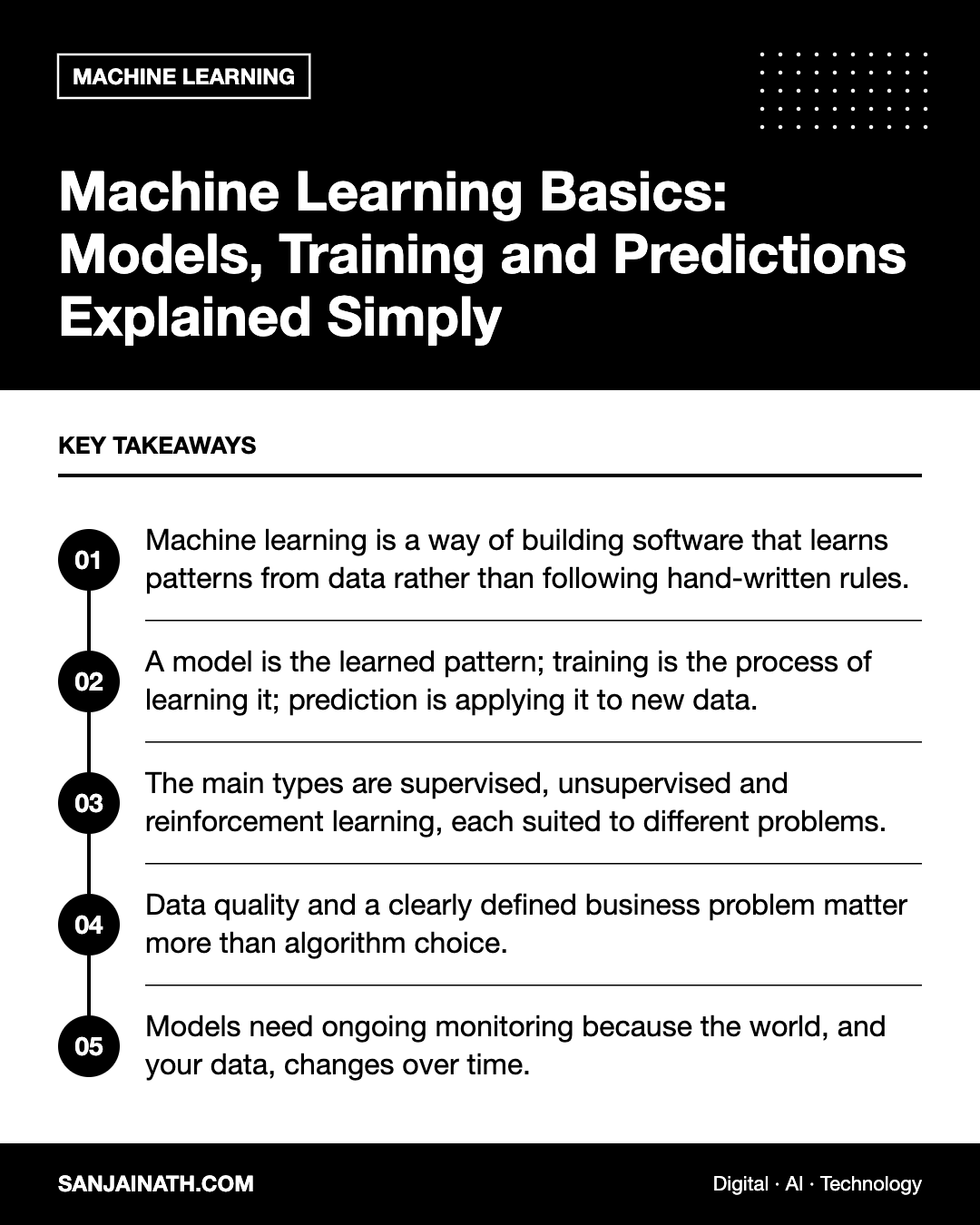
- Machine learning is a way of building software that learns patterns from data rather than following hand-written rules.
- A model is the learned pattern; training is the process of learning it; prediction is applying it to new data.
- The main types are supervised, unsupervised and reinforcement learning, each suited to different problems.
- Data quality and a clearly defined business problem matter more than algorithm choice.
- Models need ongoing monitoring because the world, and your data, changes over time.
What is machine learning?
Traditional software follows explicit rules written by programmers: “if the invoice total exceeds this amount, flag it for approval”. Machine learning takes a different approach. Instead of writing every rule, you provide examples, and an algorithm discovers the patterns that connect inputs to outcomes.
Imagine teaching a new employee to spot suspicious transactions. You could write a long rulebook, or you could show them thousands of past transactions labelled “legitimate” or “fraudulent” and let them learn the warning signs. Machine learning works much like the second approach, but at far greater scale and speed.
Machine learning basics: the key terms
| Term | Plain-language meaning |
|---|---|
| Data | The examples the system learns from, such as past sales, customer records or images |
| Features | The input details used to make a prediction, for example customer age, purchase history or location |
| Label | The known answer in training data, such as “churned” or “did not churn” |
| Algorithm | The method used to find patterns in data |
| Model | The result of training: a learned set of patterns that can make predictions |
| Training | The process of feeding data to an algorithm so it can learn |
| Inference or prediction | Using a trained model on new data to produce an output |
The three main types of machine learning
Supervised learning
The model learns from labelled examples, where the correct answer is known. It is used for:
- Classification: predicting categories, such as spam or not spam, or likely to buy or not.
- Regression: predicting numbers, such as next month’s sales or a property’s likely value.
Unsupervised learning
The model looks for structure in unlabelled data. Common uses include customer segmentation, grouping similar products and detecting unusual activity that differs from normal patterns.
Reinforcement learning
The model learns by trial and error, receiving rewards or penalties for its actions. It is used in areas such as robotics, game-playing systems and some optimisation problems, and it also plays a role in refining modern language models.
How training works, step by step
- Define the problem: what exactly are you trying to predict, and how will the prediction be used?
- Collect and prepare data: gather relevant historical data, clean errors, handle missing values and ensure consistency.
- Split the data: keep a portion aside for testing so you can judge performance on examples the model has not seen.
- Train the model: the algorithm adjusts its internal parameters to reduce errors on the training data.
- Evaluate: measure accuracy and other metrics on the test data.
- Tune and iterate: try different features, algorithms or settings to improve results.
- Deploy: integrate the model into a real process or application.
- Monitor: track performance over time and retrain when it declines.
How predictions are made
Once trained, a model receives new data, for example a customer’s recent activity, and produces an output, such as a probability that they will cancel their subscription. That output feeds a business decision: send a retention offer, alert an account manager or do nothing.
It is important to remember that most predictions are probabilities, not certainties. A model might say a transaction has a high likelihood of being fraudulent, and a human or rule then decides what action to take.
Common pitfalls to understand
Overfitting
A model that memorises its training data rather than learning general patterns performs well in testing but poorly on new data. Separate test data and simpler models help prevent this.
Poor or biased data
Models learn from the past. If historical data is incomplete or reflects unfair decisions, the model may repeat those problems. Review data sources carefully and test outcomes across different groups.
Data drift
Customer behaviour, markets and products change. A model trained on last year’s data may gradually become less accurate, so monitoring and retraining are essential.
Unclear business value
A highly accurate model that nobody uses delivers nothing. Define how predictions will change decisions before investing in development.
Machine learning vs generative AI
Generative AI, such as large language models, is a branch of machine learning. Traditional machine learning models typically predict a label or number, while generative models produce new content, including text, images and code. Both rely on the same principles of learning from data, and many business solutions combine them.
Getting started in your organisation
- Identify a decision made frequently that would benefit from better prediction, such as lead prioritisation or stock planning.
- Check whether you have enough historical, reliable data for that decision.
- Explore built-in machine learning features in your existing CRM, analytics or ERP systems before commissioning custom work.
- Consider data protection requirements, including regional regulations in the UAE and wider GCC, when handling personal data.
Questions to ask before a machine learning project
- What decision will the prediction improve, and who will act on it?
- How is that decision made today, and how well does it work?
- Do we have reliable historical data that includes the outcome we want to predict?
- What would a wrong prediction cost, and how will we handle it?
- Who will own the model after launch?
Frequently asked questions
Do I need to know coding to understand machine learning basics?
No. Understanding machine learning basics, such as data, models, training and predictions, is enough to identify opportunities and work effectively with technical teams.
How much data does a machine learning model need?
It depends on the problem’s complexity and the variety in the data. Simple problems can work with modest datasets, while complex tasks need much more. Quality and relevance matter as much as quantity.
Is machine learning the same as artificial intelligence?
Machine learning is a subset of artificial intelligence. AI is the broader field of making machines perform tasks that require intelligence; machine learning is the most common approach used today.
How accurate are machine learning models?
Accuracy varies widely by problem and data. Evaluate models against a meaningful baseline, such as current manual performance, rather than expecting perfection.
Final thoughts
Machine learning is less mysterious than it sounds: it learns patterns from examples and applies them to new situations. By grasping these machine learning basics, you can ask better questions, spot realistic opportunities and avoid common pitfalls. Start with a clear business problem and good data, and the technology becomes a practical tool for better decisions.