

Many businesses publish content regularly yet see few enquiries in return. The missing ingredient is usually not effort but direction. A well-defined content marketing strategy connects what you publish to the problems your buyers are trying to solve and the path they take towards a purchase. This guide walks through a practical framework for building a content marketing strategy that generates qualified leads, not just page views.
Key takeaways
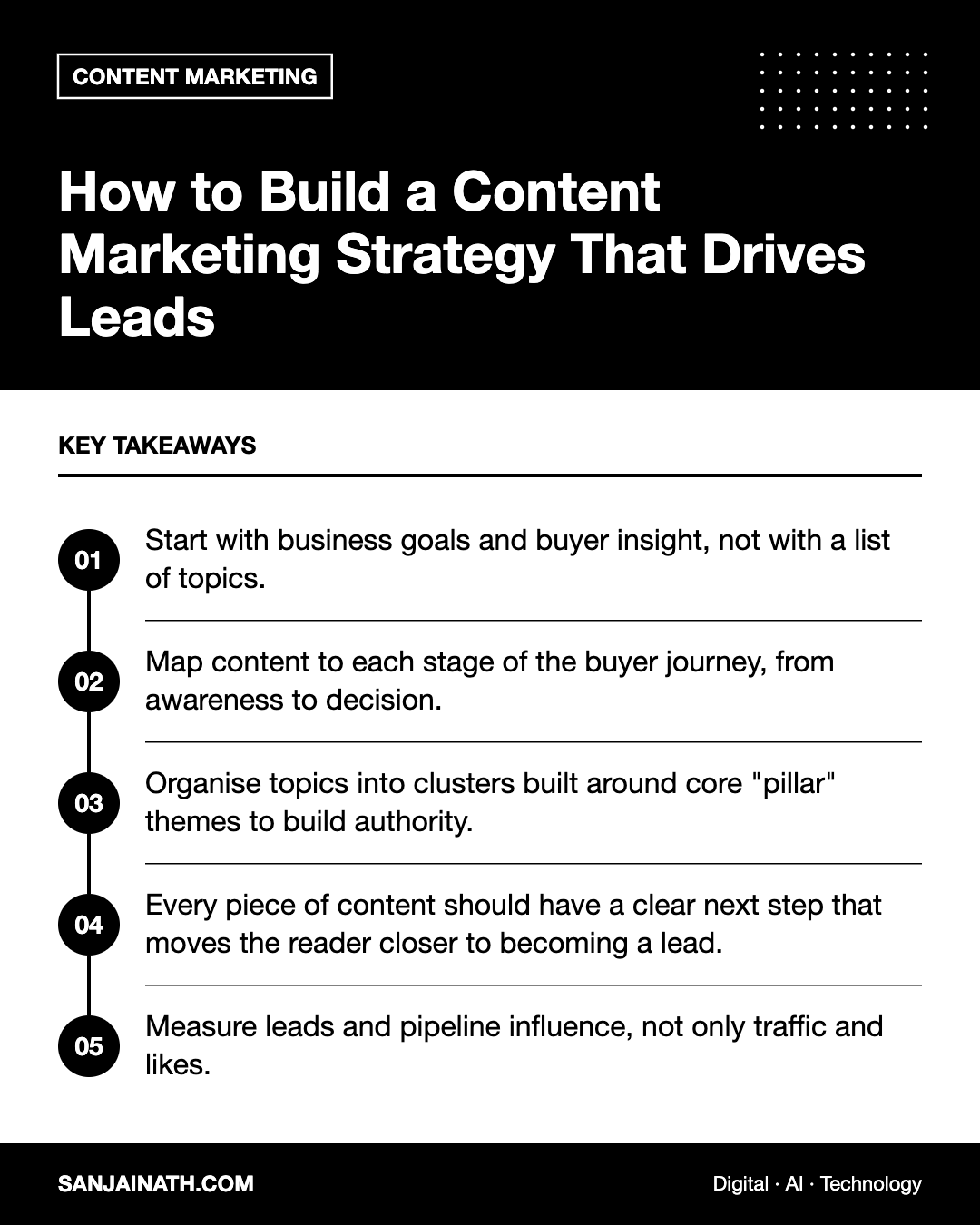
- Start with business goals and buyer insight, not with a list of topics.
- Map content to each stage of the buyer journey, from awareness to decision.
- Organise topics into clusters built around core “pillar” themes to build authority.
- Every piece of content should have a clear next step that moves the reader closer to becoming a lead.
- Measure leads and pipeline influence, not only traffic and likes.
Step 1: Define goals that link to revenue
A content marketing strategy should begin with outcomes the business cares about. Examples include increasing demo requests, generating qualified consultation bookings or growing a newsletter audience that later converts. Make goals specific and measurable, and agree with sales on what counts as a qualified lead.
- What do we want readers to do after consuming our content?
- Which products or services should content support first?
- How will we know content contributed to a sale?
Step 2: Understand your buyers deeply
Generic personas produce generic content. Build buyer profiles from real evidence:
- Interview customers about why they started looking for a solution and what nearly stopped them buying.
- Talk to your sales team about recurring questions and objections.
- Review support tickets for common problems.
- Study search data to see how people phrase their questions.
Capture each buyer’s role, goals, pain points, decision criteria, preferred channels and who else influences the decision. In B2B markets across the GCC, purchases often involve several stakeholders and a strong emphasis on trust and relationships, so content should support the whole buying group.
Step 3: Map content to the buyer journey
| Stage | Buyer mindset | Content formats | Call to action |
|---|---|---|---|
| Awareness | “I have a problem or goal.” | Educational articles, guides, social posts, short videos | Read more, subscribe |
| Consideration | “What are my options?” | Comparisons, checklists, webinars, templates | Download, register |
| Decision | “Who should I choose?” | Case studies, pricing guides, demos, FAQs | Book a call, request a quote |
| Retention | “How do I get more value?” | Onboarding guides, tips, community content | Upgrade, refer |
Most businesses over-invest in awareness content and neglect decision-stage material, which is often what tips a prospect into becoming a lead.
Step 4: Build topic clusters and pillar pages
Rather than publishing isolated posts, organise content into clusters:
- Choose three to five pillar themes that align with your core offerings.
- Create a comprehensive pillar page for each theme.
- Publish cluster articles that explore specific subtopics in depth.
- Link cluster articles to the pillar and to each other.
This structure helps readers explore a topic fully, and helps search engines and AI tools recognise your expertise in that area.
Step 5: Create lead-generating assets
Content turns into leads when it offers enough value that readers willingly share their details or take the next step. Effective lead magnets include:
- Practical templates, checklists and calculators.
- In-depth guides or industry reports based on your own expertise.
- Webinars and workshops with live Q&A.
- Free assessments, audits or consultations.
Keep forms short, explain what happens next and follow up promptly with relevant, helpful communication rather than immediate hard selling.
Step 6: Plan distribution, not just creation
Publishing is only half the job. A simple distribution plan for each piece might include:
- Optimising for search with a clear target keyword and intent.
- Sharing on LinkedIn and other relevant social platforms, adapted to each format.
- Featuring in your email newsletter.
- Equipping sales with content to send to prospects.
- Repurposing into videos, carousels, short posts and presentations.
- Promoting high-value assets with targeted paid campaigns.
Step 7: Set up a sustainable workflow
Editorial calendar
Plan content a quarter ahead, balanced across pillars and journey stages. Consistency matters more than volume.
Roles and approvals
Define who researches, writes, edits, approves and publishes. Involve subject-matter experts for credibility, even if only through short interviews.
Content refresh
Schedule regular reviews of existing content. Updating a strong article often delivers better results than writing a new one.
Step 8: Measure what matters
| Metric type | Examples |
|---|---|
| Reach | Organic traffic, impressions, social reach |
| Engagement | Time on page, scroll depth, return visits |
| Conversion | Form submissions, downloads, bookings |
| Revenue | Leads influenced, pipeline value, closed deals |
Use UTM parameters, CRM integration and conversion tracking to connect content to outcomes. Review performance monthly and adjust topics and formats based on what drives qualified leads.
Common content marketing strategy mistakes to avoid
Even well-resourced teams fall into predictable traps. Recognising them early keeps your content marketing strategy focused on leads rather than activity.
- Writing for yourself, not your buyer: content that showcases internal jargon or product features without addressing buyer problems rarely converts.
- Chasing volume over quality: publishing frequently with thin content dilutes your authority and wastes promotion effort.
- No clear next step: articles that end abruptly leave interested readers with nowhere to go. Add a relevant call to action to every piece.
- Ignoring sales input: sales teams hear objections and questions daily. Without their input, content misses the issues that actually stall deals.
- Treating publishing as the finish line: without distribution, even excellent content struggles to find an audience.
- Measuring vanity metrics only: traffic and likes are useful signals, but they do not prove commercial impact on their own.
A quick self-assessment
Review your last ten published pieces and ask three questions of each: which buyer stage did it serve, what action did it invite, and did it generate any measurable response? Patterns in the answers will show where your strategy needs the most attention, whether that is more decision-stage content, stronger calls to action or better promotion.
Frequently asked questions
How long does a content marketing strategy take to generate leads?
Some assets, such as decision-stage case studies promoted to existing audiences, can produce leads quickly. Organic search growth typically takes several months of consistent publishing.
How much content should we publish?
Publish what you can produce consistently at high quality. One excellent, well-promoted article a week often outperforms several rushed ones.
What should a content marketing strategy document include?
It should include goals, buyer profiles, journey mapping, pillar themes, formats, distribution channels, workflow, roles and measurement. Keep it concise enough that the team actually uses it.
Is content marketing effective for B2B?
Yes. B2B buyers often research extensively before contacting suppliers, so helpful, credible content allows you to influence decisions early.
Final thoughts
A content marketing strategy that drives leads is built on buyer understanding, journey-focused planning and clear calls to action. Start with goals, map content to real questions, invest in distribution and measure outcomes that matter to the business. With that discipline, content becomes a dependable source of pipeline rather than a publishing obligation.