

Answer engine optimization (AEO) is the discipline of structuring content so that answer-driven platforms, including AI assistants such as ChatGPT and Gemini, featured snippets and voice assistants, can pick out a clear, accurate response to a user’s question. Where traditional SEO asks “How do I rank this page?”, AEO asks “How do I become the answer?” This guide focuses on the practical page-level structure that makes your content answer-ready.
Key takeaways
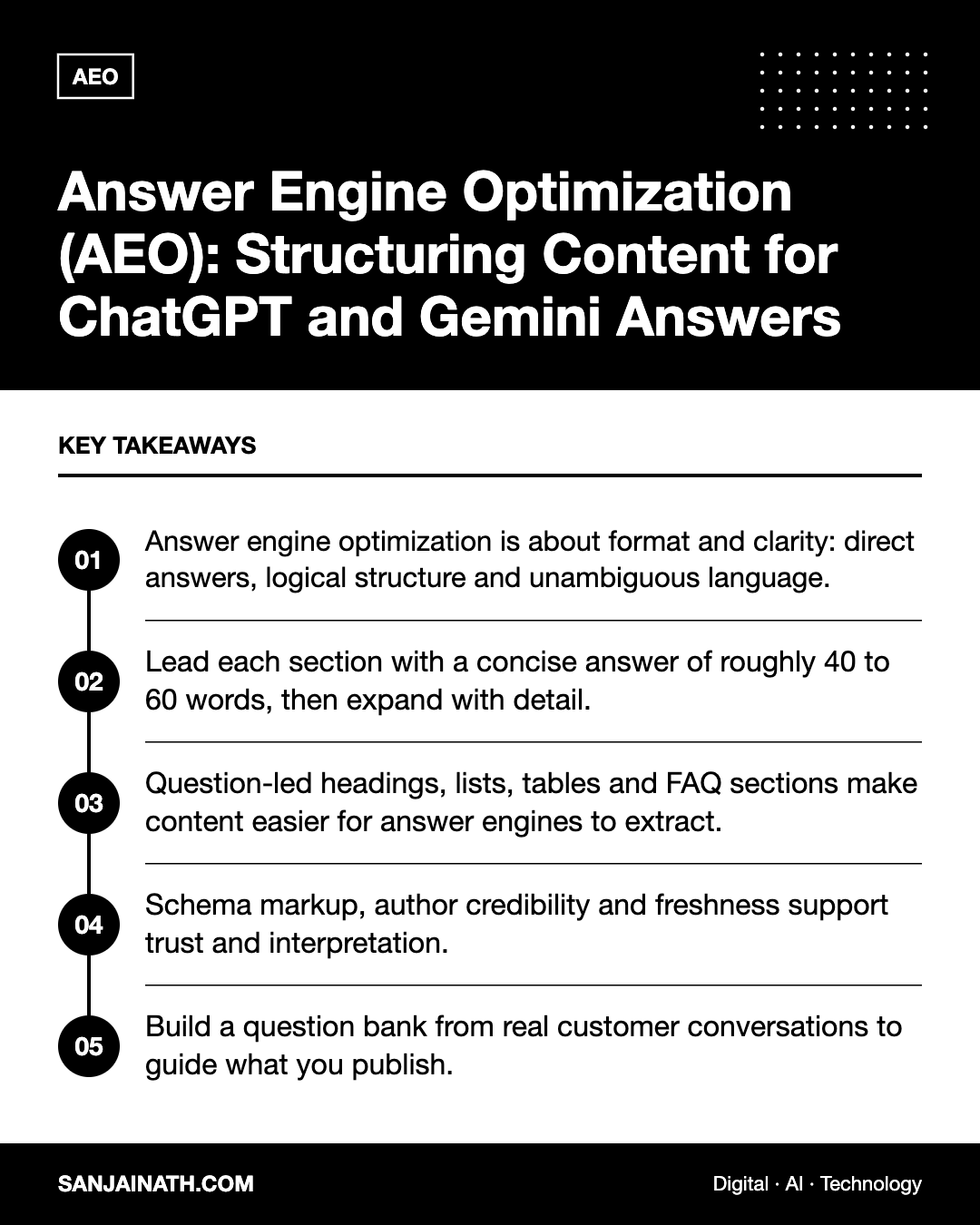
- Answer engine optimization is about format and clarity: direct answers, logical structure and unambiguous language.
- Lead each section with a concise answer of roughly 40 to 60 words, then expand with detail.
- Question-led headings, lists, tables and FAQ sections make content easier for answer engines to extract.
- Schema markup, author credibility and freshness support trust and interpretation.
- Build a question bank from real customer conversations to guide what you publish.
How do answer engines read your content?
Answer engines break pages into passages and evaluate which passage best addresses a query. They reward content where a question is clearly identified, the answer follows immediately, and supporting detail is organised logically. Long, meandering introductions and answers buried mid-paragraph make extraction harder.
It helps to think like an editor preparing content for a reference book: every section should stand on its own and deliver something specific.
What is the answer-first content structure?
A reliable pattern for answer engine optimization is the inverted pyramid, borrowed from journalism:
- Question as a heading, phrased the way people ask it.
- Direct answer in the first one or two sentences.
- Supporting detail: context, conditions and exceptions.
- Structured elements: steps, lists or a table.
- Next step: a link or pointer to related information.
Example
Heading: “How long does it take to register a trade name?”
Answer: “Timelines depend on the jurisdiction and whether documents are complete; many straightforward applications are processed quickly once all paperwork is submitted. The main factors are…” followed by a short list of factors and steps.
Notice the answer is honest and specific about what influences the outcome, without inventing a figure the writer cannot stand behind.
Which writing techniques make answers easier to extract?
Use definitional sentences
Sentences in the form “X is a Y that does Z” are easy for answer engines to quote. Place them at the start of sections that introduce a concept.
Keep paragraphs short and focused
One idea per paragraph reduces ambiguity. Aim for two to four sentences.
Name things explicitly
Avoid relying on “it”, “this” or “they” across paragraphs. Repeating the subject makes each passage understandable on its own.
Use lists and tables deliberately
- Numbered lists for sequential processes.
- Bulleted lists for options, features or criteria.
- Tables for comparisons across consistent attributes.
State conditions and exceptions
Good answers say when something applies and when it does not. This improves accuracy and makes your content more trustworthy than oversimplified alternatives.
How do you build a question bank?
AEO succeeds when you answer the questions people actually ask. Gather them from:
- Sales and support conversations, including email and WhatsApp enquiries.
- The “People also ask” boxes and related searches in search results.
- Community forums, social media comments and review sites.
- Internal site search logs.
- Questions you can pose to AI assistants to see what related topics they surface.
Group questions by intent, such as definitions, how-to, comparisons, costs and troubleshooting, and map each group to a page or section. For GCC audiences, capture Arabic and English phrasing, as people may ask the same question differently in each language.
Page templates for common answer types
| Question type | Best structure | Example heading |
|---|---|---|
| Definition | One-sentence definition, then context and examples | What is a customer data platform? |
| How-to | Short summary, then numbered steps | How do I set up email authentication? |
| Comparison | Verdict summary, then comparison table | Shopify vs WooCommerce: which is better? |
| Cost or time | Honest range or influencing factors, then breakdown | What affects website development cost? |
| Troubleshooting | Likely causes, then fixes in order of simplicity | Why is my contact form not sending emails? |
What technical setup supports AEO?
- Schema markup: use FAQPage, HowTo, Article, Product and Organisation markup where appropriate, reflecting content that is visible on the page.
- Clean HTML headings: use a proper H2 and H3 hierarchy rather than styled paragraphs.
- Accessibility: content should load without requiring interaction or scripts to reveal it.
- Dates and authorship: show when content was published or updated, and who wrote it.
- Internal links: connect related answers so engines understand topic relationships.
Which trust signals help you become the answer?
Answer engines aim to give reliable responses, so credibility matters. Strengthen it by publishing author bios with relevant experience, citing reputable sources where claims need support, keeping information current and maintaining consistent brand details across the web. A well-structured answer from an unknown or inconsistent source is less likely to be selected than one from a recognised authority.
The evidence supports this. In the KDD 2024 study that introduced generative engine optimization, adding quotations, statistics and source citations raised a page’s visibility in AI-generated answers by up to about 40% (Aggarwal et al., 2024). Google, for its part, says there are no special requirements for AI Overviews or AI Mode beyond being indexed and eligible for a snippet (Google Search Central), so answer-first formatting works best on top of solid SEO. For the wider strategy, see how to get cited by AI search.
How do you audit existing pages for AEO?
You do not need to start from scratch. Many sites already hold valuable answers that are simply buried. A focused audit can unlock quick wins.
- List your priority questions from the question bank and match each to an existing page.
- Check where the answer appears. If it sits halfway down a long paragraph, move a concise version directly under a question-led heading.
- Tighten introductions. Replace long preambles with a two- or three-sentence summary that states what the page covers.
- Break up dense text into lists, steps and tables where the content naturally suits them.
- Add an FAQ section for related questions that do not warrant their own page.
- Test the result by asking AI assistants the target questions and noting whether your content is used or cited over the following weeks.
Signs a page needs rework
- The page ranks but rarely appears in featured snippets or AI answers.
- Headings are vague labels, such as “Overview” or “Our approach”, rather than descriptive statements or questions.
- Key facts are only available inside images, PDFs or interactive widgets.
- Information is outdated or lacks a visible update date.
Answer engine optimization is an ongoing editorial habit. Each time you publish or update content, review it against these points before it goes live.
Frequently asked questions
What is the difference between AEO and SEO?
SEO aims to rank pages in search results and earn clicks. Answer engine optimization aims to have your content selected as the direct answer in snippets, voice results and AI assistants. The two overlap heavily and work best together.
Is AEO the same as GEO?
They are closely related. AEO focuses on structuring content to provide direct answers, while generative engine optimization looks more broadly at how AI systems discover, trust and cite brands. Many practitioners use both terms together.
How long should an answer be?
Lead with a concise answer of about 40 to 60 words, then expand. The short version serves quick answers; the detail serves readers and gives engines context.
Does FAQ schema still matter?
Structured data helps search engines understand content, even when rich result displays change. Use it accurately and only for questions and answers visible on the page.
Final thoughts
Answer engine optimization rewards content that respects the reader’s time. Put the answer first, structure the detail clearly, and support it with credibility and clean technical foundations. Start by rewriting your ten most important pages in an answer-first format, and build from there using your question bank.
Related reading
- Generative Engine Optimization (GEO): How to Get Cited by AI Search
- SEO in the Age of AI: What Google’s New Search Means for Brands
- The Complete SEO Checklist for 2026: On-Page, Off-Page and Technical
- ChatGPT vs Gemini vs Claude vs Copilot: Which AI Assistant Fits Your Work?
- Core Web Vitals Explained: LCP, INP and CLS for Non-Developers