

The difference between generic AI output and genuinely useful marketing material usually comes down to how you ask. Learning a handful of prompt engineering techniques can turn an AI assistant from a novelty into a dependable member of your marketing team. This guide covers the prompt engineering techniques marketers use most, with examples you can adapt straight away.
Key takeaways
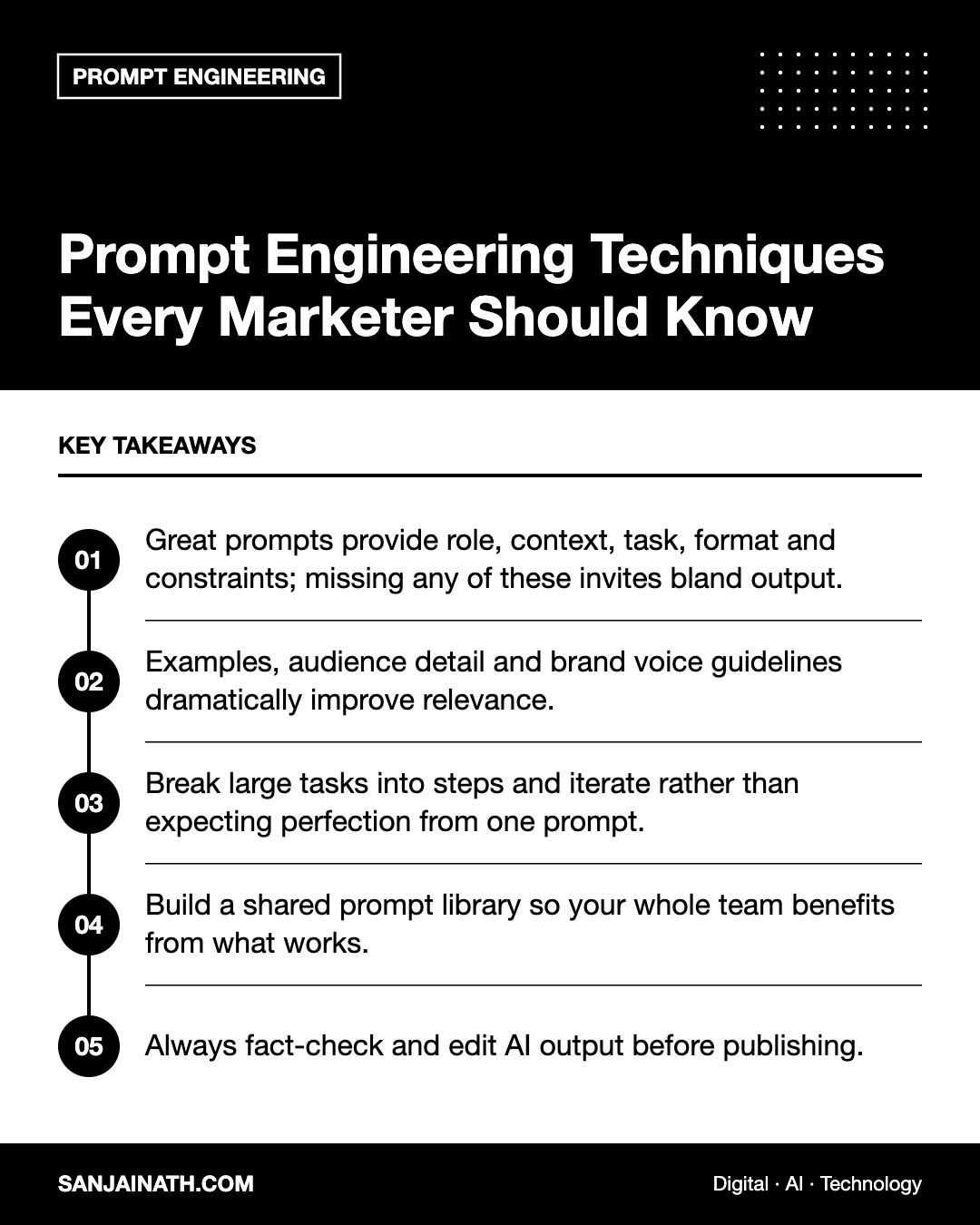
- Great prompts provide role, context, task, format and constraints; missing any of these invites bland output.
- Examples, audience detail and brand voice guidelines dramatically improve relevance.
- Break large tasks into steps and iterate rather than expecting perfection from one prompt.
- Build a shared prompt library so your whole team benefits from what works.
- Always fact-check and edit AI output before publishing.
Why prompts matter so much in marketing
Marketing depends on specifics: a particular audience, a distinctive brand voice, a clear offer and a defined channel. AI models are trained on vast amounts of general text, so without direction they default to average, safe language. Your prompt is how you supply the specifics that make content persuasive and on-brand.
Technique 1: Use a structured prompt framework
A simple framework ensures you never forget essential information. One practical version is RCTFC:
- Role: who the AI should act as, such as “an experienced B2B copywriter”.
- Context: the brand, product, audience and goal.
- Task: exactly what you want produced.
- Format: length, structure and output style.
- Constraints: what to avoid, tone rules and compliance requirements.
Example: “Act as a senior email marketer. We are a Dubai-based interior design studio targeting homeowners of new villas. Write three subject lines and a 120-word email promoting a free design consultation. Use a warm, premium tone. Avoid exclamation marks and discount language.”
Technique 2: Give examples (few-shot prompting)
Showing is more effective than telling. Paste two or three examples of content you like, such as past high-performing posts or ads, and ask the AI to follow their style, structure and length. This technique is especially useful for maintaining a consistent brand voice across many pieces.
Tip: explain what makes each example good. “Notice the short opening line and the single clear call to action” helps the model focus on the right features.
Technique 3: Describe the audience in depth
“Small business owners” is too broad. Describe your audience’s role, concerns, knowledge level and objections. For example: “Operations managers at mid-sized logistics companies who are sceptical of new software because previous rollouts disrupted their teams.” The more precisely you describe the reader, the more targeted the messaging becomes.
Technique 4: Break tasks into steps (prompt chaining)
Complex deliverables benefit from a sequence of prompts rather than one enormous request. A typical content chain looks like this:
- Generate ten angle ideas for a topic and audience.
- Select the strongest angle and create a detailed outline.
- Draft the piece section by section.
- Review the draft against a checklist of brand and SEO requirements.
- Produce social posts and email snippets from the final version.
Each step lets you review and steer, which keeps quality high and reduces rework.
Technique 5: Ask the AI to ask you questions
When you are unsure what information is needed, end your prompt with: “Before you begin, ask me up to five questions that would help you do this well.” This surfaces missing details, such as pricing, differentiators or tone preferences, that would otherwise lead to vague output.
Technique 6: Specify format precisely
Tell the AI exactly how you want results presented. Useful format instructions include:
- “Return a table with columns for headline, hook and call to action.”
- “Give me five options, each under 90 characters.”
- “Write in short paragraphs of no more than three sentences.”
- “Use British English spelling throughout.”
Clear format rules make output easier to review, compare and paste into your tools.
Technique 7: Use critique and revision loops
Ask the AI to evaluate its own work against specific criteria. For example: “Review this landing page copy as a sceptical CFO. List the three weakest claims and suggest stronger alternatives.” Role-based critique often uncovers gaps in logic, clarity or persuasion that a single draft misses.
Technique 8: Set guardrails for accuracy and compliance
AI models can produce confident but incorrect statements. Reduce risk with explicit constraints:
- “Do not invent statistics, testimonials or customer names.”
- “Only use the product details provided below.”
- “Mark any claim that needs verification with [CHECK].”
For regulated sectors, such as financial services, healthcare or real estate in the UAE, include relevant advertising guidelines in the prompt and keep a human reviewer in the approval loop.
Common prompt mistakes to avoid
| Mistake | Result | Better approach |
|---|---|---|
| One-line prompts | Generic, predictable copy | Add role, audience, goal and constraints |
| No examples | Off-brand tone | Include two or three reference pieces |
| Asking for everything at once | Shallow, unfocused output | Chain smaller, focused prompts |
| Accepting the first draft | Missed improvements | Request critique and revisions |
| No fact-checking | Errors reach customers | Verify every claim before publishing |
Building a team prompt library
Once you find prompts that work, save them. A shared library, whether in a document, a knowledge base or your AI tool’s saved instructions, helps your team produce consistent results. Organise prompts by task, such as social posts, ad copy, blog outlines and email sequences, and include notes on when to use each one and example outputs.
Putting the techniques together: a worked example
Here is how several techniques combine for a common task, launching a new service on LinkedIn:
- Framework: “Act as a B2B social media strategist. We are launching a managed IT support service for mid-sized companies. Our audience is operations directors who worry about downtime.”
- Questions first: “Before writing, ask me up to five questions about the service and audience.”
- Examples: paste two past posts that performed well and explain why.
- Format: “Write three post options, each under 150 words, with a strong first line and one clear call to action.”
- Critique: “Now review each option as a sceptical operations director and suggest improvements.”
- Guardrails: “Do not include statistics or client names unless I provide them.”
The result is far more targeted than a single request such as “write a LinkedIn post about our new IT service”. The same pattern works for emails, ads, landing pages and video scripts.
Frequently asked questions
What are the most important prompt engineering techniques for beginners?
Start with structured prompts that include role, context, task, format and constraints. Then add examples and practise iterating on drafts. These prompt engineering techniques deliver the biggest improvements quickly.
Do prompts work the same way across different AI tools?
The core principles apply to all major assistants, although each model responds slightly differently. Test important prompts in the tool your team uses and adjust wording as needed.
How long should a marketing prompt be?
As long as needed to convey essential context. Many effective marketing prompts run to several paragraphs, especially when they include brand guidelines and examples.
Can AI keep our brand voice consistent?
Yes, if you provide clear voice guidelines and examples, and save them as reusable instructions. Human review remains important to catch drift.
Final thoughts
Prompt engineering is less about secret formulas and more about clear briefing, the same skill that makes a good creative brief work with human writers. Apply these prompt engineering techniques consistently, save what works and keep a human editor in charge, and AI will become a genuine accelerator for your marketing output.