
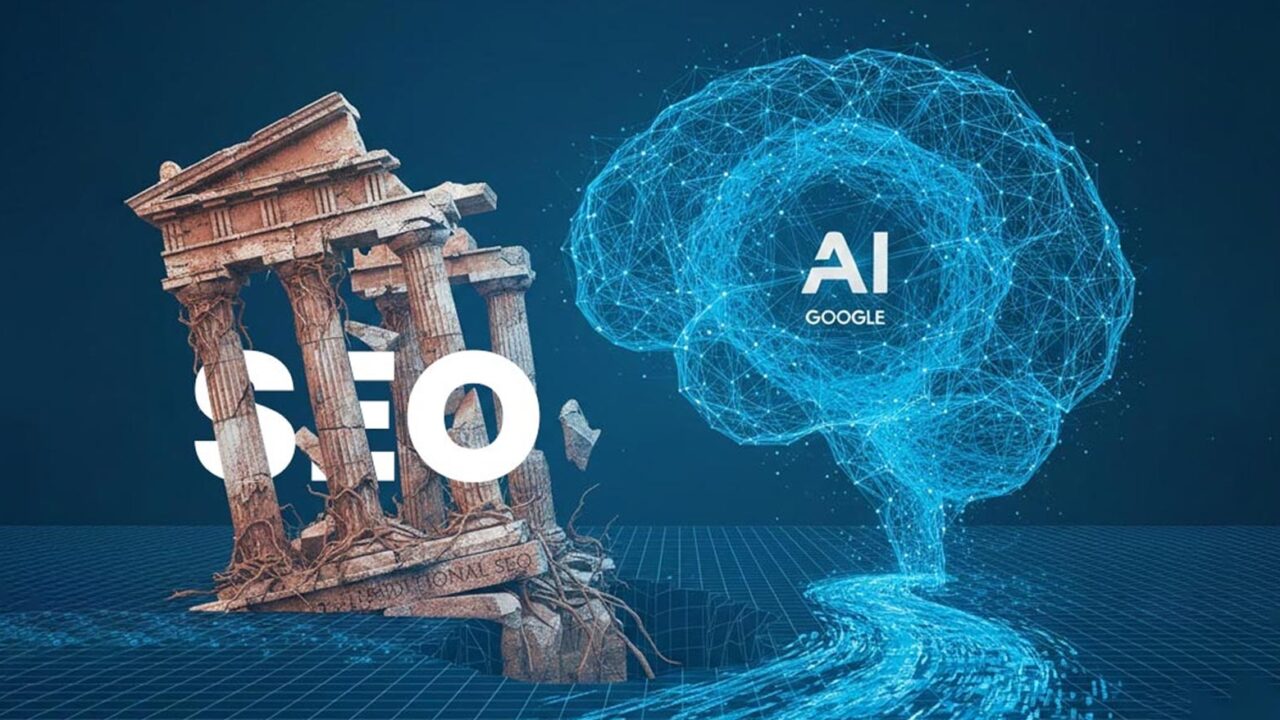
Short answer: SEO is not dead in the age of AI, but its job has changed. Google’s AI Overviews and AI Mode now answer many questions on the results page, so fewer people click through. Brands win by becoming the source those answers rely on: clear, expert, well-structured content on a site Google can easily crawl, understand and cite.
For two decades the formula was simple: pick a high-volume keyword, publish a long blog post and build links until you reach page one. In 2026 that playbook no longer works on its own. The page of “ten blue links” is giving way to AI-generated answers, and brands need a different way to earn visibility.
Key takeaways
- AI summaries reduce clicks: in a Pew Research Center study, users clicked a traditional result on 8% of visits when an AI summary appeared, versus 15% without one.
- Google says there are no special requirements for AI Overviews or AI Mode. Pages must be indexed and eligible for a snippet, so SEO fundamentals still apply.
- Visibility now means being cited inside answers, not just ranking. Clear answers, original evidence and named expertise make content easier to cite.
- Measure success by qualified visits, leads and brand demand rather than raw traffic.
How has AI changed Google Search?
Google’s AI Overviews (which grew out of the Search Generative Experience) place a generated summary above the organic results, and AI Mode lets people run a full conversational search with follow-up questions. Instead of only pointing users to websites, the results page increasingly resolves the question itself.
The effect on clicks is measurable. Pew Research Center tracked the browsing of 900 US adults in March 2025 and found that about 18% of their Google searches produced an AI summary. On those pages, users clicked a traditional result link on 8% of visits, compared with 15% when no summary appeared, and clicked a link inside the summary on only about 1% of visits. They also ended their browsing session more often: 26% of the time, versus 16% on pages without a summary.
What is a zero-click search?
A zero-click search is one where the user gets what they need on the results page and never visits a website. Simple informational queries, such as “how to fix a leaky faucet”, are the most exposed because a step-by-step answer can be shown instantly. The queries themselves are changing too: people now type or speak longer, conversational questions, such as “what are the best waterproof hiking boots for wide feet in muddy terrain?”, instead of short keyword bursts like “best hiking boots”.
Is SEO dead?
No. What has ended is the era of thin content farms and keyword stuffing. Google states that there are “no additional requirements” to appear in AI Overviews or AI Mode: a page simply needs to be indexed and eligible to show a snippet. The same fundamentals that earn rankings, such as crawlable pages, useful content, internal links and a good page experience, are also what make a page eligible to be used in AI answers.
The difference is what happens after you rank. A top position no longer guarantees a visit, so content has to be good enough to be quoted, and memorable enough that people search for your brand by name.
How do GEO and AEO fit with SEO?
Generative engine optimization (GEO) is the practice of making content easy for AI systems to understand, trust and cite. Answer engine optimization (AEO) focuses on formatting content so a clear answer can be lifted straight out of the page. Both build on SEO rather than replacing it. I cover each in more depth in how to get cited by AI search and structuring content for ChatGPT and Gemini answers.
Research supports the approach. In the KDD 2024 paper that introduced the term GEO, researchers from Princeton University and partner institutions found that adding citations, quotations and statistics to content could increase its visibility in generative engine responses by up to 40%.
| Old SEO habit | What works in AI search |
|---|---|
| Targeting one exact-match keyword | Covering the full question and its likely follow-ups |
| Long introductions before the point | A 40–60 word direct answer at the top of each section |
| Generic content anyone could write | Original data, examples and first-hand experience |
| Anonymous articles | Named authors with clear credentials and profiles |
| Chasing traffic volume | Measuring leads, conversions and brand demand |
What should brands do now?
- Answer first. Open each page and section with a concise answer, then add detail. Use question-based headings and FAQs that match how people actually ask.
- Show real expertise. Add named authors, credentials, case studies and data you own. Google’s guidance on helpful, people-first content puts weight on originality and effort.
- Strengthen your entity. Use Person or Organization schema, consistent social profiles and a clear About section so search engines and AI tools can recognise who is behind the content.
- Cite your sources. Link to primary research and official documentation, and include specific figures where you have them.
- Fix the technical basics. Make sure Googlebot and AI crawlers can reach your pages, keep important content in HTML text and keep pages fast. Core Web Vitals explained and the complete SEO checklist for 2026 walk through the details.
- Be present beyond Google. People also search on TikTok, Instagram, Reddit and AI assistants. See why social platforms are becoming search engines.
How should you measure SEO success now?
When fewer searches end in a click, traffic alone undercounts your visibility. Track a broader set of signals:
- Impressions and clicks in Google Search Console. Google reports traffic from AI Overviews and AI Mode within the standard “Web” performance data.
- Conversions and lead quality from organic visits.
- Branded search volume and direct traffic, as signs that AI answers are building awareness.
- Mentions and citations of your brand in AI assistants, checked regularly with a fixed set of prompts.
When someone does click through from an AI summary, they have often already compared their options. That single visit can be worth more than several casual sessions, which is why authority and conversion matter more than raw volume.
Frequently asked questions
Is SEO dead because of AI Overviews?
No. AI Overviews draw on pages that are indexed and eligible for snippets, so SEO is what makes your content available to them in the first place. What has changed is that ranking alone no longer guarantees a click.
Do I need special markup or files to appear in AI Overviews?
Google says no special schema, AI text files or other optimizations are required. Structured data still helps search engines understand your pages, as long as it matches the content people can see.
What is the difference between SEO, GEO and AEO?
SEO earns visibility in search results. GEO aims to get your content cited by generative AI tools such as ChatGPT, Gemini and Google AI Mode. AEO formats content so a direct answer can be extracted. All three rely on the same foundation of useful, well-structured, trustworthy content.
How can a brand get cited by AI search?
Publish clear answers to real questions, back them with data and sources, show who wrote them and why they are qualified, and make sure pages are crawlable and fast. Consistent mentions on other reputable sites also help AI tools recognise your brand.
Final thoughts
The brands that do well in AI search will not be the ones publishing the most pages, but the ones that are easiest to trust and quote. Focus on authority, clarity and conversions rather than raw traffic, and SEO remains one of the most valuable channels a business has.
Related reading
- Generative Engine Optimization (GEO): How to Get Cited by AI Search
- Answer Engine Optimization (AEO): Structuring Content for ChatGPT and Gemini Answers
- The Complete SEO Checklist for 2026: On-Page, Off-Page and Technical
- How to Build a Content Marketing Strategy That Drives Leads
- ChatGPT vs Gemini vs Claude vs Copilot: Which AI Assistant Fits Your Work?
Sources
- Pew Research Center (2025): Google users are less likely to click on links when an AI summary appears in the results
- Google Search Central: AI features and your website
- Google Search Central: Creating helpful, reliable, people-first content
- Aggarwal et al. (2024): GEO: Generative Engine Optimization, KDD 2024